TheQuran.com
Differences Analysis · argument tier

Questions raised about the text

Linguistic, historical, scientific and internal-consistency questions, verse by verse. Each item is an argument, with the sources it cites and a place for the responses.

Codex Parisino-petropolitanus, c. late 7th–early 8th century
Codex Parisino-petropolitanus, c. late 7th–early 8th century · credit
items
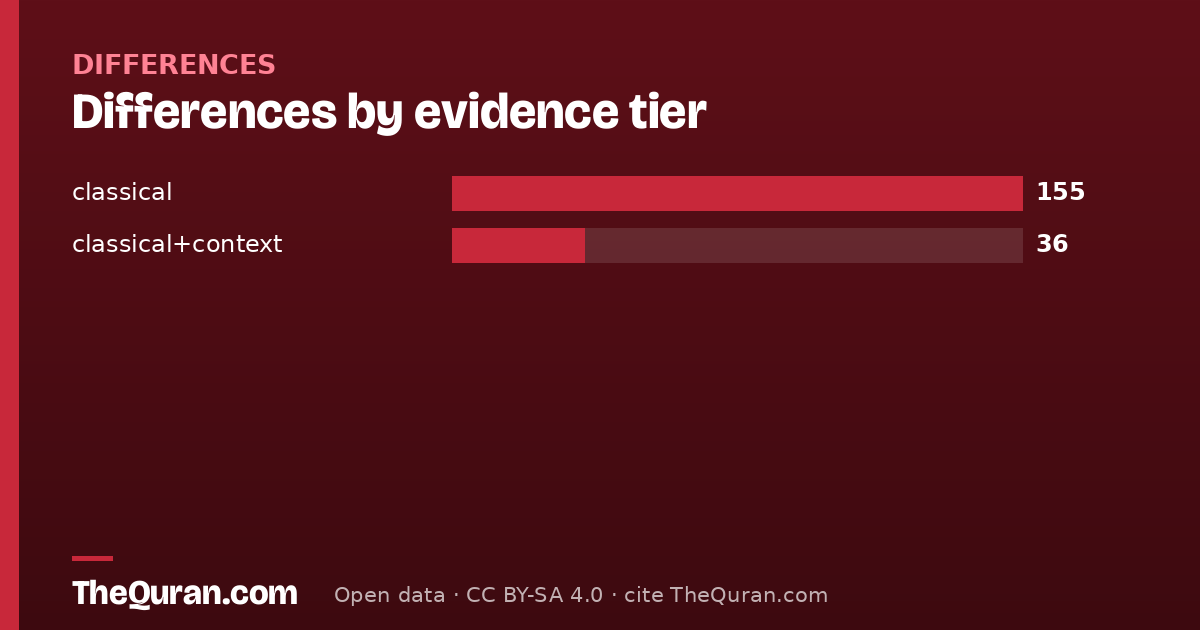
191191 original · 0 proposed
verses covered
3035% of 6,236
suras
26of 114
cite a source
100%0 cite none
Browse by category

The old site's categories

Each item is filed under one category from the old site's list (its most specific one); the other categories it carries still show as tags.

All category tags

What the questions are about

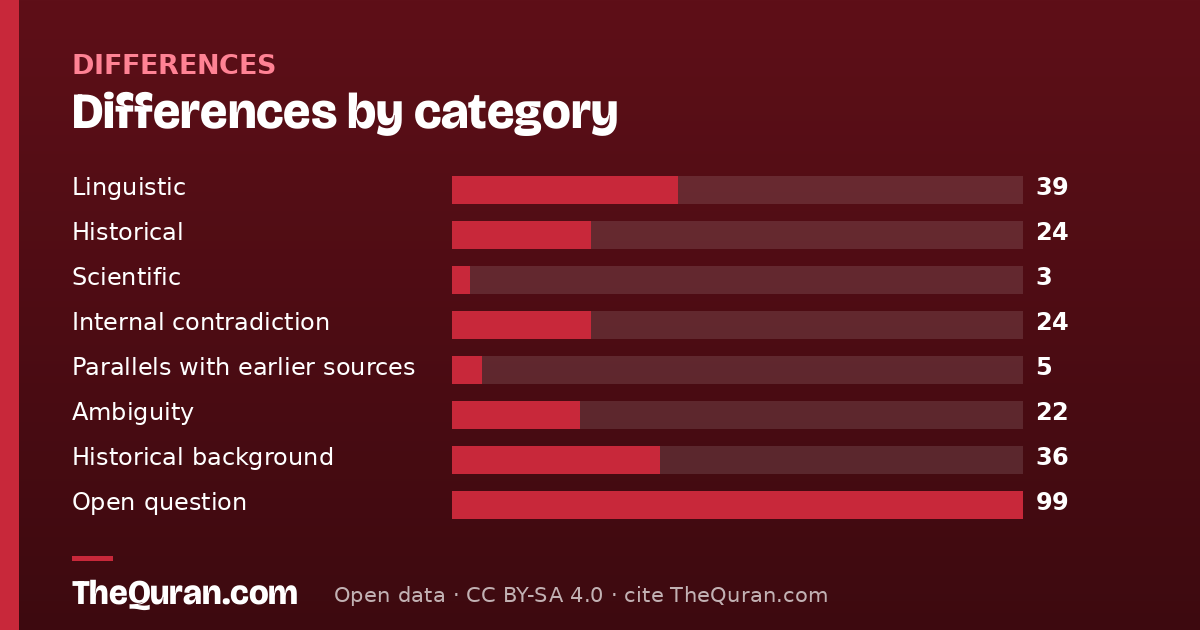
  1. Open question · old label “Question” 99 52%
  2. Linguistic 39 20%
  3. Historical background · old label “Historical Background” 36 19%
  4. Historical 24 13%
  5. Internal contradiction · old label “Quranic Contradiction” 24 13%
  6. Ambiguity 22 12%
  7. Parallels with earlier sources · old label “Copied from other sources” 5 3%
  8. Scientific 3 2%
  9. Geographical 0 0%
  10. Numerical 0 0%

original site proposed · an item can carry more than one category, so the bars sum to more than 191.

Across the Qur'an

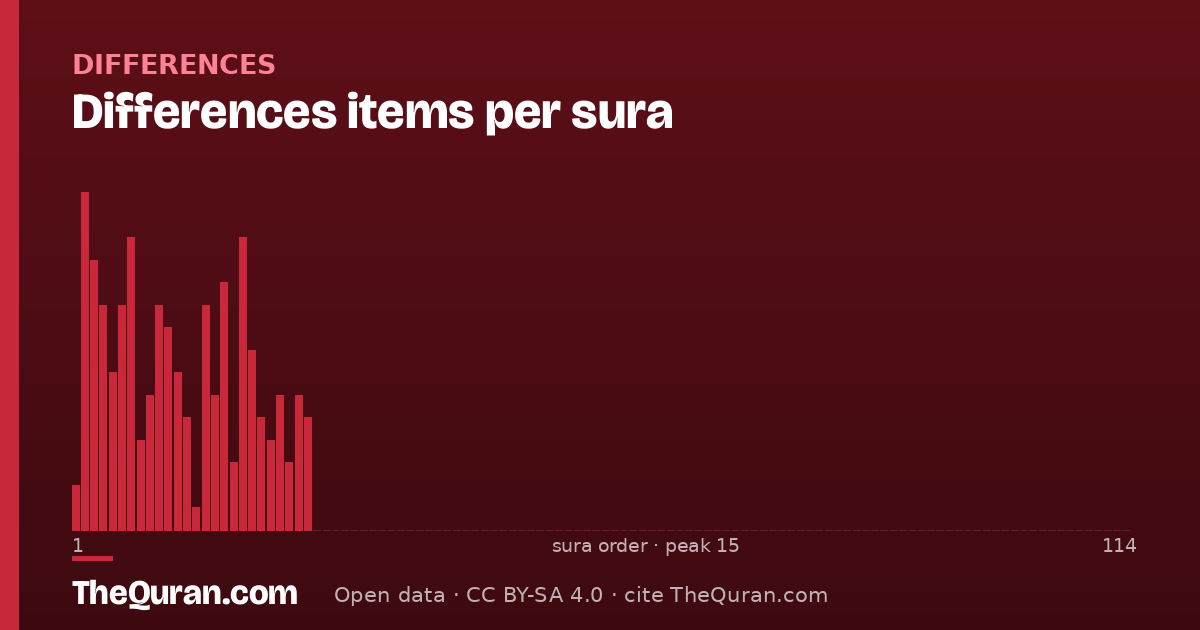
Items per sura

1114sura order · darker = more items · none = blank
191 items · page 4 of 5
  1. 15:922 verses Open question Argument The text states that all the people will be asked on Yawm al-Qiyāma (“Day of Judgment”) about “what they have done”. This verse contradicts Q 55.39: “On that day neither man nor ginn shall be asked about his crime!”
  2. 16:21 Open question Argument This verse presents two issues: Redundant prose The verse describes the idols as “[d]ead, not living.” The word “dead” would have been sufficient in Arabic to describe their state. Why does the verse add “not living”? What manner…
  3. 16:24 Historical background Argument The verse informs the reader that the Quraysh accused Muhammad of reciting Qur’ānic verses to his Companions that were not revelations from God but merely stories taken from prior books, or “‘Old folks’ tales!’” (See the critical…
  4. 16:26 Open question Argument The Qur’ānic story in this verse does not clearly identify the mentioned group of people nor provides any clues to help the reader. To resolve this problem, Islamic commentators suggest that the verse is speaking about Nimrod and…
  5. 16:76 Open question Argument In trying to clarify the incapability of idols, Islamic commentators suggest that this verse compares an idol to a mute man. Al-Ţabarī explains that just as a mute man is a burden to his family, so is the idol a burden to his own…
  6. 16:843 verses Internal contradiction Argument Verse 84 states that “those who misbelieve not be allowed (to excuse themselves).” But, two verses later (Q 16.86) the Qur’ān states that they (misbelievers) will speak: “And when those who join their partners with God say, ‘Our …
  7. 16:100 Linguistic Argument The problem with this verse is not as clearly seen as it is in other translations: “His authority is only over those who befriend him and those who associate others with Him” (Shakir trans.; emphasis added). To whom does the seco…
  8. 17:1 Historical background Open question Argument The sura mentions al-Masjid al-Aqšā, or “the Remote Mosque,” as the first destination of Muhammad’s Night Journey from Mecca. Muslim exegetes state the following remarks about this mosque: The “Remote Mosque” means the mosque of …
  9. 17:42 verses Ambiguity Open question Argument Verse 4 informs that Allah decreed that the Children of Israel (the Israelites) in the Book (Torah) will do evil “in the earth twice.” When the threat of the first evil came, people “endued with violence” came to the Children of …
  10. 17:16 Open question Argument The decree of Allah, given in the verse, states that if he wanted to destroy a city he would command “the opulent ones thereof” and they would spread abomination. In other words, when Allah decides to destroy a town, he prepares …
  11. 17:45 Historical background Argument It is narrated that Muhammad was subject to possible harm by the Quraysh whenever he recited the Qur’ān. So, Allah made him invisible to them. In the Palmer translation, the verse states, “…[W]e place between thee and those who b…
  12. 17:58 Open question Argument This verse forewarns that every city will face perdition before the “day of judgment”. Muslim exegetes state that all towns will either be subject to utter destruction or that killing and suffering with overtake them, including M…
  13. 17:60 Linguistic Open question Argument The text in this verse contains two issues: Word definition (“the vision”) The verse states that Muhammad’s vision became “a cause of sedition unto men.” Muslim exegetes offer different meanings for “the vision”: A true vision sh…
  14. 17:64 Open question Argument In this verse Allah responds to Iblīs by stating that Iblīs may “[e]ntice away” people and use his power to oppress them and share with them wealth and children. In their explanation of this verse, Muslim exegetes discuss the key…
  15. 17:72 Open question Argument In this verse, another example of Qur’ānic textual ambiguity, the ambiguity rests in the meaning or symbolism of the blindness and the state of blindness “in this life” and “in the next”. One opinion states that the blindness men…
  16. 17:78 Ambiguity Argument Islamic scholars offer differing opinions regarding the time and religious purpose of the “declining of the sun.” One group holds that the time is when the sun sets and the appropriate prayer is the sunset (al-maghrib) prayer. An…
  17. 17:85 Open question Argument A question was addressed to Muhammad concerning the spirit. He replied, “The spirit comes at the bidding of my Lord, and ye are given but a little knowledge thereof.” The details of this report are that a Jew suggested to the peo…
  18. 17:101 Historical Argument It is stated in the text that Moses was brought “nine manifest signs.” Islamic scholars mention that the nine signs are the five plagues that came down on the Egyptians, as mentioned in Q 7, and the rest are miracles. The Torah (…
  19. 18:12 verses Linguistic Open question Argument In one section of this passage, the Arabic literally states “did not make to it crookedness that is strait.” Without his albeit helpful insertions, Sale’s translation more closely reflects the Arabic wording: “…and hath not inser…
  20. 18:50 Ambiguity Argument The verse presents a problem concerning the identity of Iblīs: Is he an angel or a jinn? The verse begins with Allah commanding the angels to bow down to Adam. They all obey except for Iblīs because he “was of the ginn.” If the c…
  21. 18:6023 verses Open question Argument These verses tell a story about a journey undertaken by Moses and his companion Joshua, son of Nun. Along the way, they meet a man (verse 65) identified in Islamic commentaries as al-Khidr. At this point, Moses and al-Khidr toget…
  22. 19:16 Ambiguity Argument This text mentions the details of Mary’s distancing herself from her family by going toward an eastern region. Some Islamic commentators have stated that the location is east of Jerusalem. Others believe that she went into seclus…
  23. 19:17 Ambiguity Argument The verse states that Allah sent his “spirit” to Mary. Muslim exegetes explain that the spirit is Jibrīl, who appeared to her as a human. It is said that Jibrīl is called the “spirit” “figuratively, out of love for him”. On the o…
  24. 19:18 Linguistic Argument When the angel appears to Mary, she says, “Verily, I take refuge in the Merciful One from thee, if thou art pious.” There is a contradiction in her words. One does not seek refuge in God from a pious person. Qur’ānic critics have…
  25. 19:24 Open question Argument Muslim exegetes disagree concerning the identity of the one who “called to her”: was it Jesus or Jibrīl? Some hold that it was Jibrīl and claim that “from beneath her'' means between her hands. Others state that it was Jesus and …
  26. 19:26 Ambiguity Argument The verse states that Mary was asked to say that she vowed to fast. Muslim exegetes agree that the intended fast is silence. For this reason, some of the readers read the word as samtan (“silence”). Some also read it as sawman sa…
  27. 19:272 verses Open question Argument The name Mary in English is actually Miriam in Hebrew. Thus, the Hebrew name for the mother of Jesus is Miriam. The Arabic form of Miriam is Maryam. The name Maryam is used in the Qur’ān to identify both Mary, the mother of Jesus…
  28. 19:30 Open question Argument This verse states that Jesus—the infant—was made to speak by Allah, declaring himself a “servant of God” (‘Abd Allah). The clear intention behind making Jesus speak as an infant in the cradle is to refute the Christian doctrine o…
  29. 19:36 Linguistic Argument Concerning the speaker in the verse who says, “God is my Lord,” al-Rāzī mentions two opinions: The speaker is Muhammad. The speaker is Jesus, as the verse starts with “and” following “Verily, I am a servant of God; He has brought…
  30. 19:56 Historical Argument The verse mentions the name Idrīs, a name that is not mentioned in ancient histories. Muslim exegetes say that he was a prophet who was lifted up to heaven. This description points to Enoch as the one called Idrīs in the Qur’ān. …
  31. 19:61 Linguistic Argument The Arabic verb translated by Palmer as “comes to pass” is ma’tiyan. In Arabic, the verb is actually in the passive voice—“made to pass”—instead of the active. The intended meaning requires the active voice as Palmer correctly tr…
  32. 19:63 Open question Argument The verse promises al-Janna (“Paradise”) to the pious worshippers, “our servants who are pious.” Question: How can there be a pious worshipper and a worshipper who is not pious? Though the Islamic commentaries ignore this issue, …
  33. 19:82 Open question Argument In this verse, the antecedent to the pronoun “they” (“They shall deny...”) is not clearly discernible. Does this pronoun refer to the worshippers or those who are being worshipped? Some Islamic scholars suggest that Allah will ra…
  34. 19:83 Open question Argument The verse discusses Allah’s granting Satan the power to lure people and lead them to deviance. (The same issue is addressed in another sura. See the critical analysis of Q 17.64).
  35. 20:5 Open question Argument The verse states that Allah “settled on the throne,” meaning that he sat down. This image describes Allah as having a body. The belief that Allah has a body is incompatible with the Muslim view that Allah is beyond description. T…
  36. 20:7 Open question Argument The meaning of wa-akhfa, translated by Palmer as “and more hidden still”, is confusing. Muslim exegetes offer the following explanations: Self-talk that a person has not done yet. Just self-talk. Plan that is about to be executed…
  37. 20:38 Internal contradiction Argument It is clear from this text that Pharaoh ordered the killing of children when Moses was young. Yet the Qur’ān also states that the command to kill was given when Moses was a prophet and spoke the truth (Q 40.23-25). (This contradi…
  38. 20:39 Internal contradiction Argument It is clear from this text that Pharaoh ordered the killing of children when Moses was young. Yet the Qur’ān also states that the command to kill was given when Moses was a prophet and spoke the truth (Q 40.23-25). (This contradi…
  39. 20:67 Linguistic Argument The name Moses appears at the end of the verse in Arabic to keep the rhyme. Grammatically, it should have come after the verb in keeping with the more typical Arabic sentence structure, where the subject comes after the verb.
  40. 20:70 Linguistic Argument The name Aaron comes before Moses, when he is a follower of Moses. The reason “Aaron” is mentioned first is to keep the rhyme. Moses should have been mentioned first because of his centrality to the verse and the narrative here.