TheQuran.com
Differences Analysis · argument tier

Questions raised about the text

Linguistic, historical, scientific and internal-consistency questions, verse by verse. Each item is an argument, with the sources it cites and a place for the responses.

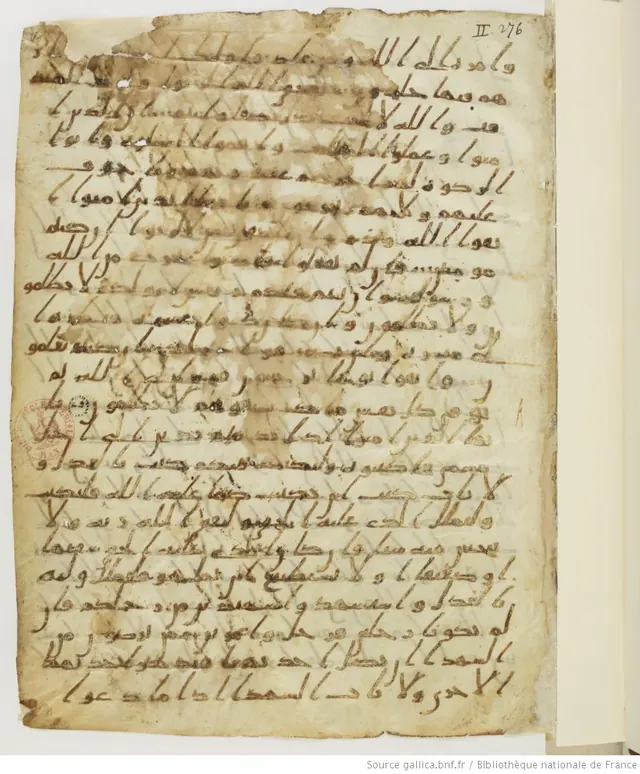
Codex Parisino-petropolitanus, c. late 7th–early 8th century
Codex Parisino-petropolitanus, c. late 7th–early 8th century · credit
items
214201 original · 13 proposed
verses covered
3616% of 6,236
suras
43of 114
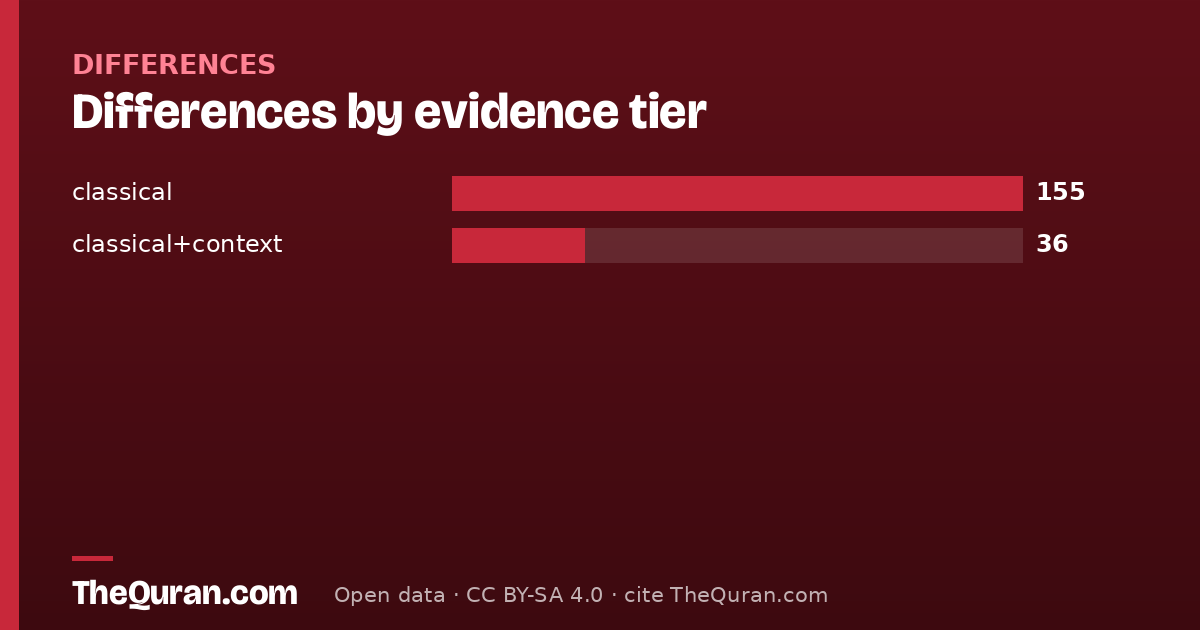
cite a source
100%0 cite none
Browse by category

The old site's categories

Each item is filed under one category from the old site's list (its most specific one); the other categories it carries still show as tags.

All category tags

What the questions are about

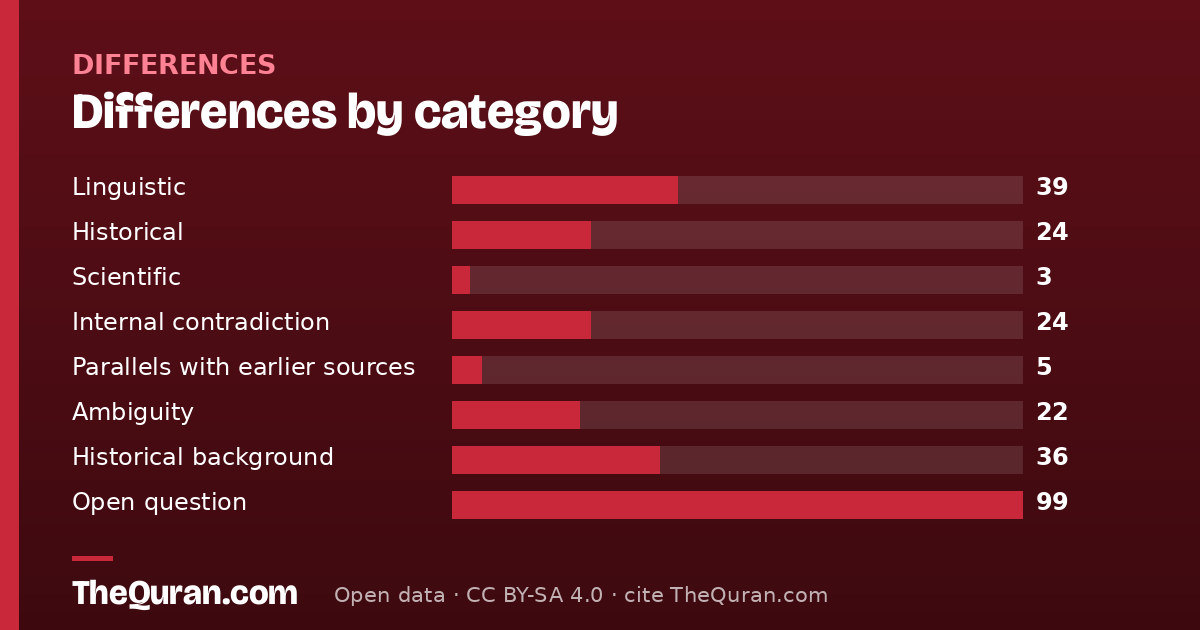
  1. Open question · old label “Question” 105 49%
  2. Linguistic 42 20%
  3. Historical background · old label “Historical Background” 39 18%
  4. Historical 31 14%
  5. Internal contradiction · old label “Quranic Contradiction” 29 14%
  6. Ambiguity 25 12%
  7. Parallels with earlier sources · old label “Copied from other sources” 7 3%
  8. Scientific 4 2%
  9. Numerical 2 1%
  10. Geographical 1 0%

original site proposed · an item can carry more than one category, so the bars sum to more than 214.

Across the Qur'an

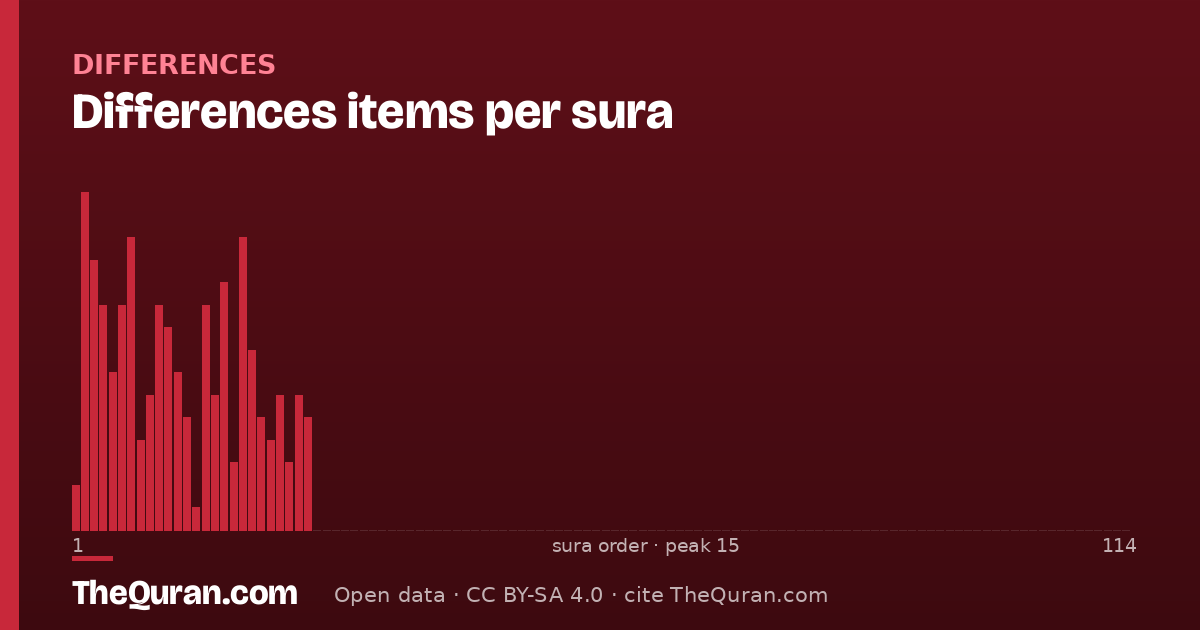
Items per sura

1114sura order · darker = more items · none = blank
11 items · page 1 of 1 Clear
  1. 7:1177 verses Internal contradiction Historical Argument This story recounts a competition arranged by Pharaoh between Moses and a band of sorcerers that ends in Moses’ victory. As a result, the sorcerers declare their belief in “the Lord of Moses and Aaron” (Q 7.117-122; Q 20.69-73; Q…
  2. 10:20 Open question Argument The verse shows that the Quraysh wished Muḥammad would perform a miracle, sent down from Allah, as evidence of his prophetic claims. Muḥammad responded that such a demand is among the unseen things that only Allah knows, adding, …
  3. 10:21 Open question Argument The verse states that idolaters use a stratagem, a cleverly contrived trick, against Allah and then adds that Muḥammad should inform them that Allah is swifter than they are at scheming a stratagem: “God [Allah] is quicker at str…
  4. 10:23 Linguistic Argument The verse in Arabic has a linguistic problem. It states, “they wrong…without just cause,” even though the verb bighayri al-ḥaqqi (“to wrong”) means to transgress by treating someone unjustly. In other words, the verb “to wrong” a…
  5. 10:28 Internal contradiction Open question Argument The verse states that Allah speaks to people on the Day of Judgment. This matter is confirmed by another verse: “But, by thy Lord! we will question them, one and all…” (Q 15.92). Conversely, another verse states that Allah does n…
  6. 10:53 Open question Argument The Quraysh asked Muḥammad, “whether it be true.” According to Islamic commentaries, the question refers to the authenticity of Muḥammad’s claim of prophethood and the veracity of the Qur’ān. Another suggestion claims that the qu…
  7. 10:61 Linguistic Argument This verse addresses Muḥammad. As translated by Palmer, the addressee is spoken to at times in the Arabic singular (takūnu) as “thou,” as in “thou be… thou recite,” and other times in the Arabic plural (takūnū(ā)) as “ye,” as in …
  8. 10:64 Internal contradiction Argument The Qur’ān declares in Q 10.64 that Allah does not change his words. Islamic commentators explain “words” as “sayings and promises". Al-Zamakhsharī explains that the phrase “‘there is no changing the words of God’” as “no changin…
  9. 10:754 verses Ambiguity Argument According to the context of these verses, Moses asks Pharaoh and his people to believe in the faith of Moses and abandon the faith of their ancestors. This request is clearly seen in verse 78, and Islamic commentator al-Rāzī stat…
  10. 10:88 Ambiguity Argument This verse describes Moses calling on his Lord to destroy the splendor and riches of Pharaoh and his chiefs, wealth that Moses acknowledges was bestowed by God on his enemies. But Moses asks for more than the destruction of his e…
  11. 10:94 Ambiguity Argument This verse addresses Muḥammad. It instructs Muḥammad to ask those who have read the Book before him whenever he is in doubt concerning the veracity of the revelation. Al-Zamakhsharī comments, “As if it was said: if you were to do…