TheQuran.com
Differences Analysis · argument tier

Questions raised about the text

Linguistic, historical, scientific and internal-consistency questions, verse by verse. Each item is an argument, with the sources it cites and a place for the responses.

Codex Parisino-petropolitanus, c. late 7th–early 8th century
Codex Parisino-petropolitanus, c. late 7th–early 8th century · credit
items
191191 original · 0 proposed
verses covered
3035% of 6,236
suras
26of 114
cite a source
100%0 cite none
Browse by category

The old site's categories

Each item is filed under one category from the old site's list (its most specific one); the other categories it carries still show as tags.

All category tags

What the questions are about

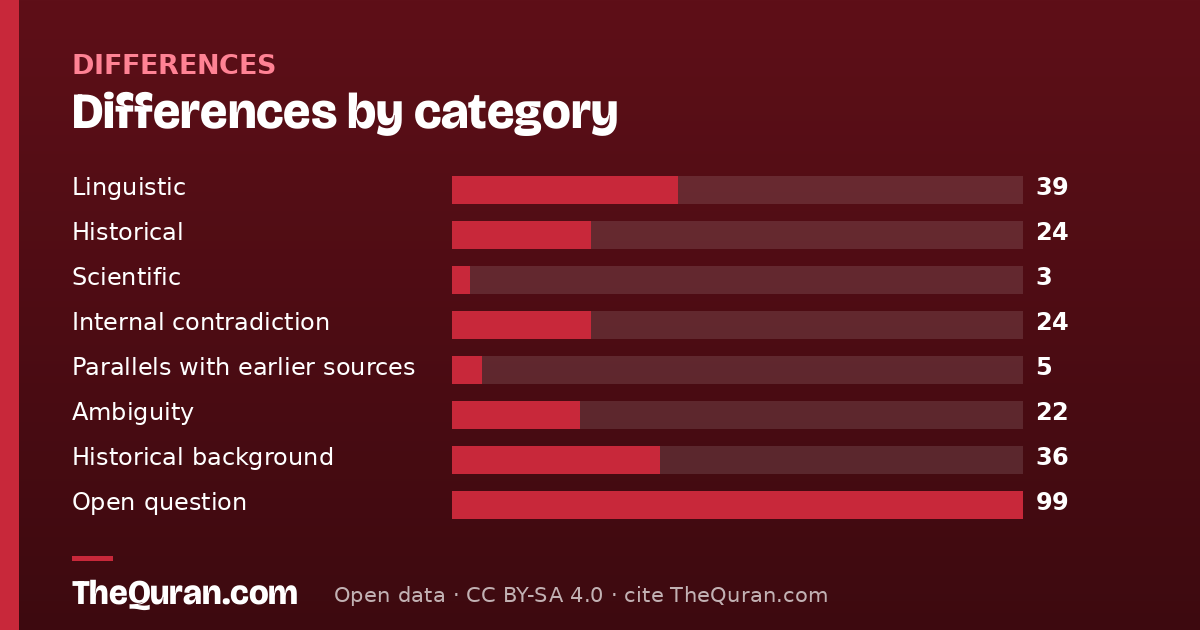
  1. Open question · old label “Question” 99 52%
  2. Linguistic 39 20%
  3. Historical background · old label “Historical Background” 36 19%
  4. Historical 24 13%
  5. Internal contradiction · old label “Quranic Contradiction” 24 13%
  6. Ambiguity 22 12%
  7. Parallels with earlier sources · old label “Copied from other sources” 5 3%
  8. Scientific 3 2%
  9. Geographical 0 0%
  10. Numerical 0 0%

original site proposed · an item can carry more than one category, so the bars sum to more than 191.

Across the Qur'an

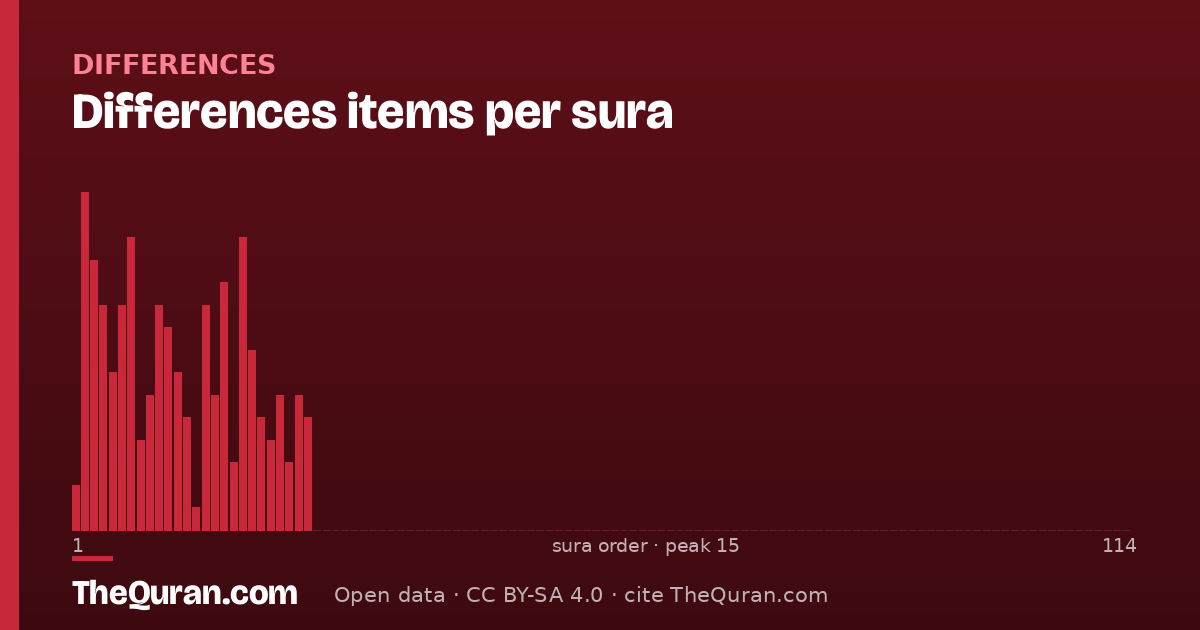
Items per sura

1114sura order · darker = more items · none = blank
191 items · page 1 of 5
  1. 1:15 verses Parallels with earlier sources Historical backgroundOpen question Argument In the Islāmic books that recount the history of the codices, records show that Ibn Mas‘ūd refused to include Q 1, Q 113, and Q 114 in his codex of the Qur’ān, because he believed that these sūras were never intended to be a part…
  2. 1:62 verses Parallels with earlier sources AmbiguityHistorical background Argument During prayer, Muslims ask Allah to guide them to “the right path.” In Arabic, this phrase implies that the petitioner is lost and cannot find the right path. Therefore, Allah is asked to guide the way to the correct path. Accord…
  3. 2:1 Linguistic AmbiguityOpen question Argument The first verse of this sūra begins with individual letters of the alphabet called muqatta‘āt. They are also called fawātih, or “openers,” because they form the opening of multiple sūras. For a discussion about their possible ori…
  4. 2:30 Open question Argument This verse recounts Allah telling the angels that he was planning to create a human being, yet they replied with an implied objection, saying, “‘Wilt Thou place therein one who will do evil therein and shed blood?...’” (Q 2.30). …
  5. 2:313 verses Open question Argument Verses 31–33 are a continuation of the conversation between Allah and the angels concerning the creation of man. These verses state that Allah taught Adam the names of “all of them.” Then Allah asks the angels to repeat these nam…
  6. 2:35 Historical Ambiguity Argument Allah said to Adam and his wife that they may eat whatever they desire in Eden but adds, “...but do not draw near this tree, or ye will be of the transgressors” (Q 2.35). The use of the definite article this indicates that the he…
  7. 2:552 verses Historical AmbiguityOpen question Argument This verse describes a scene from Moses’ journey with the Israelites in the wilderness after leaving Egypt. According to al-Tabarī’s commentary, prior to this response from Moses (verse 55), he was with a group of Jewish people w…
  8. 2:61 Historical Argument The Old Testament mentions that as the people of Israel were running away from Pharaoh and his soldiers, they arrived at the edge of the sea, where they could go no further. There, in the depth of their despair, they said to Mose…
  9. 2:62 Historical Open question Argument This verse puts the Jews, Christians, Sabaeans, and Muslims into one group (the believers in Allah) and promises them their reward at the end of time (Q 2.62). Another verse, Q 5.69, repeats this promise word for word. However, i…
  10. 2:652 verses Historical Argument This verse talks about the residents of a Jewish village who break the sanctity of the Sabbath. The exegetes explain that these Jews defiled the Sabbath by fishing on that day, “so Allah metamorphosed them into monkeys because of…
  11. 2:972 verses Internal contradiction Open question Argument This verse states that the angel Gabriel (Jibrīl) is the one who transmitted the Qur’ān to Muhammad. However, another Qur’ānic text states that the Holy Spirit is the one who carried out this task: “Say, ‘The Holy Spirit brought …
  12. 2:1062 verses Internal contradiction Open question Argument In the midst of the doctrinal controversy between Muhammad and the Jews in Medina, the Jews noticed that Muhammad was annulling, time and again, rulings that he had enacted. This issue became a subject of their criticism. They sa…
  13. 2:124 Linguistic Argument Within this verse we notice that the reading that would make the word “evildoers'' more proper in Arabic would be in the nominative instead of the accusative case of the noun, i.e., “The evildoers are not within the reach of My P…
  14. 2:158 Historical background Argument This verse continues to address what Muhammad initiated in Q 2.144 when he changed the qibla for Muslims from the Sacred House (Jerusalem) to Mecca. Muhammad reached the conviction that there was no future hope with the Jews of M…
  15. 2:221 Internal contradiction Open question Argument In this verse, the Qur’ān forbids Muslim men and women from marrying “unbelievers”: “Wed not with idolatrous women…And wed not to idolatrous men….” Because the Qur’ān accuses the Christians of being unbelievers (idolaters), marri…
  16. 2:223 Historical background Open question Argument This verse views women as farms (or tilth, meaning “tilled earth or soil”) that men plow. In the commentary by al-Tabarī, al-Suddiy describes a woman as “a farm that can be plowed” by a man. It also allows Muslim men to have sexu…
  17. 2:2293 verses Historical background Open question Argument The Qur’ān justifies, or approves, repeated divorces. According to verse 229, the man is given the right to divorce his wife twice and to remarry her after the first and second divorces. But, if he divorces her a third time, she …
  18. 3:32 verses Historical AmbiguityHistorical background Argument These verses address Muhammad, stating that the book that came down to him “is confirming to what was sent down before of Allah’s books, which he had sent down upon his prophets and messengers.” It is “confirming…what they have t…
  19. 3:7 Internal contradiction Argument This verse states that some of the verses of the Qur’ān are muhkamāt (“decisive”) and others are mutashābihāt (“similar, allegorical, or ambiguous”). The muhkamāt verses are of established meaning, without a need for interpretati…
  20. 3:14 Open question Argument Regarding this verse, most of the scholars said, “Allah has beautified to people the love of desires and things they covet.” Al-Zamakhsharī explains that Allah beautified for people the love of desires and things they covet to te…
  21. 3:353 verses Historical Argument This text tells us of ‘Imrān’s wife, who is Hannah, according to the scholars. When she felt that she was pregnant, she offered what was in her womb as a servant to Allah. However, after she delivered, she discovered that the bab…
  22. 3:424 verses Internal contradiction Argument This verse states that angels brought glad tidings to Mary about the birth of Jesus. But another verse states that only one angel came to her (Q 19.17-21). The scholars ignored this contradiction. However, the commentary Tafsīr a…
  23. 3:54 Open question Argument The closest translation to the Arabic is found in the Pickthall translation: “Allah is the best of schemers” (Q 3.54). The Arabic text is clear in discussing Allah’s fight against evil by stating that Allah answers deception with…
  24. 3:55 Historical Open question Argument Allah is addressing Jesus, telling him that Allah will deliver him from those who rejected him (Jews). Allah also promises Jesus that Allah will make Jesus’ followers (Christians) above the disbelievers and that Allah will judge …
  25. 3:59 Open question Argument This verse demonstrates the similarity of the origin of Jesus and Adam as they were both created without a father. However, the difference is that Adam was created from dust or clay, while Jesus was created by the word of Allah, …
  26. 3:133 Internal contradiction Argument This verse identifies the width of paradise, “a Garden whose width is that (of the whole) of the heavens and of the earth….” (Yusuf Ali trans. Q 3.133) Yet another verse mentions that the width of paradise is the width of one hea…
  27. 3:144 Open question Argument This verse was unknown to the Muslims of Muhammad’s day, even to Muhammad’s friends. The account of its revelation was recorded by the scholar al-Qurtubī: When Muhammad died and the news spread, ‘Umar Ibn al-Khattāb went to Muham…
  28. 3:183 Historical background Argument The reports tell that a group of Jews (including Ka‘b Ibn al-Ashraf, Mālik Ibn al-Siyīf, Wahb Ibn Yahūdhā, Finhās. Ibn‘zūr, and others) entered into a discussion with Muhammad. To prove that Muhammad’s prophecy was true, they req…
  29. 3:192 Open question Argument This verse declares that whoever Allah sends to hell will be humiliated: “Lord! verily, whomsoever Thou hast made to enter the fire, Thou hast disgraced him.” It is well known that the Qur’ān states that everyone will go to hell:…
  30. 4:22 verses Linguistic Historical backgroundOpen question Argument In the first verse, the Qur’ān warns Muslims against seizing the money of orphans, considering it a great sin (Q 4.2). In the next verse, it tells Muslim men “if ye fear” that they shall not be able to deal justly with orphans, t…
  31. 4:15 Linguistic Argument The verse determines the penalty for women who “commit adultery” by confining them to their houses “until death releases them.” In Arabic, this phrase is more literally translated “until they pass away by death.” Since there is n…
  32. 4:20 Linguistic Ambiguity Argument This verse commands men not to take a woman’s dowry “for a calumny.” The term “calumny” was used in this verse outside of its proper linguistic meaning. Calumny means slander. However, the act of not giving the woman her dowry is…
  33. 4:49 Internal contradiction Historical backgroundOpen question Argument The reports state that the Jews and Christians used to boast, saying, “We are the sons of God and His beloved...” (Q 5.18). So Muammad answered them by saying that it was not permitted for people to praise themselves, and that pr…
  34. 4:512 verses Historical background Open question Argument This verse accuses “those to whom a portion of the Book has been given” that they “believe in Gibt and Taghut.” According to the Arabic concordance al-Qāmūs al-Muhīt., Gibt means idols or other false deities and Tāghūt means the …
  35. 4:782 verses Internal contradiction Argument Contradictions in the Qur’ān usually occur in verses that are apart from each other in the same sūra or in verses from different sūras. However, in this passage, the contradiction occurs in two consecutive verses. Q 4.78 teaches …
  36. 4:136 Linguistic Historical backgroundOpen question Argument This verse demands of Muslims to believe in Allah and his messenger. Linguistic scholars call these forms of speech “clarifying the obvious.” How could a believer be asked to believe? This is why scholars attempted to remove the …
  37. 4:157 Internal contradiction Historical backgroundOpen question Argument This verse recounts a discussion where the Jews said that they were responsible for the crucifixion of Jesus. But Muhammad twisted this declaration in order to enforce his own teachings that Jesus was not crucified. Therefore, he…
  38. 4:158 Internal contradiction Historical backgroundOpen question Argument This verse recounts a discussion where the Jews said that they were responsible for the crucifixion of Jesus. But Muhammad twisted this declaration in order to enforce his own teachings that Jesus was not crucified. Therefore, he…
  39. 4:1622 verses Linguistic Argument The verse contains a contradiction to Arabic grammatical rules. The verse in Arabic uses the wrong grammatical case: hadhān instead of hadhāīn for “the twain.” ‘Ā’isha, the favorite wife of Muhammad, conceded that human error was…
  40. 5:1 Linguistic Historical backgroundOpen question Argument This verse first commands Muslims to keep all their obligations ( compacts, covenants or contracts). Then it adds this declaration: “Lawful for you are brute beasts....” This statement means that these animals, al-an‘ām or “cattl…