TheQuran.com
Differences Analysis · argument tier

Questions raised about the text

Linguistic, historical, scientific and internal-consistency questions, verse by verse. Each item is an argument, with the sources it cites and a place for the responses.

Codex Parisino-petropolitanus, c. late 7th–early 8th century
Codex Parisino-petropolitanus, c. late 7th–early 8th century · credit
items
191191 original · 0 proposed
verses covered
3035% of 6,236
suras
26of 114
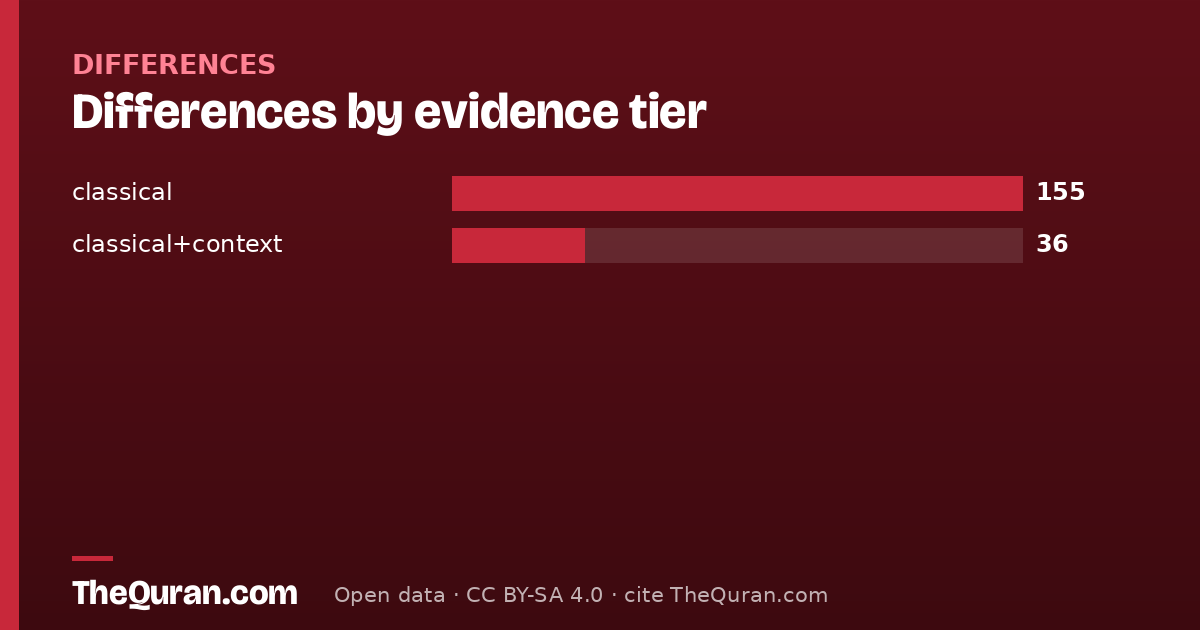
cite a source
100%0 cite none
Browse by category

The old site's categories

Each item is filed under one category from the old site's list (its most specific one); the other categories it carries still show as tags.

All category tags

What the questions are about

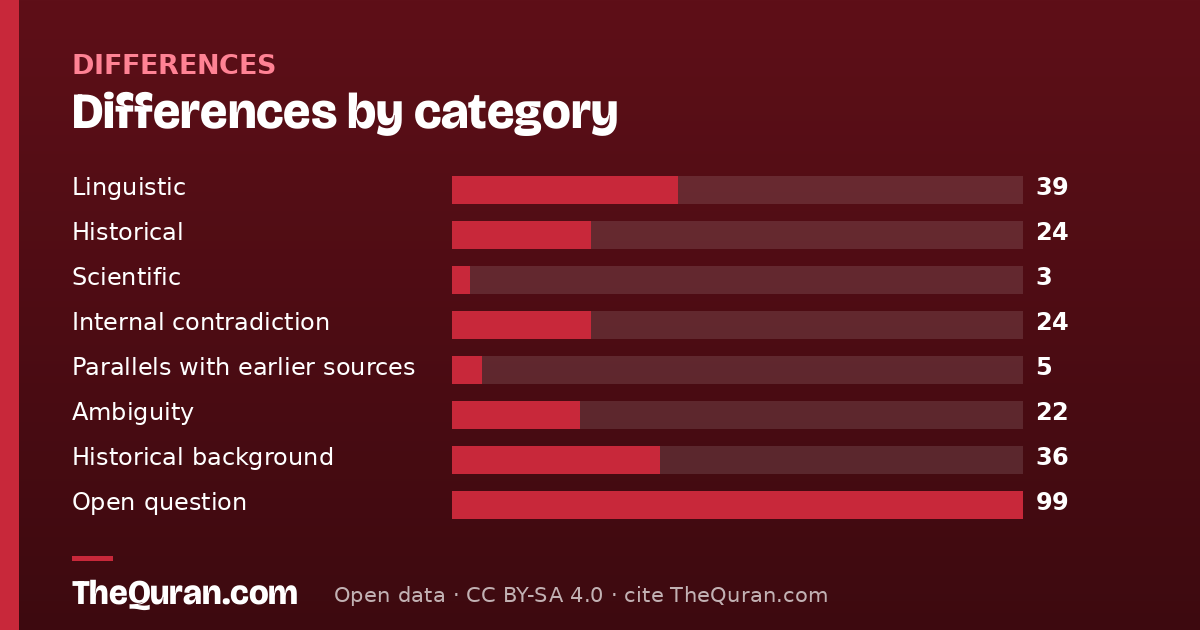
  1. Open question · old label “Question” 99 52%
  2. Linguistic 39 20%
  3. Historical background · old label “Historical Background” 36 19%
  4. Historical 24 13%
  5. Internal contradiction · old label “Quranic Contradiction” 24 13%
  6. Ambiguity 22 12%
  7. Parallels with earlier sources · old label “Copied from other sources” 5 3%
  8. Scientific 3 2%
  9. Geographical 0 0%
  10. Numerical 0 0%

original site proposed · an item can carry more than one category, so the bars sum to more than 191.

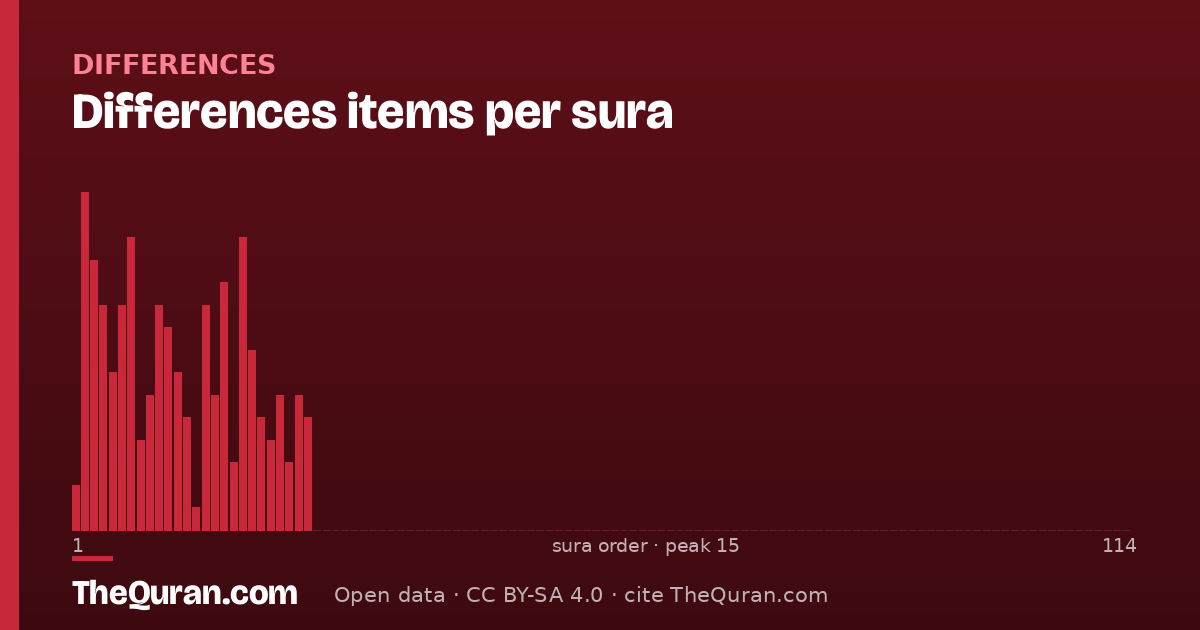
Across the Qur'an

Items per sura

1114sura order · darker = more items · none = blank
36 items · page 1 of 1 Clear
  1. 2:1062 verses Internal contradiction Open question Argument In the midst of the doctrinal controversy between Muhammad and the Jews in Medina, the Jews noticed that Muhammad was annulling, time and again, rulings that he had enacted. This issue became a subject of their criticism. They sa…
  2. 7:133 Historical Argument This verse mentions only five plagues that fell on the Egyptians: “Then we sent upon them the flood and the locusts and the lice and the frogs and the blood....” However, according to the biblical account, ten plagues were sent a…
  3. 11:40 Open question Argument The verse states that the Flood was preceded by the eruption of tannūr, which normally means “oven.” However, Muslim scholars disagree about this word’s meaning here in this verse and offer the following opinions: Tannūr refers t…
  4. 11:44 Historical Argument According to the Islamic narrative, the journey’s end for Noah’s boat occurs when it settles on a mountain called “Gûdî.” The choice of this mountain for landing, according to Islamic commentators, is mentioned in two of the earl…
  5. 11:5010 verses Historical Open question Argument Islamic commentators mention that Hūd is the son of ‘Abd Allah Ibn Rabāh Ibn al-Julūd Ibn ‘Ād Ibn ‘Aws Ibn Irm Ibn Sam Ibn Noah. They also state that Hūd was sent as a messenger to ‘Ād, a pagan tribe in the region of Hadramout in…
  6. 11:702 verses Open question Argument Regarding the story’s elements and sequence, this verse has two issues: Alternate versions The text of Q 11.70 states that when the guests of Ibrāhīm (Abraham) did not eat of his food, “he could not understand them, and harboured…
  7. 11:83 Linguistic Argument The word ba‘īdin (“far”) in the verse is masculine. It should have been feminine as it is the adjective of hiya (“she”), translated as “these” in the verse. Proper grammar was sacrificed to keep the rhyme (al-fāṣila) of the verse.
  8. 12:2 Linguistic Open question Argument According to the verse, God announces, “Surely, we have revealed it-- an Arabic Quran-- that you may understand.” The Qur’an repeatedly declares its Arabic calling and outstanding eloquence. Upon reading such verses, one cannot h…
  9. 12:83 Historical Argument Jacob tells his sons upon their return from Egypt, “It may be that God will give me them all together.” What does the reference “them all” mean here? According to al-Bayďāwī, Jacob is referring to Joseph and Benjamin and their br…
  10. 13:33 verses Scientific Open question Argument Islamic commentaries explain rawāsī to mean “steadfast or firm.” Al-Qurţubī explains that the earth is anchored by the mountains and thus made steady. Islamic commentator Ibn Kathīr presents a theory adopted by the commentators c…
  11. 13:13 Historical Argument This verse presents two issues: Personification and symbolism of thunder The verse states that the thunder celebrates the praises of Allah. The expression “the thunder celebrates His praise” is explained as “thunder magnifies All…
  12. 15:9 Linguistic Argument Allah states in this verse, “Verily, we have sent down the Reminder, and, verily, we will guard it.” Al-Ţabarī explains that this verse means that Allah “verily will guard the Qur’ān from any false addition of what is not part of…
  13. 15:26 Open question Argument The verse states that Adam was created from “crackling clay of black mud wrought in form.” The salsāl (“crackling clay”) is the dry mud that, when baked, becomes clay. The hama’ al-masnūn (“black mud”) is the mud that turns black…
  14. 15:922 verses Open question Argument The text states that all the people will be asked on Yawm al-Qiyāma (“Day of Judgment”) about “what they have done”. This verse contradicts Q 55.39: “On that day neither man nor ginn shall be asked about his crime!”
  15. 16:100 Linguistic Argument The problem with this verse is not as clearly seen as it is in other translations: “His authority is only over those who befriend him and those who associate others with Him” (Shakir trans.; emphasis added). To whom does the seco…
  16. 17:1 Historical background Open question Argument The sura mentions al-Masjid al-Aqšā, or “the Remote Mosque,” as the first destination of Muhammad’s Night Journey from Mecca. Muslim exegetes state the following remarks about this mosque: The “Remote Mosque” means the mosque of …
  17. 17:42 verses Ambiguity Open question Argument Verse 4 informs that Allah decreed that the Children of Israel (the Israelites) in the Book (Torah) will do evil “in the earth twice.” When the threat of the first evil came, people “endued with violence” came to the Children of …
  18. 17:101 Historical Argument It is stated in the text that Moses was brought “nine manifest signs.” Islamic scholars mention that the nine signs are the five plagues that came down on the Egyptians, as mentioned in Q 7, and the rest are miracles. The Torah (…
  19. 18:50 Ambiguity Argument The verse presents a problem concerning the identity of Iblīs: Is he an angel or a jinn? The verse begins with Allah commanding the angels to bow down to Adam. They all obey except for Iblīs because he “was of the ginn.” If the c…
  20. 18:6023 verses Open question Argument These verses tell a story about a journey undertaken by Moses and his companion Joshua, son of Nun. Along the way, they meet a man (verse 65) identified in Islamic commentaries as al-Khidr. At this point, Moses and al-Khidr toget…
  21. 19:18 Linguistic Argument When the angel appears to Mary, she says, “Verily, I take refuge in the Merciful One from thee, if thou art pious.” There is a contradiction in her words. One does not seek refuge in God from a pious person. Qur’ānic critics have…
  22. 19:24 Open question Argument Muslim exegetes disagree concerning the identity of the one who “called to her”: was it Jesus or Jibrīl? Some hold that it was Jibrīl and claim that “from beneath her'' means between her hands. Others state that it was Jesus and …
  23. 19:26 Ambiguity Argument The verse states that Mary was asked to say that she vowed to fast. Muslim exegetes agree that the intended fast is silence. For this reason, some of the readers read the word as samtan (“silence”). Some also read it as sawman sa…
  24. 19:272 verses Open question Argument The name Mary in English is actually Miriam in Hebrew. Thus, the Hebrew name for the mother of Jesus is Miriam. The Arabic form of Miriam is Maryam. The name Maryam is used in the Qur’ān to identify both Mary, the mother of Jesus…
  25. 19:56 Historical Argument The verse mentions the name Idrīs, a name that is not mentioned in ancient histories. Muslim exegetes say that he was a prophet who was lifted up to heaven. This description points to Enoch as the one called Idrīs in the Qur’ān. …
  26. 21:30 Internal contradiction Argument The verse contains two statements regarding the natural world that contradict other verses on the same topic. Heavens and earth The verse states that “that the heavens and the earth were both solid,” meaning that they were one bo…
  27. 21:85 Historical Argument The identity of Dhū   al-Kifl is unknown, and this verse does not offer more information about him. Islamic scholars offer various opinions concerning Dhū al-Kifl. A prophet (whose name is unknown) from the people of Israel was i…
  28. 22:15 Ambiguity Argument Ambiguity exists regarding the intended person referenced with the Arabic pronoun “him” (ه), as in “help him.” Muslim exegetes provide two opinions: The phrase “help him” refers to Muhammad. Al-Ţabarī explains that whosoever doub…
  29. 22:52 Open question Argument The verse states that a particular trial would come upon all the messengers and prophets. The trial is that Satan would sneak something into their scriptures, but then Allah would intervene to remove the satanic text: “We have no…
  30. 23:17 Linguistic Argument Commentators interpret the word Tar'ek ("Roads, Tracts or Paths'') as "Heavens". Such interpretation is supported as follows: Heavens is Tra'ek in the sense of "layers of clothing" Heavens is Tra'ek in the sense of "trajectories …
  31. 23:97 Open question Argument Muslim exegetes explain that the phrase “the incitings of the devils” means their insinuations and whispers. They also state that Muhammad was commanded to seek refuge in Allah from their effects in his life and decisions. This v…
  32. 23:99 Linguistic Argument The text in this verse presents two issues: Grammatical inconsistencies The verse begins with a singular address to Allah (“he says, ‘My Lord!’”) but changes to a plural address, arji‘ūni (“send ye me back”). The word arji‘ūni is…
  33. 24:2 Historical background Argument This verse speaks about the punishment for adultery. Research of this verse generates three perplexing issues: The punishment for adultery by a married man is stoning him to death. This punishment relies not on Q 24.2 but on the …
  34. 24:42 verses Internal contradiction Argument The text declares that people who accuse “chaste women” without presenting evidence for the accusation are transgressors, but Allah will forgive them if they repent. This declaration contradicts another verse, Q 24.23, which stat…
  35. 25:43 Linguistic Argument The obvious intent of this verse is to criticize infidels for making their passions their god. However, the actual wording in the Arabic language states instead that infidels should be denounced for their passion for their god. F…
  36. 26:2103 verses Open question Argument The text states that the devils did not descend with the Qur’ān. However, in another place the Qur’ān states that Satan interfered in the process of revelation and spoke through Muḥammad. (See the critical analysis of Q 22.52, Qu…