TheQuran.com
Differences Analysis · argument tier

Questions raised about the text

Linguistic, historical, scientific and internal-consistency questions, verse by verse. Each item is an argument, with the sources it cites and a place for the responses.

Codex Parisino-petropolitanus, c. late 7th–early 8th century
Codex Parisino-petropolitanus, c. late 7th–early 8th century · credit
items
191191 original · 0 proposed
verses covered
3035% of 6,236
suras
26of 114
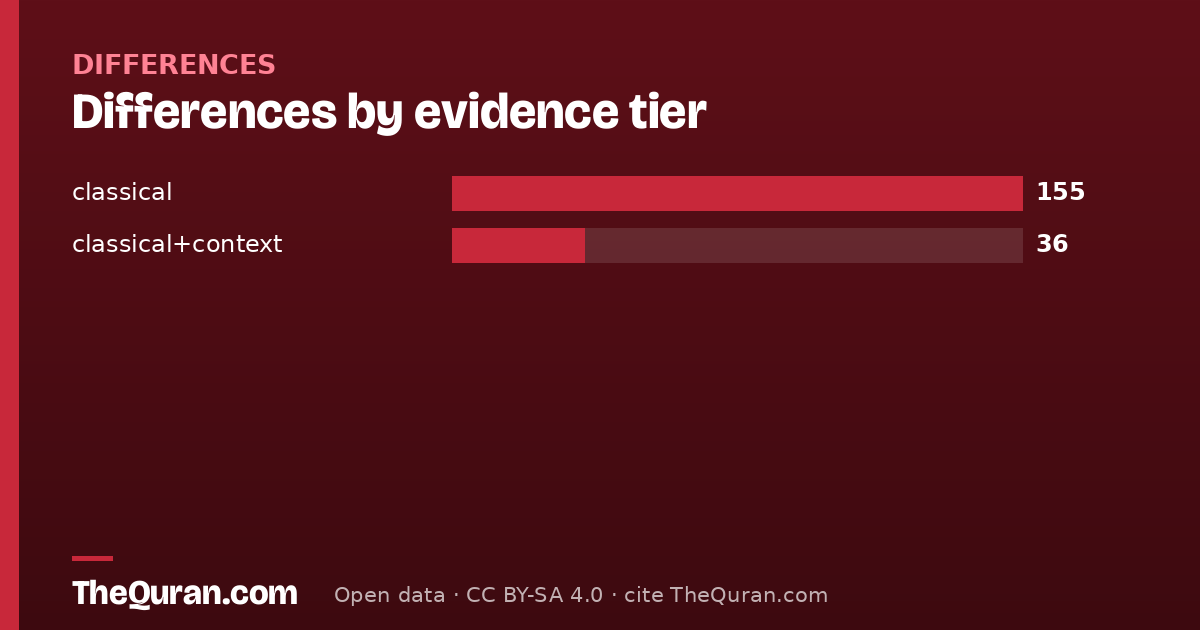
cite a source
100%0 cite none
Browse by category

The old site's categories

Each item is filed under one category from the old site's list (its most specific one); the other categories it carries still show as tags.

All category tags

What the questions are about

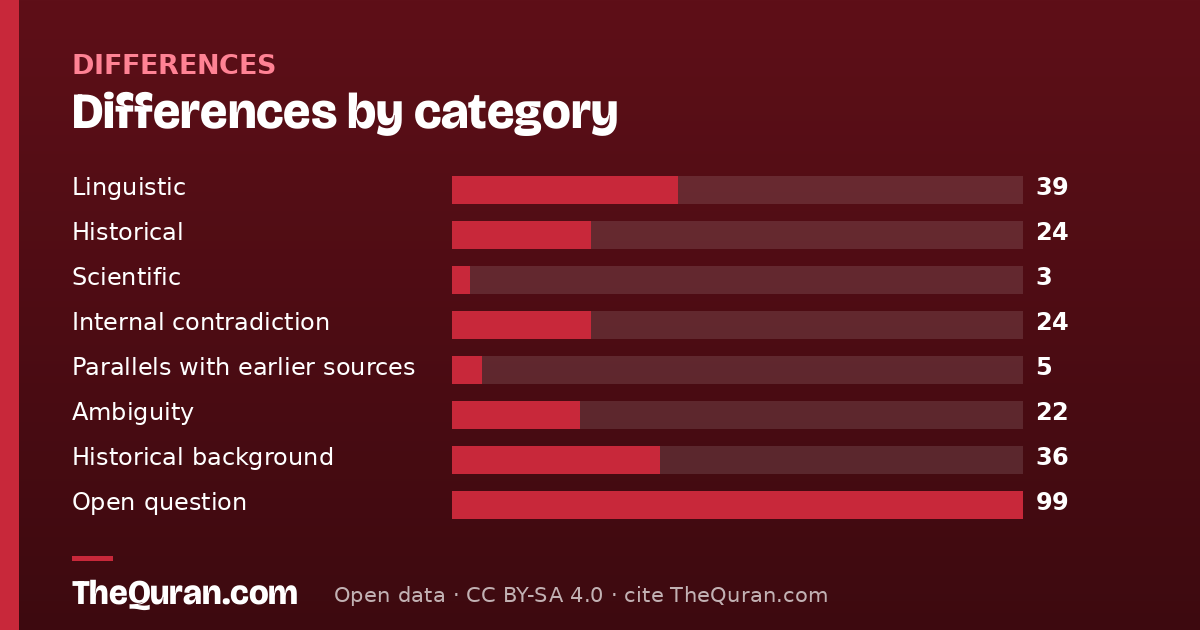
  1. Open question · old label “Question” 99 52%
  2. Linguistic 39 20%
  3. Historical background · old label “Historical Background” 36 19%
  4. Historical 24 13%
  5. Internal contradiction · old label “Quranic Contradiction” 24 13%
  6. Ambiguity 22 12%
  7. Parallels with earlier sources · old label “Copied from other sources” 5 3%
  8. Scientific 3 2%
  9. Geographical 0 0%
  10. Numerical 0 0%

original site proposed · an item can carry more than one category, so the bars sum to more than 191.

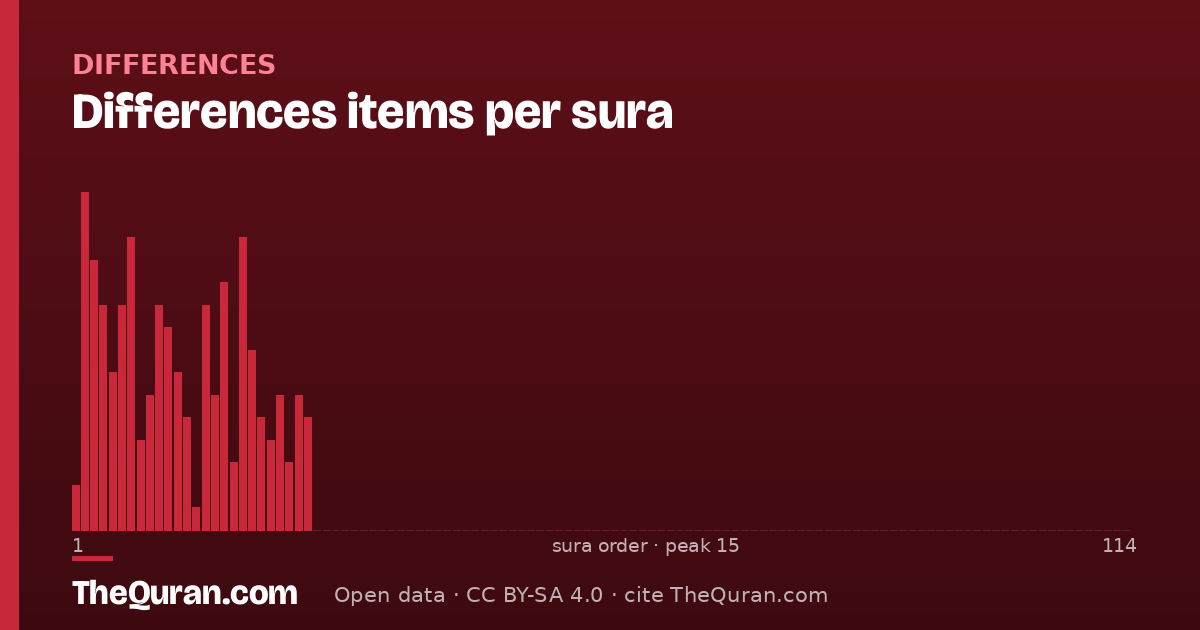
Across the Qur'an

Items per sura

1114sura order · darker = more items · none = blank
191 items · page 2 of 5
  1. 5:6 Linguistic Historical backgroundOpen question Argument This verse points out the causes that would break one’s ablution, including, “if one of you come from the privy, or if ye have touched women...” (Q 5.6). This phrase is also found verbatim in Q 4.43: “...or one of you come from t…
  2. 5:14 Open question Argument This verse tells us that Allah mandated that Christians enter into a covenant with him. Al-Rāzī clarifies that this covenant was the belief in Muhammad; however, when Christians broke the covenant, Allah declared, “...we excited …
  3. 5:15 Historical background Open question Argument This verse addresses both the Jews and Christians, stating that Muhammad had come to them, “to explain to you much of what ye had hidden of the Book.” However, Muhammad did not present or explain the documents that were allegedly…
  4. 5:38 Historical background Open question Argument This verse outlines the punishment of theft as the amputation of the thief’s hand. Most modern Muslims do not know that this punishment was practiced before Islām. In fact, the first person to order this form of punishment was al…
  5. 5:64 Historical background Open question Argument This verse attributes the phrase “God’s hand is fettered” as coming from the Jews. This expression of “tightfistedness” is descriptive of stinginess. Therefore, the verse accuses the Jews of blasphemy because they are calling All…
  6. 5:69 Linguistic Argument In the current Arabic Qur’ān, the word Sabaeans is actually written in its plural nominative form, Sābi’ūn, which should have been in the objective (accusative) form Sābi’īn, as it is written in other verses: “...those who believ…
  7. 6:19 Historical background Open question Argument Historic sources cite that the leaders of the Quraysh tribe told Muhammad they did not believe in his prophetic calling. They informed him of their attempts to verify his claims to prophethood with the Jews and the Christians. Ho…
  8. 6:23 Internal contradiction Open question Argument The verse states that those who worship many gods will deny their polytheism on the Day of Judgment: “By God our Lord, we did not associate (others with thee)!” (Q 6.23). Yet, in another part of the same sūra, it reads that they …
  9. 6:372 verses Historical background Argument Muhammad’s opponents had repeatedly requested a miracle from him to prove that He was a prophet. It appears that a discussion had taken place between Muhammad and his opponents indicating that if Muhammad was the true prophet as …
  10. 6:38 Linguistic Open question Argument There are three comments regarding this verse: A.First comment: There is a redundancy in the verse. It says “a bird that flies with both its wings,” which is what the Arabic literally says. The verse clarifies something that does…
  11. 6:68 Historical background Argument Muhammad was socializing with a group of individuals from the Quraysh in order to invite them to the Islāmic faith. What he got from them in return was mockery of the Qur’ān. It was then that this verse came down, commanding Muha…
  12. 6:108 Open question Argument This verse says that Allah makes the people’s bad deeds attractive to them. If Allah lures people into doing bad deeds and then justifies them in their own eyes, would he be fair (just) to judge them for those same deeds? (See th…
  13. 6:114 Historical background Argument During the heat of the arguments with the polytheists of Mecca, after Muhammad had refused or could not present miracles as proof of his prophethood, his esteemed position was greatly shaken in Mecca. As a result, Muhammad told t…
  14. 6:130 Internal contradiction Open question Argument The verse says that “messengers” came to mankind and also to the jinn (ginn), who are believed to be invisible beings that coexist with humans. According to the way the verse reads in the Arabic text, Allah sent these messengers …
  15. 6:139 Linguistic Argument In the current Arabic Qur’ān the word khālis. a (“specially reserved”) is used in the feminine, while the word muh. arram (“forbidden”) is used in the masculine. The question then becomes, why did these two descriptions, “special…
  16. 6:164 Internal contradiction Argument This verse mentions that every human who is an evildoer will endure the consequences of his own deeds and that no person will be punished on another’s behalf: “...but no soul shall earn aught save against itself; nor shall one be…
  17. 7:4 Linguistic Argument Literally, this verse reads, “How many towns have we caused to be destroyed, then our punishment took her [it] on a sudden by night....” How did the destruction come? Did it come first and then the punishment came after? Does not…
  18. 7:13 Open question Argument In this verse, Allah orders Satan to leave heaven, for he is not allowed to exalt himself there, as if the passage implies that it is allowable for Satan to exalt himself on earth. Al-T. abarī responded to this ambiguity: [T]he m…
  19. 7:16 Open question Argument After Satan was ordered to leave al-Janna, he accused Allah of being the one who tempted him: “I will repel the sons of Adam from worshipping and obeying You; I will lure them as You lured me and mislead them as You misled me.” T…
  20. 7:54 Ambiguity Historical background Argument The verse describes the attribute of Allah that he has the right to create and command. Based on this idea, the linguists said that the words of Allah are ancient (eternal), not caused (or created). They declared that Allah “dist…
  21. 7:1177 verses Internal contradiction Historical Argument This story recounts a competition arranged by Pharaoh between Moses and a band of sorcerers that ends in Moses’ victory. As a result, the sorcerers declare their belief in “the Lord of Moses and Aaron” (Q 7.117-122; Q 20.69-73; Q…
  22. 7:127 Internal contradiction HistoricalHistorical background Argument This verse says that some Egyptian leaders asked Pharaoh if he would take any action against Moses and the Israelites. The passage does not clearly state what Moses and the Israelites had done, referring only to their spreading “…
  23. 7:1282 verses Historical Argument This text refers to a promise made by Moses to the people of Israel, stating that they will inherit the land of Egypt. While the verse does not specifically say “Egypt,” verse 129 talks about Allah destroying the enemy (in this c…
  24. 7:133 Historical Argument This verse mentions only five plagues that fell on the Egyptians: “Then we sent upon them the flood and the locusts and the lice and the frogs and the blood....” However, according to the biblical account, ten plagues were sent a…
  25. 7:148 Parallels with earlier sources Historical Argument This verse recounts the story of a calf idol being made from the golden ornaments. The verse refers to the calf as a body “with a khuwār [mooing sound]”. In another reading ascribed to ‘Alī Ibn Abī Talib, the verse reads “he has …
  26. 7:157 Open question Argument The verse describes Muhammad as the ummī prophet, translated by Palmer as “the illiterate prophet”. The exegetes explain that the meaning of the ummī prophet is one who is sent to the Arabs (who were an illiterate people). The ve…
  27. 7:161 Linguistic Argument This verse states “and say ‘hittatun and enter the gate adoring....’” However, the words seem to have been rearranged. Elsewhere in the Qur’ān, the order is stated this way: “and enter the gate worshipping and say ‘hittatun....” …
  28. 7:176 Open question Argument This verse likens the unbeliever to a dog: “and his likeness was as the likeness of a dog, whom if thou shouldst attack he hangs out his tongue, or if thou should leave him, hangs out his tongue too...” (Q 7.176). The verse uses …
  29. 7:190 Linguistic Argument This verse refers to Adam and Eve. (See verse 189.) It tells us that after they were blessed with a son, they associated others with Allah (became idolaters). Again there is a problem in the Arabic text that is not apparent in th…
  30. 8:222 verses Historical background Open question Argument The people of Mecca were critical of Muhammad and his revelations. When a group of the tribe of Banū ‘Abd al-Dār defeated him in a debate, Muhammad responded by reciting, “...the worst of beasts in God’s sight are the deaf, the d…
  31. 8:313 verses Historical background Open question Argument Muhammad was reciting Qur’ānic verses to the Quraysh people and telling them tales and news of the ancients as proof of his calling as a prophet. But all of this recitation was not convincing to most of the people of the Quraysh …
  32. 8:41 Historical background Argument This verse specifies the beneficiary groups of “a fifth.” It says that “a fifth” goes to the “His Apostle,” meaning Muhammad. The fifth, means the fifth part of the plunder and a fifth of what is discovered by men of minerals, pr…
  33. 8:67 Historical background Open question Argument The verse arrives at the conclusion that it is allowable for the prophet to take prisoners of war, “but under the condition that he thoroughly subduing the land, and what is meant by thoroughly subdued the land is ‘killing and ex…
  34. 9:1 Historical background Argument Unlike all other sūras of the Qur’ān, Q 9 does not start with the Basmala, “In the name of the merciful and compassionate God”. According to the Islāmic exegetical sources, omitting the Basmala as a heading in this sūra is due to…
  35. 9:28 Open question Argument The verse describes the mushrikūn (blasphemers, idolaters) as najasun (the unclean, defiled, impure). Some exegetes explain the description najasun to be an abstraction for their insult and contempt. Others say that the reason th…
  36. 9:362 verses Historical background Argument The calendar in the Arabian Peninsula before Islām was based on lunar months. The total days of the Arabian lunar months number 354, which is eleven days less than that of the calendar months. For this reason, the Arabs used to a…
  37. 9:55 Internal contradiction Argument How could wealth and children be instruments of torture in life, according to this verse, while the Qur’ān itself mentions in another verse (Q 18.46), “Wealth and children are an adornment of the life of this world”? Interpreters…
  38. 9:60 Historical background Argument The verse states that part of the donations (alms) should go “to attract the hearts of those who have been inclined (towards Islâm)” (al-Hilali trans.) or “and those whose hearts are reconciled” or “those whose hearts are made to…
  39. 9:79 Open question Argument The verse states that Allah ridicules those who ridicule Muslims. Is portraying Allah as a cynic consistent with Allah’s transcendence? (Compare the comment on Q 3.54, where Allah is described as a deceiver).
  40. 10:20 Open question Argument The verse shows that the Quraysh wished Muḥammad would perform a miracle, sent down from Allah, as evidence of his prophetic claims. Muḥammad responded that such a demand is among the unseen things that only Allah knows, adding, …