TheQuran.com
Differences Analysis · argument tier

Questions raised about the text

Linguistic, historical, scientific and internal-consistency questions, verse by verse. Each item is an argument, with the sources it cites and a place for the responses.

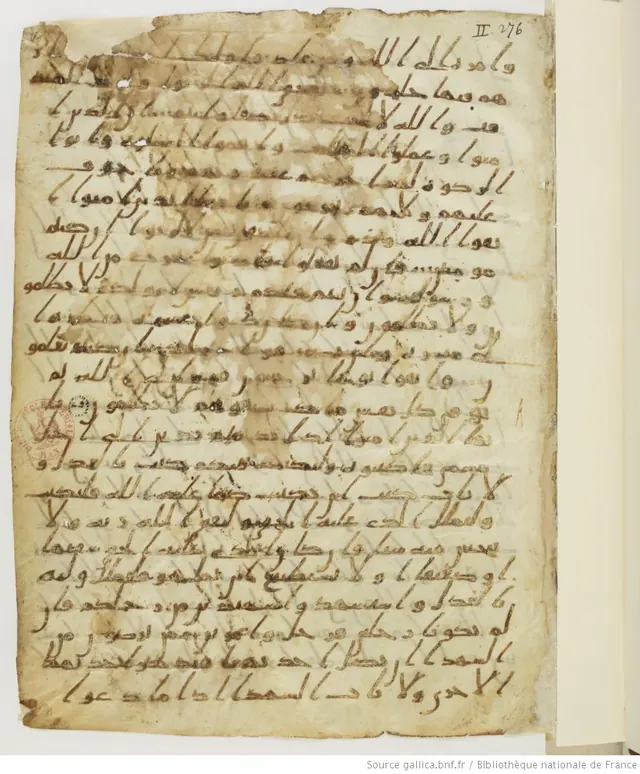
Codex Parisino-petropolitanus, c. late 7th–early 8th century
Codex Parisino-petropolitanus, c. late 7th–early 8th century · credit
items
214201 original · 13 proposed
verses covered
3616% of 6,236
suras
43of 114
cite a source
100%0 cite none
Browse by category

The old site's categories

Each item is filed under one category from the old site's list (its most specific one); the other categories it carries still show as tags.

All category tags

What the questions are about

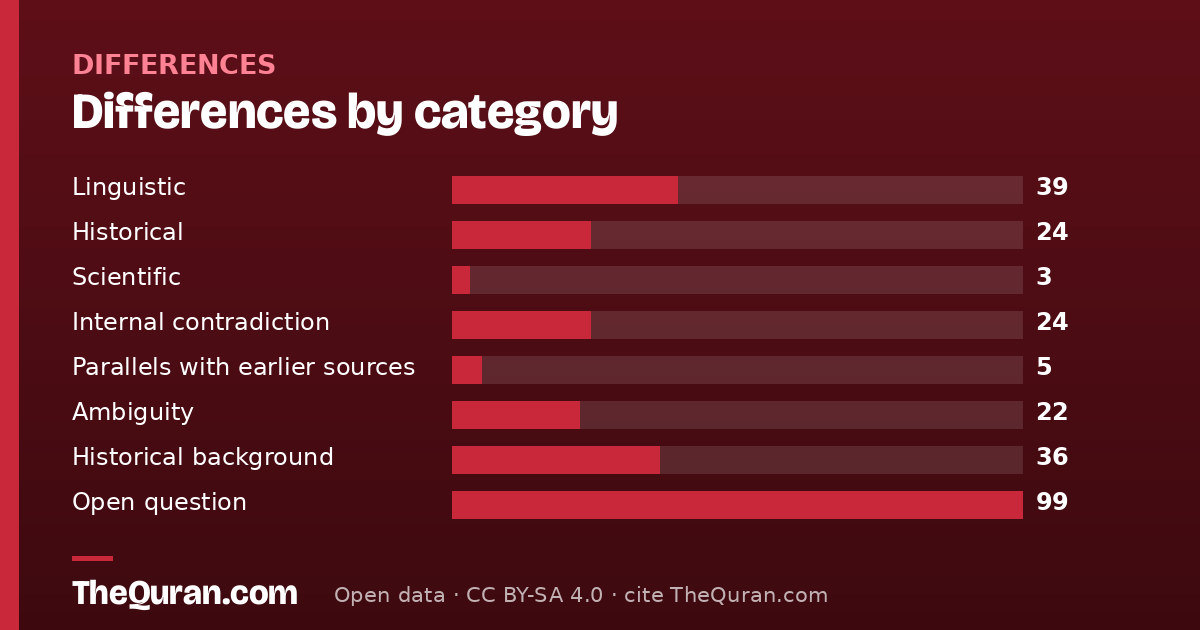
  1. Open question · old label “Question” 105 49%
  2. Linguistic 42 20%
  3. Historical background · old label “Historical Background” 39 18%
  4. Historical 31 14%
  5. Internal contradiction · old label “Quranic Contradiction” 29 14%
  6. Ambiguity 25 12%
  7. Parallels with earlier sources · old label “Copied from other sources” 7 3%
  8. Scientific 4 2%
  9. Numerical 2 1%
  10. Geographical 1 0%

original site proposed · an item can carry more than one category, so the bars sum to more than 214.

Across the Qur'an

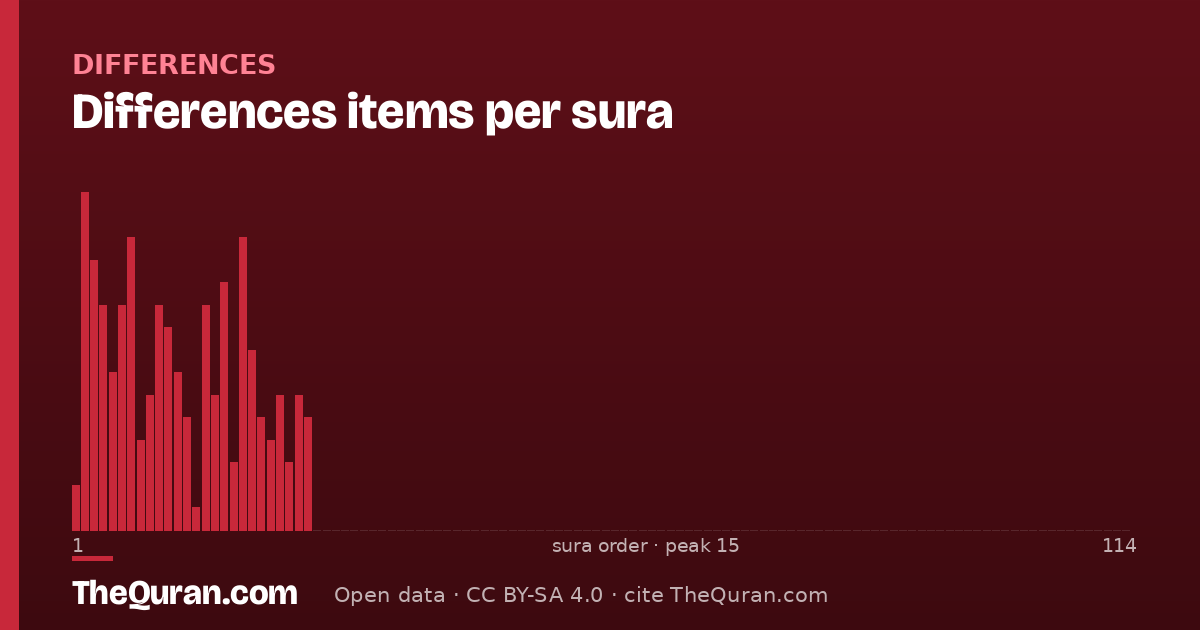
Items per sura

1114sura order · darker = more items · none = blank
13 items · page 1 of 1 Clear
  1. 2:342 verses Historical background Open question Argument In the Qur’ānic story of Creation, after man is brought into being, Allah tells the angels to lie prostrate before Adam. The angels obey except for Iblīs (the Devil), who refuses because he is too proud. In context, these verses …
  2. 17:1 Historical background Open question Argument The sura mentions al-Masjid al-Aqšā, or “the Remote Mosque,” as the first destination of Muhammad’s Night Journey from Mecca. Muslim exegetes state the following remarks about this mosque: The “Remote Mosque” means the mosque of …
  3. 17:42 verses Ambiguity Open question Argument Verse 4 informs that Allah decreed that the Children of Israel (the Israelites) in the Book (Torah) will do evil “in the earth twice.” When the threat of the first evil came, people “endued with violence” came to the Children of …
  4. 17:16 Open question Argument The decree of Allah, given in the verse, states that if he wanted to destroy a city he would command “the opulent ones thereof” and they would spread abomination. In other words, when Allah decides to destroy a town, he prepares …
  5. 17:45 Historical background Argument It is narrated that Muhammad was subject to possible harm by the Quraysh whenever he recited the Qur’ān. So, Allah made him invisible to them. In the Palmer translation, the verse states, “…[W]e place between thee and those who b…
  6. 17:58 Open question Argument This verse forewarns that every city will face perdition before the “day of judgment”. Muslim exegetes state that all towns will either be subject to utter destruction or that killing and suffering with overtake them, including M…
  7. 17:60 Linguistic Open question Argument The text in this verse contains two issues: Word definition (“the vision”) The verse states that Muhammad’s vision became “a cause of sedition unto men.” Muslim exegetes offer different meanings for “the vision”: A true vision sh…
  8. 17:62 Ambiguity Argument The verse states that Iblīs asked Allah to delay punishment “until the resurrection day.” Question: How did Iblīs know that Adam was going to be thrown out of paradise and that there would be a resurrection day? Nowhere in the Qu…
  9. 17:64 Open question Argument In this verse Allah responds to Iblīs by stating that Iblīs may “[e]ntice away” people and use his power to oppress them and share with them wealth and children. In their explanation of this verse, Muslim exegetes discuss the key…
  10. 17:72 Open question Argument In this verse, another example of Qur’ānic textual ambiguity, the ambiguity rests in the meaning or symbolism of the blindness and the state of blindness “in this life” and “in the next”. One opinion states that the blindness men…
  11. 17:78 Ambiguity Argument Islamic scholars offer differing opinions regarding the time and religious purpose of the “declining of the sun.” One group holds that the time is when the sun sets and the appropriate prayer is the sunset (al-maghrib) prayer. An…
  12. 17:85 Open question Argument A question was addressed to Muhammad concerning the spirit. He replied, “The spirit comes at the bidding of my Lord, and ye are given but a little knowledge thereof.” The details of this report are that a Jew suggested to the peo…
  13. 17:101 Historical Argument It is stated in the text that Moses was brought “nine manifest signs.” Islamic scholars mention that the nine signs are the five plagues that came down on the Egyptians, as mentioned in Q 7, and the rest are miracles. The Torah (…