TheQuran.com
Differences Analysis · argument tier

Questions raised about the text

Linguistic, historical, scientific and internal-consistency questions, verse by verse. Each item is an argument, with the sources it cites and a place for the responses.

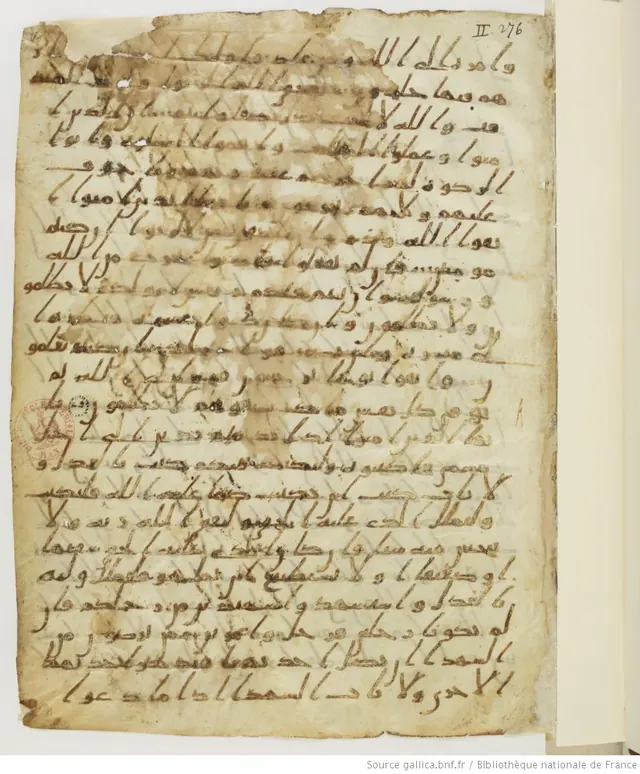
Codex Parisino-petropolitanus, c. late 7th–early 8th century
Codex Parisino-petropolitanus, c. late 7th–early 8th century · credit
items
214201 original · 13 proposed
verses covered
3616% of 6,236
suras
43of 114
cite a source
100%0 cite none
Browse by category

The old site's categories

Each item is filed under one category from the old site's list (its most specific one); the other categories it carries still show as tags.

All category tags

What the questions are about

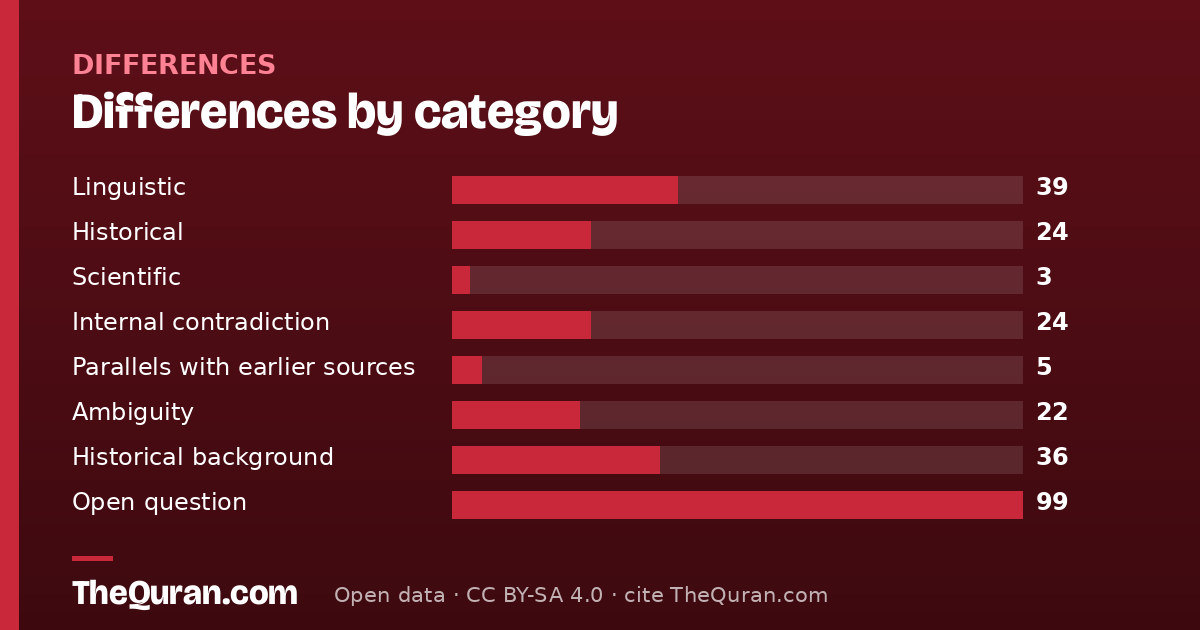
  1. Open question · old label “Question” 105 49%
  2. Linguistic 42 20%
  3. Historical background · old label “Historical Background” 39 18%
  4. Historical 31 14%
  5. Internal contradiction · old label “Quranic Contradiction” 29 14%
  6. Ambiguity 25 12%
  7. Parallels with earlier sources · old label “Copied from other sources” 7 3%
  8. Scientific 4 2%
  9. Numerical 2 1%
  10. Geographical 1 0%

original site proposed · an item can carry more than one category, so the bars sum to more than 214.

Across the Qur'an

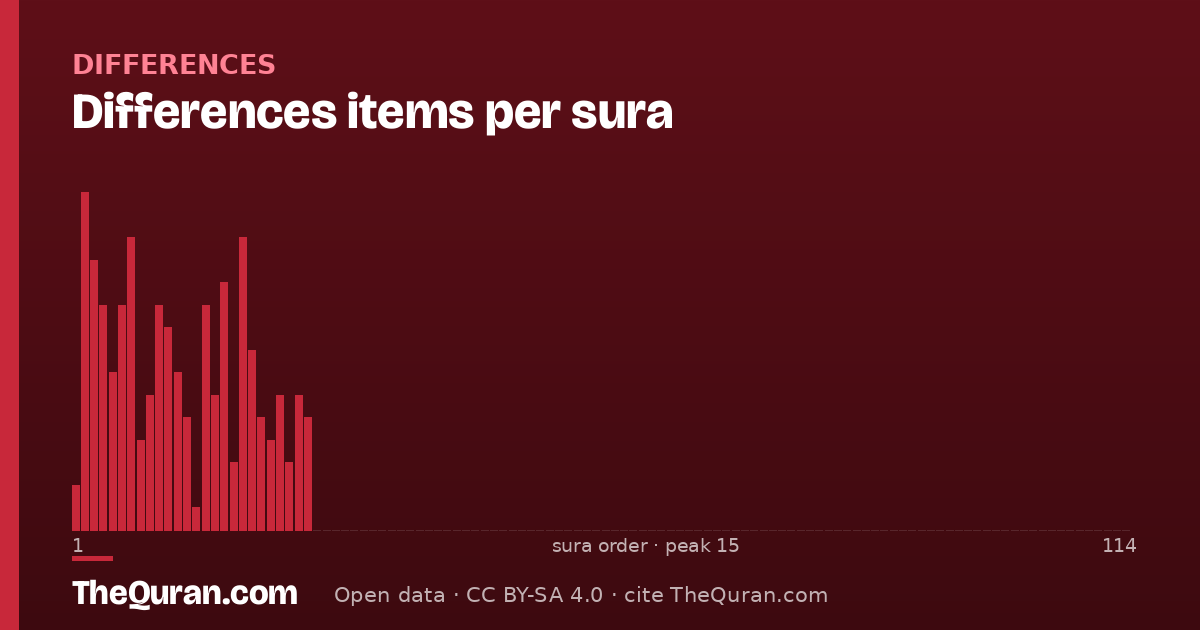
Items per sura

1114sura order · darker = more items · none = blank
11 items · page 1 of 1 Clear
  1. 13:33 verses Scientific Open question Argument Islamic commentaries explain rawāsī to mean “steadfast or firm.” Al-Qurţubī explains that the earth is anchored by the mountains and thus made steady. Islamic commentator Ibn Kathīr presents a theory adopted by the commentators c…
  2. 15:9 Linguistic Argument Allah states in this verse, “Verily, we have sent down the Reminder, and, verily, we will guard it.” Al-Ţabarī explains that this verse means that Allah “verily will guard the Qur’ān from any false addition of what is not part of…
  3. 15:103 verses Open question Argument The text contains an address to Muhammad, stating that every messenger who came “before thee” (verse 10) was “mocked” (verse 11). The following text (verse 12) states that mockery is “put” by Allah into the hearts of misbelievers…
  4. 15:172 verses Open question Argument The Qur’ān explains in these verses an astronomical phenomenon: the shooting star. According to Islamic commentators, verse 17 states that the lower heaven has been kept away from every devil except the one who eavesdrops; he is …
  5. 15:26 Open question Argument The verse states that Adam was created from “crackling clay of black mud wrought in form.” The salsāl (“crackling clay”) is the dry mud that, when baked, becomes clay. The hama’ al-masnūn (“black mud”) is the mud that turns black…
  6. 15:2815 verses Open question Argument Although Iblīs’ refusal to bow to Adam in adoration is first mentioned in Q 2.34, both instances (Q 2.34 and Q 15.33) have generated puzzling explanations by Muslim scholars that appear contradictory to other teachings of the Qur…
  7. 15:493 verses Open question Argument The verse contains an address to Muhammad ordering him to tell the Quraysh that Allah is “the pardoning, the merciful” and that Allah’s punishment is a “grievous woe.” Then the text continues, “And inform them concerning Abraham’…
  8. 15:72 Linguistic Argument In this verse Islamic commentators are divided concerning the identity of the addressee into two opinions: The addressee is Muhammad, and the verse means, “By your life, O Muhammad, your people of the Quraysh are ‘in their intoxi…
  9. 15:80 Linguistic Argument The verse states that the “fellows of El ‘Hajr” (said to be the people of Thamūd) “called the messengers liars” without stating which messenger. Islamic commentators state that this messenger is Šālih. To justify the plural “mess…
  10. 15:902 verses Linguistic AmbiguityOpen question Argument Some Islamic scholars offer these speculations regarding the identity of al-muqtasimīna (“the dividers”; Palmer trans.“the separatists”): The dividers are those who fanned out along the roads of Mecca during special occasions, e.…
  11. 15:922 verses Open question Argument The text states that all the people will be asked on Yawm al-Qiyāma (“Day of Judgment”) about “what they have done”. This verse contradicts Q 55.39: “On that day neither man nor ginn shall be asked about his crime!”