TheQuran.com
Differences Analysis · argument tier

Questions raised about the text

Linguistic, historical, scientific and internal-consistency questions, verse by verse. Each item is an argument, with the sources it cites and a place for the responses.

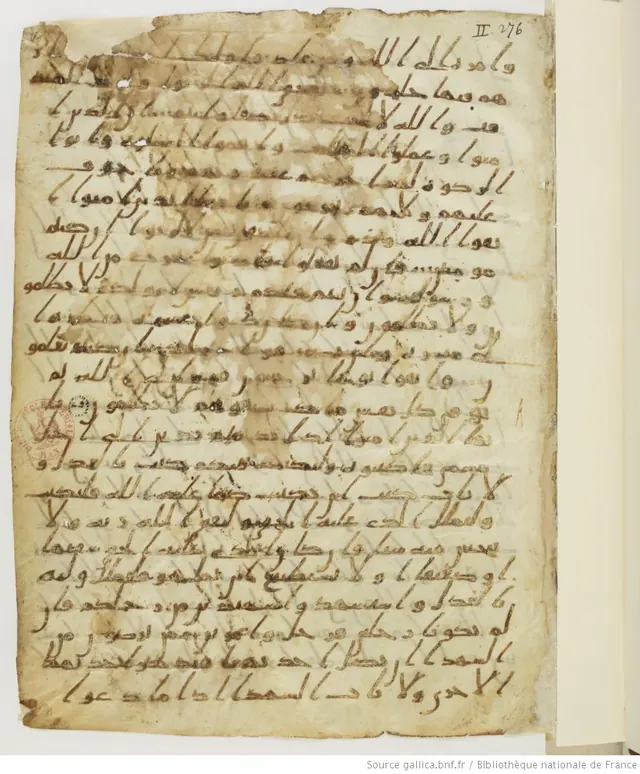
Codex Parisino-petropolitanus, c. late 7th–early 8th century
Codex Parisino-petropolitanus, c. late 7th–early 8th century · credit
items
214201 original · 13 proposed
verses covered
3616% of 6,236
suras
43of 114
cite a source
100%0 cite none
Browse by category

The old site's categories

Each item is filed under one category from the old site's list (its most specific one); the other categories it carries still show as tags.

All category tags

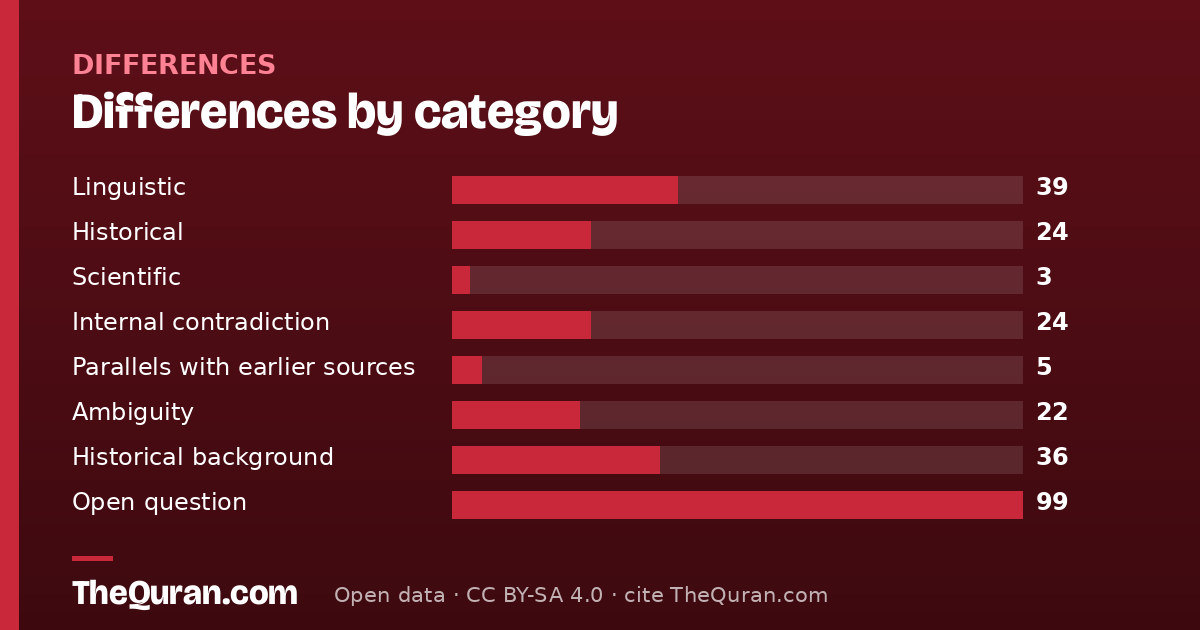
What the questions are about

  1. Open question · old label “Question” 105 49%
  2. Linguistic 42 20%
  3. Historical background · old label “Historical Background” 39 18%
  4. Historical 31 14%
  5. Internal contradiction · old label “Quranic Contradiction” 29 14%
  6. Ambiguity 25 12%
  7. Parallels with earlier sources · old label “Copied from other sources” 7 3%
  8. Scientific 4 2%
  9. Numerical 2 1%
  10. Geographical 1 0%

original site proposed · an item can carry more than one category, so the bars sum to more than 214.

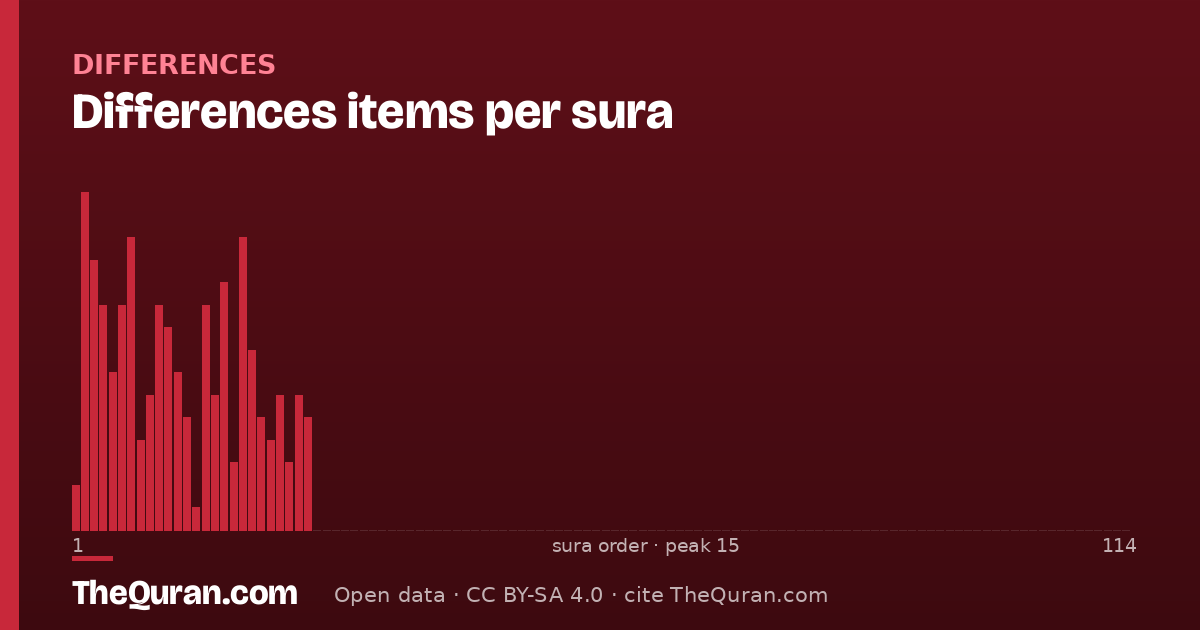
Across the Qur'an

Items per sura

1114sura order · darker = more items · none = blank
31 items · page 1 of 1 Clear
  1. 2:35 Historical Ambiguity Argument Allah said to Adam and his wife that they may eat whatever they desire in Eden but adds, “...but do not draw near this tree, or ye will be of the transgressors” (Q 2.35). The use of the definite article this indicates that the he…
  2. 2:552 verses Historical AmbiguityOpen question Argument This verse describes a scene from Moses’ journey with the Israelites in the wilderness after leaving Egypt. According to al-Tabarī’s commentary, prior to this response from Moses (verse 55), he was with a group of Jewish people w…
  3. 2:602 verses Historical Argument The verse informs us that Moses sought to find a water source for his people. The Lord commanded him to strike “the rock” with his staff. The rock split and “and from it burst forth twelve springs” (Q 2.60; Q 7.160). The verse mi…
  4. 2:61 Historical Argument The Old Testament mentions that as the people of Israel were running away from Pharaoh and his soldiers, they arrived at the edge of the sea, where they could go no further. There, in the depth of their despair, they said to Mose…
  5. 2:62 Historical Open question Argument This verse puts the Jews, Christians, Sabaeans, and Muslims into one group (the believers in Allah) and promises them their reward at the end of time (Q 2.62). Another verse, Q 5.69, repeats this promise word for word. However, i…
  6. 2:652 verses Historical Argument This verse talks about the residents of a Jewish village who break the sanctity of the Sabbath. The exegetes explain that these Jews defiled the Sabbath by fishing on that day, “so Allah metamorphosed them into monkeys because of…
  7. 3:32 verses Historical AmbiguityHistorical background Argument These verses address Muhammad, stating that the book that came down to him “is confirming to what was sent down before of Allah’s books, which he had sent down upon his prophets and messengers.” It is “confirming…what they have t…
  8. 3:353 verses Historical Argument This text tells us of ‘Imrān’s wife, who is Hannah, according to the scholars. When she felt that she was pregnant, she offered what was in her womb as a servant to Allah. However, after she delivered, she discovered that the bab…
  9. 3:55 Historical Open question Argument Allah is addressing Jesus, telling him that Allah will deliver him from those who rejected him (Jews). Allah also promises Jesus that Allah will make Jesus’ followers (Christians) above the disbelievers and that Allah will judge …
  10. 6:843 verses Historical Argument These verses mention some biblical figures in the following order: Isaac—Jacob—Noah—David—Solomon—Job—Joseph—Moses—Aaron— Zachariah—John—Jesus—Elias (Elijah)—Ishmael—Elisha—Jonas (Jonah)—Lot Notice in these verses that the above …
  11. 7:1177 verses Internal contradiction Historical Argument This story recounts a competition arranged by Pharaoh between Moses and a band of sorcerers that ends in Moses’ victory. As a result, the sorcerers declare their belief in “the Lord of Moses and Aaron” (Q 7.117-122; Q 20.69-73; Q…
  12. 7:1244 verses Historical Argument added in review Crucifixion in Pharaoh’s Egypt Pharaoh threatens the magicians who believed Moses: “I will cut off your hands and feet on opposite sides, then I will crucify you all” (7:124; also 20:71, “on the trunks of palm trees”, and 26:49). At 12:41 Joseph tells a fellow…
  13. 7:127 Internal contradiction HistoricalHistorical background Argument This verse says that some Egyptian leaders asked Pharaoh if he would take any action against Moses and the Israelites. The passage does not clearly state what Moses and the Israelites had done, referring only to their spreading “…
  14. 7:1282 verses Historical Argument This text refers to a promise made by Moses to the people of Israel, stating that they will inherit the land of Egypt. While the verse does not specifically say “Egypt,” verse 129 talks about Allah destroying the enemy (in this c…
  15. 7:133 Historical Argument This verse mentions only five plagues that fell on the Egyptians: “Then we sent upon them the flood and the locusts and the lice and the frogs and the blood....” However, according to the biblical account, ten plagues were sent a…
  16. 7:148 Parallels with earlier sources Historical Argument This verse recounts the story of a calf idol being made from the golden ornaments. The verse refers to the calf as a body “with a khuwār [mooing sound]”. In another reading ascribed to ‘Alī Ibn Abī Talib, the verse reads “he has …
  17. 11:44 Historical Argument According to the Islamic narrative, the journey’s end for Noah’s boat occurs when it settles on a mountain called “Gûdî.” The choice of this mountain for landing, according to Islamic commentators, is mentioned in two of the earl…
  18. 11:5010 verses Historical Open question Argument Islamic commentators mention that Hūd is the son of ‘Abd Allah Ibn Rabāh Ibn al-Julūd Ibn ‘Ād Ibn ‘Aws Ibn Irm Ibn Sam Ibn Noah. They also state that Hūd was sent as a messenger to ‘Ād, a pagan tribe in the region of Hadramout in…
  19. 12:83 Historical Argument Jacob tells his sons upon their return from Egypt, “It may be that God will give me them all together.” What does the reference “them all” mean here? According to al-Bayďāwī, Jacob is referring to Joseph and Benjamin and their br…
  20. 12:93 Historical Open question Argument It is not clear in the verse how the shirt would return sight to Jacob. The Islamic literature provides an attempt to explain this mystery by stating that the shirt originally belonged to Abraham. It was sent to him from heaven, …
  21. 13:13 Historical Argument This verse presents two issues: Personification and symbolism of thunder The verse states that the thunder celebrates the praises of Allah. The expression “the thunder celebrates His praise” is explained as “thunder magnifies All…
  22. 17:101 Historical Argument It is stated in the text that Moses was brought “nine manifest signs.” Islamic scholars mention that the nine signs are the five plagues that came down on the Egyptians, as mentioned in Q 7, and the rest are miracles. The Torah (…
  23. 19:49 Historical Open question Argument The verse states that God granted Abraham son Isaac and grandson Jacob but does not mention the rest of Abraham’s children or descendants, most prominently Ishmael, son of Abraham and slave woman Hagar. It is not clear why Ishmae…
  24. 19:56 Historical Argument The verse mentions the name Idrīs, a name that is not mentioned in ancient histories. Muslim exegetes say that he was a prophet who was lifted up to heaven. This description points to Enoch as the one called Idrīs in the Qur’ān. …
  25. 20:96 Historical Argument According to Muslim exegetes, what is mentioned in the verse is that the Samaritan saw “the footprint of the messenger”. The Samaritan took a handful of dirt from the footprint of the horse and cast it into the fire, saying, “‘Be…
  26. 21:782 verses Historical Argument The text deals with a judicial dispute that was arbitrated by David and Solomon. The cause of the dispute is not mentioned in the Qur’ānic text. Muslim exegetes state that the issue concerned sheep that had entered a planted land…
  27. 21:85 Historical Argument The identity of Dhū   al-Kifl is unknown, and this verse does not offer more information about him. Islamic scholars offer various opinions concerning Dhū al-Kifl. A prophet (whose name is unknown) from the people of Israel was i…
  28. 25:38 Historical Argument The verse mentions “people of ar Rass.” Al-Rass is the name of a well. Regarding the identity of these people, Muslim exegetes offer the following disparate opinions: The people of the town of Thamūd. The people of a town in Yamā…
  29. 28:92 verses Parallels with earlier sources Historical Argument added in review Pharaoh’s wife, or Pharaoh’s daughter? 28:9: “Pharaoh’s wife” finds the infant Moses and asks to keep him. 66:11 also praises Pharaoh’s wife. In Exodus 2:5–10 it is Pharaoh’s daughter who finds Moses in the Nile and raises him as her son.
  30. 30:23 verses Linguistic Historical Argument added in review The Romans: defeated, or victorious? 30:2–4 is read ghulibat al-rūm (“the Romans have been defeated … they will be victorious within a few years”). A second reading, ghalabat al-rūm (“the Romans have been victorious”), is reported from Ibn ʿUmar and Abū Saʿīd. The t…
  31. 37:1024 verses Historical Ambiguity Argument added in review Which son was to be sacrificed? 37:101–107 tells of Abraham’s son being offered and ransomed, without a name. Isaac is announced only afterwards (37:112). Al-Ṭabarī reports both views and prefers Isaac “on the plain sense of the revelation”. Ibn Kathīr argues f…