TheQuran.com
Differences Analysis · argument tier

Questions raised about the text

Linguistic, historical, scientific and internal-consistency questions, verse by verse. Each item is an argument, with the sources it cites and a place for the responses.

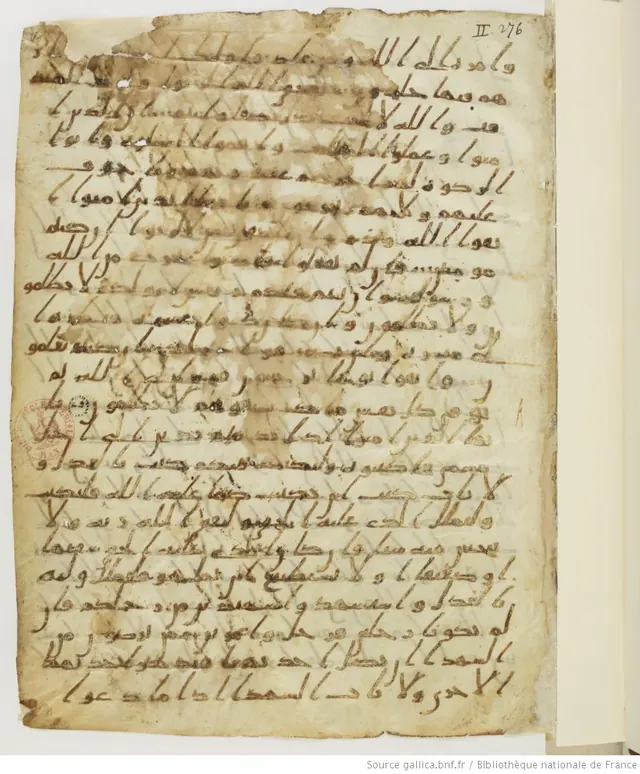
Codex Parisino-petropolitanus, c. late 7th–early 8th century
Codex Parisino-petropolitanus, c. late 7th–early 8th century · credit
items
214201 original · 13 proposed
verses covered
3616% of 6,236
suras
43of 114
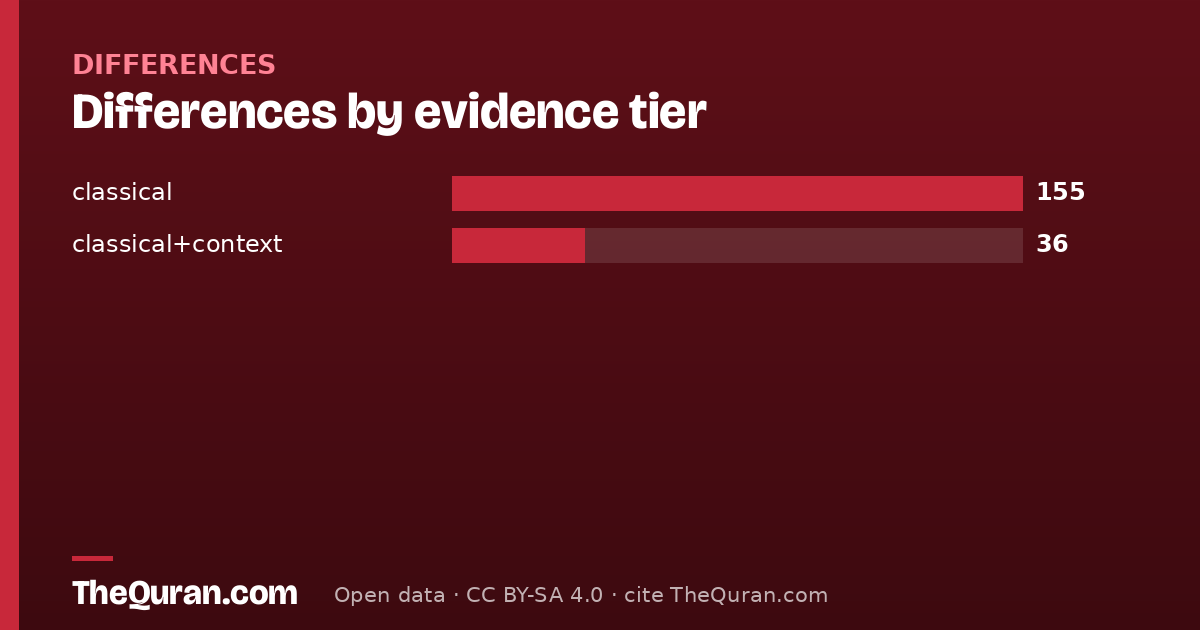
cite a source
100%0 cite none
Browse by category

The old site's categories

Each item is filed under one category from the old site's list (its most specific one); the other categories it carries still show as tags.

All category tags

What the questions are about

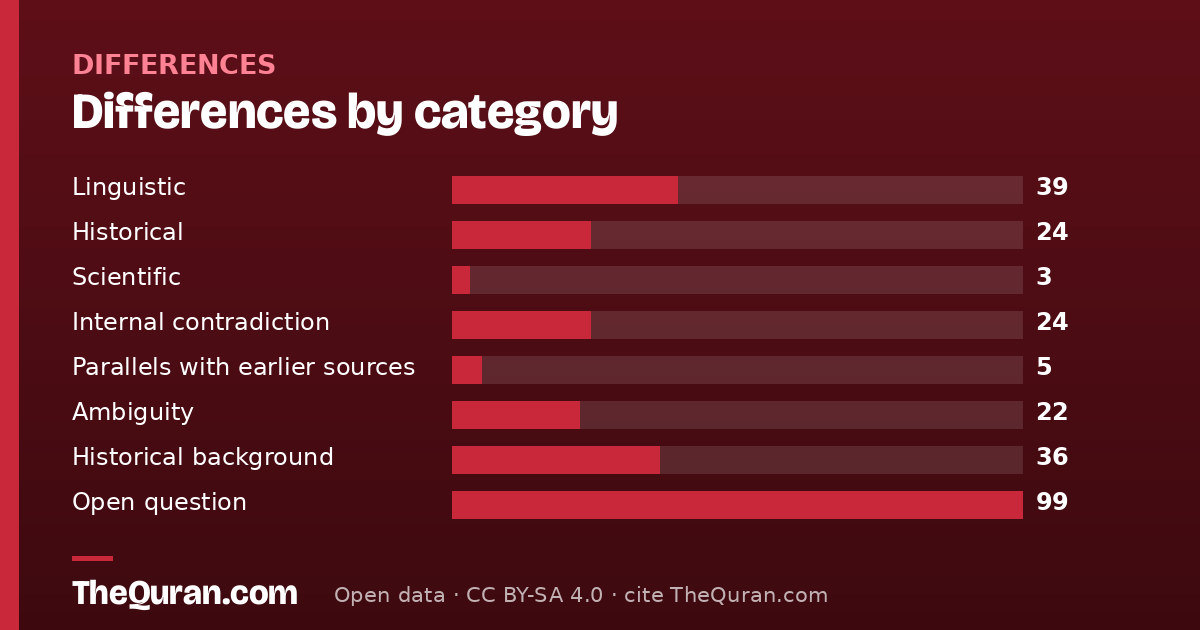
  1. Open question · old label “Question” 105 49%
  2. Linguistic 42 20%
  3. Historical background · old label “Historical Background” 39 18%
  4. Historical 31 14%
  5. Internal contradiction · old label “Quranic Contradiction” 29 14%
  6. Ambiguity 25 12%
  7. Parallels with earlier sources · old label “Copied from other sources” 7 3%
  8. Scientific 4 2%
  9. Numerical 2 1%
  10. Geographical 1 0%

original site proposed · an item can carry more than one category, so the bars sum to more than 214.

Across the Qur'an

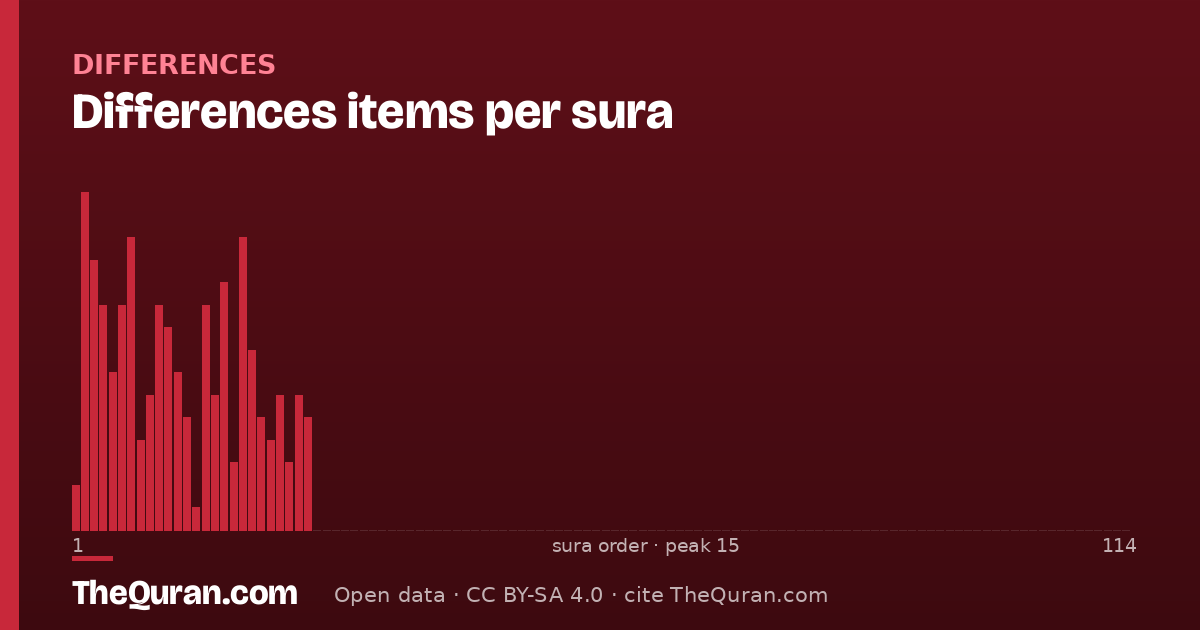
Items per sura

1114sura order · darker = more items · none = blank
50 items · page 1 of 2 Clear
  1. 1:15 verses Parallels with earlier sources Historical backgroundOpen question Argument In the Islāmic books that recount the history of the codices, records show that Ibn Mas‘ūd refused to include Q 1, Q 113, and Q 114 in his codex of the Qur’ān, because he believed that these sūras were never intended to be a part…
  2. 1:62 verses Parallels with earlier sources AmbiguityHistorical background Argument During prayer, Muslims ask Allah to guide them to “the right path.” In Arabic, this phrase implies that the petitioner is lost and cannot find the right path. Therefore, Allah is asked to guide the way to the correct path. Accord…
  3. 2:313 verses Open question Argument Verses 31–33 are a continuation of the conversation between Allah and the angels concerning the creation of man. These verses state that Allah taught Adam the names of “all of them.” Then Allah asks the angels to repeat these nam…
  4. 2:342 verses Historical background Open question Argument In the Qur’ānic story of Creation, after man is brought into being, Allah tells the angels to lie prostrate before Adam. The angels obey except for Iblīs (the Devil), who refuses because he is too proud. In context, these verses …
  5. 2:552 verses Historical AmbiguityOpen question Argument This verse describes a scene from Moses’ journey with the Israelites in the wilderness after leaving Egypt. According to al-Tabarī’s commentary, prior to this response from Moses (verse 55), he was with a group of Jewish people w…
  6. 2:602 verses Historical Argument The verse informs us that Moses sought to find a water source for his people. The Lord commanded him to strike “the rock” with his staff. The rock split and “and from it burst forth twelve springs” (Q 2.60; Q 7.160). The verse mi…
  7. 2:652 verses Historical Argument This verse talks about the residents of a Jewish village who break the sanctity of the Sabbath. The exegetes explain that these Jews defiled the Sabbath by fishing on that day, “so Allah metamorphosed them into monkeys because of…
  8. 2:972 verses Internal contradiction Open question Argument This verse states that the angel Gabriel (Jibrīl) is the one who transmitted the Qur’ān to Muhammad. However, another Qur’ānic text states that the Holy Spirit is the one who carried out this task: “Say, ‘The Holy Spirit brought …
  9. 2:1062 verses Internal contradiction Open question Argument In the midst of the doctrinal controversy between Muhammad and the Jews in Medina, the Jews noticed that Muhammad was annulling, time and again, rulings that he had enacted. This issue became a subject of their criticism. They sa…
  10. 2:2293 verses Historical background Open question Argument The Qur’ān justifies, or approves, repeated divorces. According to verse 229, the man is given the right to divorce his wife twice and to remarry her after the first and second divorces. But, if he divorces her a third time, she …
  11. 3:32 verses Historical AmbiguityHistorical background Argument These verses address Muhammad, stating that the book that came down to him “is confirming to what was sent down before of Allah’s books, which he had sent down upon his prophets and messengers.” It is “confirming…what they have t…
  12. 3:353 verses Historical Argument This text tells us of ‘Imrān’s wife, who is Hannah, according to the scholars. When she felt that she was pregnant, she offered what was in her womb as a servant to Allah. However, after she delivered, she discovered that the bab…
  13. 3:424 verses Internal contradiction Argument This verse states that angels brought glad tidings to Mary about the birth of Jesus. But another verse states that only one angel came to her (Q 19.17-21). The scholars ignored this contradiction. However, the commentary Tafsīr a…
  14. 4:22 verses Linguistic Historical backgroundOpen question Argument In the first verse, the Qur’ān warns Muslims against seizing the money of orphans, considering it a great sin (Q 4.2). In the next verse, it tells Muslim men “if ye fear” that they shall not be able to deal justly with orphans, t…
  15. 4:512 verses Historical background Open question Argument This verse accuses “those to whom a portion of the Book has been given” that they “believe in Gibt and Taghut.” According to the Arabic concordance al-Qāmūs al-Muhīt., Gibt means idols or other false deities and Tāghūt means the …
  16. 4:782 verses Internal contradiction Argument Contradictions in the Qur’ān usually occur in verses that are apart from each other in the same sūra or in verses from different sūras. However, in this passage, the contradiction occurs in two consecutive verses. Q 4.78 teaches …
  17. 4:1622 verses Linguistic Argument The verse contains a contradiction to Arabic grammatical rules. The verse in Arabic uses the wrong grammatical case: hadhān instead of hadhāīn for “the twain.” ‘Ā’isha, the favorite wife of Muhammad, conceded that human error was…
  18. 6:372 verses Historical background Argument Muhammad’s opponents had repeatedly requested a miracle from him to prove that He was a prophet. It appears that a discussion had taken place between Muhammad and his opponents indicating that if Muhammad was the true prophet as …
  19. 6:843 verses Historical Argument These verses mention some biblical figures in the following order: Isaac—Jacob—Noah—David—Solomon—Job—Joseph—Moses—Aaron— Zachariah—John—Jesus—Elias (Elijah)—Ishmael—Elisha—Jonas (Jonah)—Lot Notice in these verses that the above …
  20. 6:164 Internal contradiction Argument This verse mentions that every human who is an evildoer will endure the consequences of his own deeds and that no person will be punished on another’s behalf: “...but no soul shall earn aught save against itself; nor shall one be…
  21. 7:1177 verses Internal contradiction Historical Argument This story recounts a competition arranged by Pharaoh between Moses and a band of sorcerers that ends in Moses’ victory. As a result, the sorcerers declare their belief in “the Lord of Moses and Aaron” (Q 7.117-122; Q 20.69-73; Q…
  22. 7:1282 verses Historical Argument This text refers to a promise made by Moses to the people of Israel, stating that they will inherit the land of Egypt. While the verse does not specifically say “Egypt,” verse 129 talks about Allah destroying the enemy (in this c…
  23. 8:222 verses Historical background Open question Argument The people of Mecca were critical of Muhammad and his revelations. When a group of the tribe of Banū ‘Abd al-Dār defeated him in a debate, Muhammad responded by reciting, “...the worst of beasts in God’s sight are the deaf, the d…
  24. 8:313 verses Historical background Open question Argument Muhammad was reciting Qur’ānic verses to the Quraysh people and telling them tales and news of the ancients as proof of his calling as a prophet. But all of this recitation was not convincing to most of the people of the Quraysh …
  25. 9:362 verses Historical background Argument The calendar in the Arabian Peninsula before Islām was based on lunar months. The total days of the Arabian lunar months number 354, which is eleven days less than that of the calendar months. For this reason, the Arabs used to a…
  26. 9:972 verses Internal contradiction Open question Argument The sūra accuses the Arabs of being “keener in misbelief and hypocrisy” (verse 97). Then after only two verses it contradicts itself, excluding “some” of the Arabs: “And of the Arabs of the desert are some who believe in God and …
  27. 10:754 verses Ambiguity Argument According to the context of these verses, Moses asks Pharaoh and his people to believe in the faith of Moses and abandon the faith of their ancestors. This request is clearly seen in verse 78, and Islamic commentator al-Rāzī stat…
  28. 11:5010 verses Historical Open question Argument Islamic commentators mention that Hūd is the son of ‘Abd Allah Ibn Rabāh Ibn al-Julūd Ibn ‘Ād Ibn ‘Aws Ibn Irm Ibn Sam Ibn Noah. They also state that Hūd was sent as a messenger to ‘Ād, a pagan tribe in the region of Hadramout in…
  29. 11:702 verses Open question Argument Regarding the story’s elements and sequence, this verse has two issues: Alternate versions The text of Q 11.70 states that when the guests of Ibrāhīm (Abraham) did not eat of his food, “he could not understand them, and harboured…
  30. 11:1182 verses Open question Argument The verse states that Allah created people to be different. What is understood from the context is that the difference is a “difference in religions,” an opinion held by the majority of Islamic commentators. However, another opin…
  31. 12:303 verses Open question Argument This text contains the story of the women who mock Zelicha because of her infatuation with Joseph and Zelicha’s response to “their malicious talk.” She invites these women to a banquet in her home, so that they too would be dazzl…
  32. 13:33 verses Scientific Open question Argument Islamic commentaries explain rawāsī to mean “steadfast or firm.” Al-Qurţubī explains that the earth is anchored by the mountains and thus made steady. Islamic commentator Ibn Kathīr presents a theory adopted by the commentators c…
  33. 13:74 verses Open question Argument Some of the Quraysh requested Muamhmad to bring forth a miracle to prove the authenticity of his claim of being a prophet (verse 7). He responded, “God knows what each female bears, and what the wombs fall short of or add…” (vers…
  34. 15:103 verses Open question Argument The text contains an address to Muhammad, stating that every messenger who came “before thee” (verse 10) was “mocked” (verse 11). The following text (verse 12) states that mockery is “put” by Allah into the hearts of misbelievers…
  35. 15:172 verses Open question Argument The Qur’ān explains in these verses an astronomical phenomenon: the shooting star. According to Islamic commentators, verse 17 states that the lower heaven has been kept away from every devil except the one who eavesdrops; he is …
  36. 15:2815 verses Open question Argument Although Iblīs’ refusal to bow to Adam in adoration is first mentioned in Q 2.34, both instances (Q 2.34 and Q 15.33) have generated puzzling explanations by Muslim scholars that appear contradictory to other teachings of the Qur…
  37. 15:493 verses Open question Argument The verse contains an address to Muhammad ordering him to tell the Quraysh that Allah is “the pardoning, the merciful” and that Allah’s punishment is a “grievous woe.” Then the text continues, “And inform them concerning Abraham’…
  38. 15:902 verses Linguistic AmbiguityOpen question Argument Some Islamic scholars offer these speculations regarding the identity of al-muqtasimīna (“the dividers”; Palmer trans.“the separatists”): The dividers are those who fanned out along the roads of Mecca during special occasions, e.…
  39. 15:922 verses Open question Argument The text states that all the people will be asked on Yawm al-Qiyāma (“Day of Judgment”) about “what they have done”. This verse contradicts Q 55.39: “On that day neither man nor ginn shall be asked about his crime!”
  40. 16:843 verses Internal contradiction Argument Verse 84 states that “those who misbelieve not be allowed (to excuse themselves).” But, two verses later (Q 16.86) the Qur’ān states that they (misbelievers) will speak: “And when those who join their partners with God say, ‘Our …