TheQuran.com
Differences Analysis · argument tier

Questions raised about the text

Linguistic, historical, scientific and internal-consistency questions, verse by verse. Each item is an argument, with the sources it cites and a place for the responses.

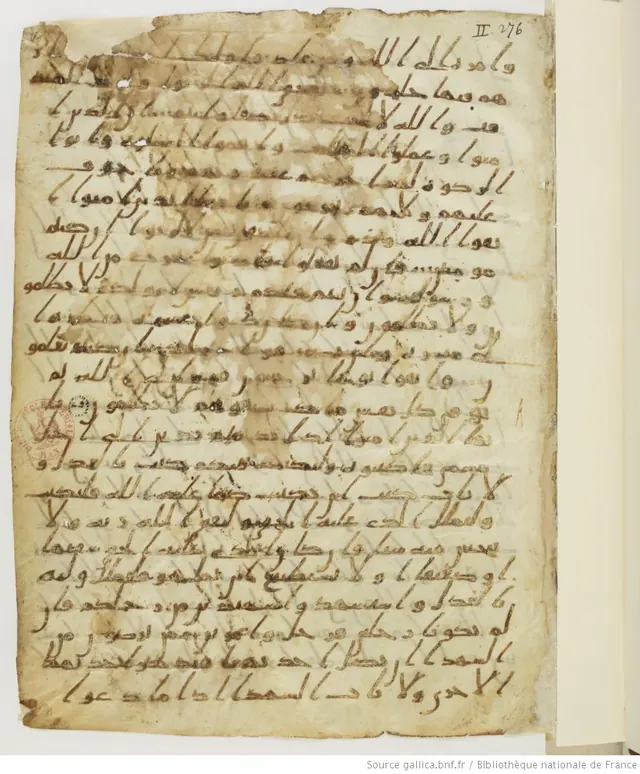
Codex Parisino-petropolitanus, c. late 7th–early 8th century
Codex Parisino-petropolitanus, c. late 7th–early 8th century · credit
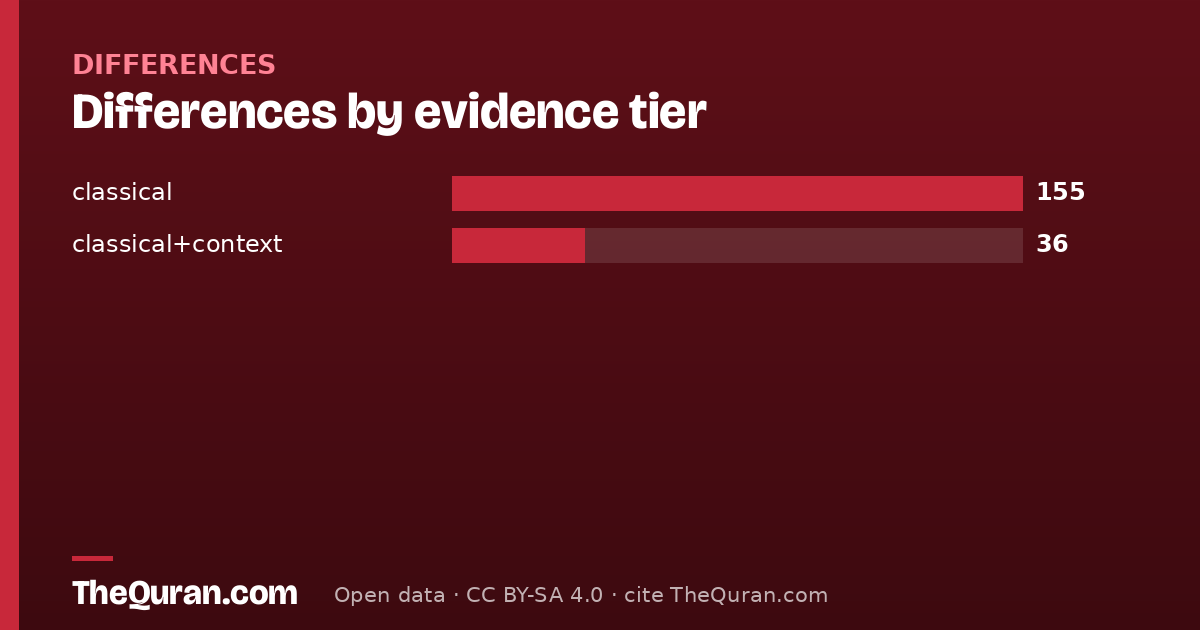
items
214201 original · 13 proposed
verses covered
3616% of 6,236
suras
43of 114
cite a source
100%0 cite none
Browse by category

The old site's categories

Each item is filed under one category from the old site's list (its most specific one); the other categories it carries still show as tags.

All category tags

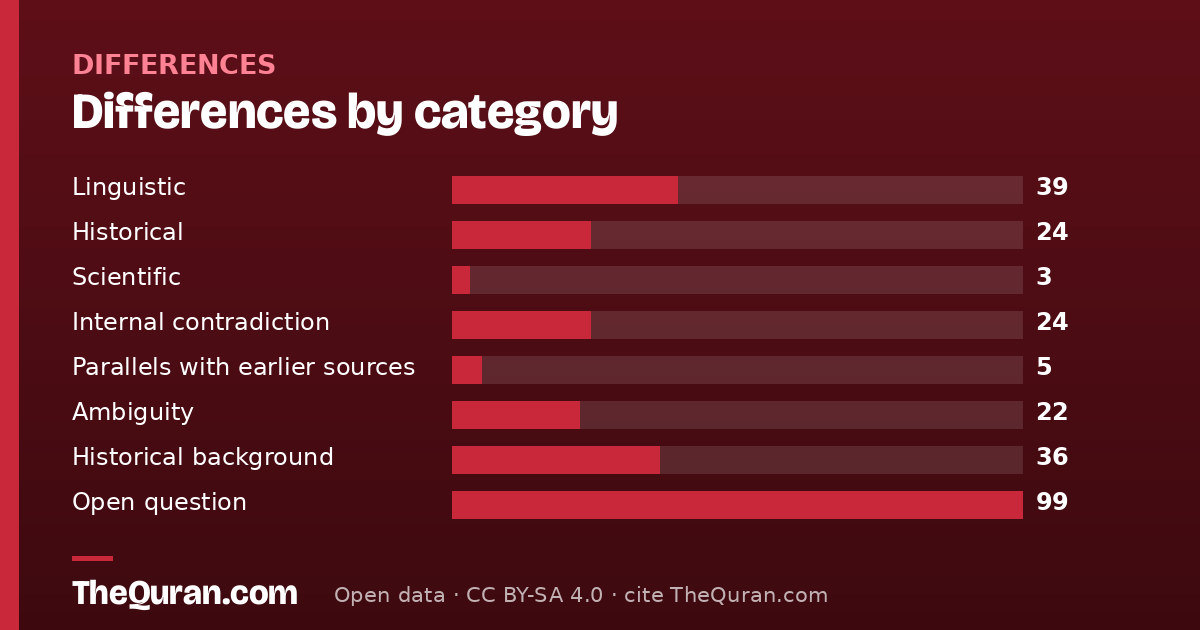
What the questions are about

  1. Open question · old label “Question” 105 49%
  2. Linguistic 42 20%
  3. Historical background · old label “Historical Background” 39 18%
  4. Historical 31 14%
  5. Internal contradiction · old label “Quranic Contradiction” 29 14%
  6. Ambiguity 25 12%
  7. Parallels with earlier sources · old label “Copied from other sources” 7 3%
  8. Scientific 4 2%
  9. Numerical 2 1%
  10. Geographical 1 0%

original site proposed · an item can carry more than one category, so the bars sum to more than 214.

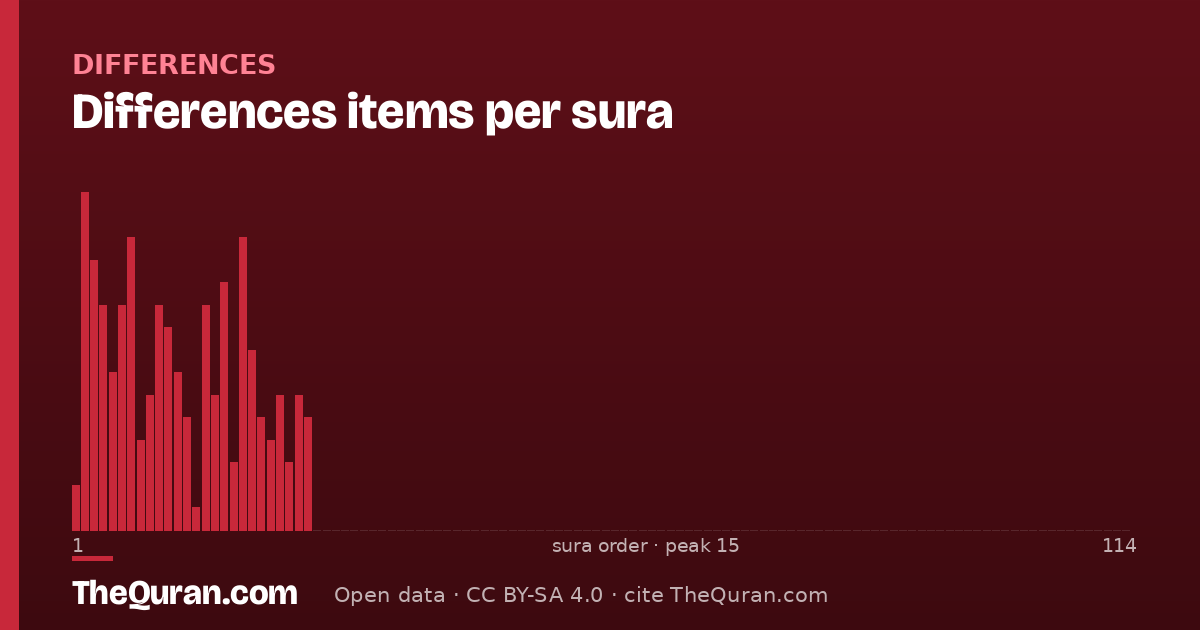
Across the Qur'an

Items per sura

1114sura order · darker = more items · none = blank
11 items · page 1 of 1 Clear
  1. 4:1622 verses Linguistic Argument The verse contains a contradiction to Arabic grammatical rules. The verse in Arabic uses the wrong grammatical case: hadhān instead of hadhāīn for “the twain.” ‘Ā’isha, the favorite wife of Muhammad, conceded that human error was…
  2. 7:1244 verses Historical Argument added in review Crucifixion in Pharaoh’s Egypt Pharaoh threatens the magicians who believed Moses: “I will cut off your hands and feet on opposite sides, then I will crucify you all” (7:124; also 20:71, “on the trunks of palm trees”, and 26:49). At 12:41 Joseph tells a fellow…
  3. 20:5 Open question Argument The verse states that Allah “settled on the throne,” meaning that he sat down. This image describes Allah as having a body. The belief that Allah has a body is incompatible with the Muslim view that Allah is beyond description. T…
  4. 20:7 Open question Argument The meaning of wa-akhfa, translated by Palmer as “and more hidden still”, is confusing. Muslim exegetes offer the following explanations: Self-talk that a person has not done yet. Just self-talk. Plan that is about to be executed…
  5. 20:12 Ambiguity Argument The verse states that Moses received inspiration in a sacred valley called Ţuwā. According to Islamic scholars, Ţuwā is a valley in al-Shām (Syria). This fact contradicts the Torah narrative that states Moses was in Mount Horeb (…
  6. 20:38 Internal contradiction Argument It is clear from this text that Pharaoh ordered the killing of children when Moses was young. Yet the Qur’ān also states that the command to kill was given when Moses was a prophet and spoke the truth (Q 40.23-25). (This contradi…
  7. 20:39 Internal contradiction Argument It is clear from this text that Pharaoh ordered the killing of children when Moses was young. Yet the Qur’ān also states that the command to kill was given when Moses was a prophet and spoke the truth (Q 40.23-25). (This contradi…
  8. 20:67 Linguistic Argument The name Moses appears at the end of the verse in Arabic to keep the rhyme. Grammatically, it should have come after the verb in keeping with the more typical Arabic sentence structure, where the subject comes after the verb.
  9. 20:70 Linguistic Argument The name Aaron comes before Moses, when he is a follower of Moses. The reason “Aaron” is mentioned first is to keep the rhyme. Moses should have been mentioned first because of his centrality to the verse and the narrative here.
  10. 20:96 Historical Argument According to Muslim exegetes, what is mentioned in the verse is that the Samaritan saw “the footprint of the messenger”. The Samaritan took a handful of dirt from the footprint of the horse and cast it into the fire, saying, “‘Be…
  11. 20:129 Linguistic Argument There is disorder in the structure of this verse, clearly seen by Palmer’s attempt to add words, i.e., “(the punishment)…(at),” to make sense of it. The words “it would have been inevitable” should have been written at the end. T…