TheQuran.com
Differences Analysis · argument tier

Questions raised about the text

Linguistic, historical, scientific and internal-consistency questions, verse by verse. Each item is an argument, with the sources it cites and a place for the responses.

Codex Parisino-petropolitanus, c. late 7th–early 8th century
Codex Parisino-petropolitanus, c. late 7th–early 8th century · credit
items
191191 original · 0 proposed
verses covered
3035% of 6,236
suras
26of 114
cite a source
100%0 cite none
Browse by category

The old site's categories

Each item is filed under one category from the old site's list (its most specific one); the other categories it carries still show as tags.

All category tags

What the questions are about

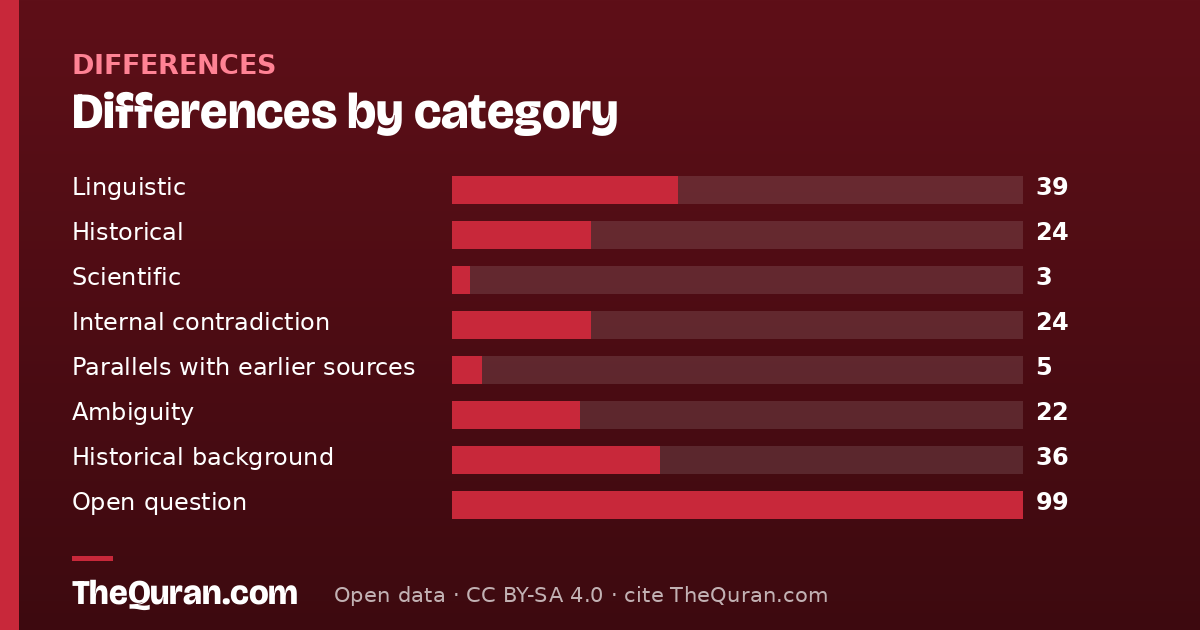
  1. Open question · old label “Question” 99 52%
  2. Linguistic 39 20%
  3. Historical background · old label “Historical Background” 36 19%
  4. Historical 24 13%
  5. Internal contradiction · old label “Quranic Contradiction” 24 13%
  6. Ambiguity 22 12%
  7. Parallels with earlier sources · old label “Copied from other sources” 5 3%
  8. Scientific 3 2%
  9. Geographical 0 0%
  10. Numerical 0 0%

original site proposed · an item can carry more than one category, so the bars sum to more than 191.

Across the Qur'an

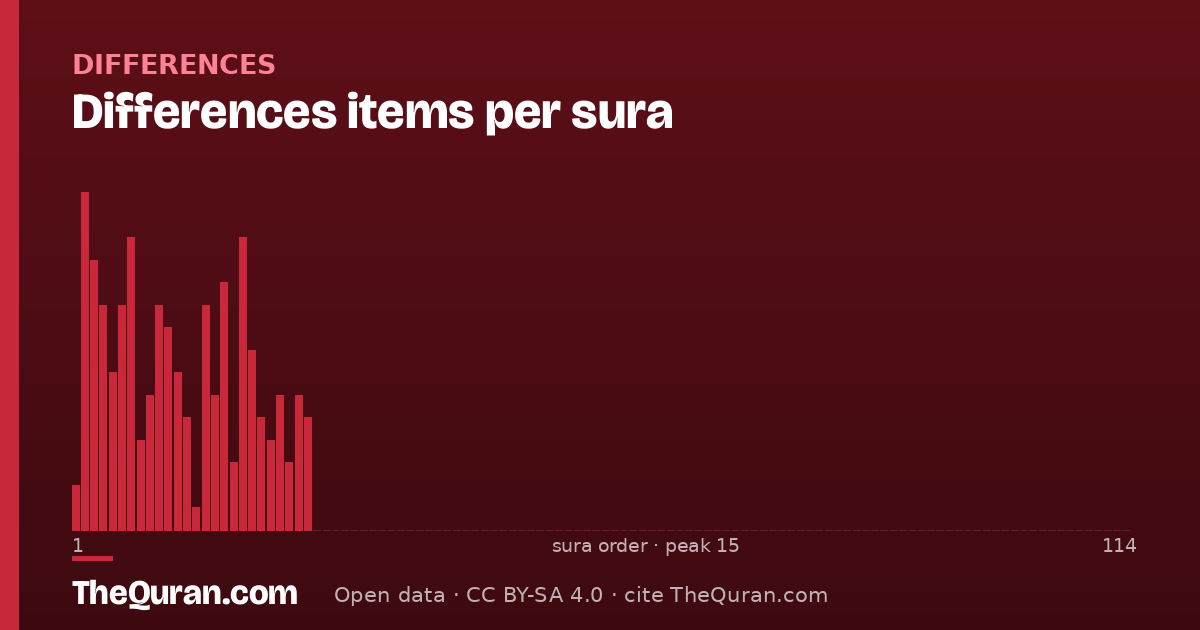
Items per sura

1114sura order · darker = more items · none = blank
191 items · page 3 of 5
  1. 10:21 Open question Argument The verse states that idolaters use a stratagem, a cleverly contrived trick, against Allah and then adds that Muḥammad should inform them that Allah is swifter than they are at scheming a stratagem: “God [Allah] is quicker at str…
  2. 10:23 Linguistic Argument The verse in Arabic has a linguistic problem. It states, “they wrong…without just cause,” even though the verb bighayri al-ḥaqqi (“to wrong”) means to transgress by treating someone unjustly. In other words, the verb “to wrong” a…
  3. 10:28 Internal contradiction Open question Argument The verse states that Allah speaks to people on the Day of Judgment. This matter is confirmed by another verse: “But, by thy Lord! we will question them, one and all…” (Q 15.92). Conversely, another verse states that Allah does n…
  4. 10:53 Open question Argument The Quraysh asked Muḥammad, “whether it be true.” According to Islamic commentaries, the question refers to the authenticity of Muḥammad’s claim of prophethood and the veracity of the Qur’ān. Another suggestion claims that the qu…
  5. 10:61 Linguistic Argument This verse addresses Muḥammad. As translated by Palmer, the addressee is spoken to at times in the Arabic singular (takūnu) as “thou,” as in “thou be… thou recite,” and other times in the Arabic plural (takūnū(ā)) as “ye,” as in …
  6. 10:64 Internal contradiction Argument The Qur’ān declares in Q 10.64 that Allah does not change his words. Islamic commentators explain “words” as “sayings and promises". Al-Zamakhsharī explains that the phrase “‘there is no changing the words of God’” as “no changin…
  7. 10:754 verses Ambiguity Argument According to the context of these verses, Moses asks Pharaoh and his people to believe in the faith of Moses and abandon the faith of their ancestors. This request is clearly seen in verse 78, and Islamic commentator al-Rāzī stat…
  8. 10:88 Ambiguity Argument This verse describes Moses calling on his Lord to destroy the splendor and riches of Pharaoh and his chiefs, wealth that Moses acknowledges was bestowed by God on his enemies. But Moses asks for more than the destruction of his e…
  9. 10:94 Ambiguity Argument This verse addresses Muḥammad. It instructs Muḥammad to ask those who have read the Book before him whenever he is in doubt concerning the veracity of the revelation. Al-Zamakhsharī comments, “As if it was said: if you were to do…
  10. 11:12 Open question Argument This verse describes Muḥammad’s hesitancy towards his people about dropping parts of the Qur’ān that displease them. It is as if the verse is asking, “Muḥammad, are you thinking about hiding parts of the verses of the Qur’ān? Are…
  11. 11:34 Open question Argument In this verse, Noah declares his inability to convince his people to believe if Allah’s will is to lead them into sin. Based on this verse, al-Qurṭubī rejects the opinion of some Muslim scholars who believe that humans are free t…
  12. 11:40 Open question Argument The verse states that the Flood was preceded by the eruption of tannūr, which normally means “oven.” However, Muslim scholars disagree about this word’s meaning here in this verse and offer the following opinions: Tannūr refers t…
  13. 11:44 Historical Argument According to the Islamic narrative, the journey’s end for Noah’s boat occurs when it settles on a mountain called “Gûdî.” The choice of this mountain for landing, according to Islamic commentators, is mentioned in two of the earl…
  14. 11:5010 verses Historical Open question Argument Islamic commentators mention that Hūd is the son of ‘Abd Allah Ibn Rabāh Ibn al-Julūd Ibn ‘Ād Ibn ‘Aws Ibn Irm Ibn Sam Ibn Noah. They also state that Hūd was sent as a messenger to ‘Ād, a pagan tribe in the region of Hadramout in…
  15. 11:702 verses Open question Argument Regarding the story’s elements and sequence, this verse has two issues: Alternate versions The text of Q 11.70 states that when the guests of Ibrāhīm (Abraham) did not eat of his food, “he could not understand them, and harboured…
  16. 11:83 Linguistic Argument The word ba‘īdin (“far”) in the verse is masculine. It should have been feminine as it is the adjective of hiya (“she”), translated as “these” in the verse. Proper grammar was sacrificed to keep the rhyme (al-fāṣila) of the verse.
  17. 11:105 Open question Argument The verse states that no one will be allowed to speak on the Day of Judgment except by Allah’s permission. However, the Qur’ān states in Q 16.111, “On the day every soul will come to wrangle for itself.” The Qur’ān also states in…
  18. 11:1182 verses Open question Argument The verse states that Allah created people to be different. What is understood from the context is that the difference is a “difference in religions,” an opinion held by the majority of Islamic commentators. However, another opin…
  19. 12:2 Linguistic Open question Argument According to the verse, God announces, “Surely, we have revealed it-- an Arabic Quran-- that you may understand.” The Qur’an repeatedly declares its Arabic calling and outstanding eloquence. Upon reading such verses, one cannot h…
  20. 12:15 Linguistic Argument No obvious predicate concludes the opening clause in this verse: “And when they had gone off with him and agreed to put him in the depths of the pit….” Al-Qurţubī suggests three possible conclusions: The phrase “and we inspired h…
  21. 12:303 verses Open question Argument This text contains the story of the women who mock Zelicha because of her infatuation with Joseph and Zelicha’s response to “their malicious talk.” She invites these women to a banquet in her home, so that they too would be dazzl…
  22. 12:52 Ambiguity Argument Unlike the Palmer English translation, “(said Joseph),” the current Arabic Qur’ān does not remove the ambiguity regarding the speaker in this verse. Islamic commentators offer two opinions regarding the speaker’s identity: The sp…
  23. 12:83 Historical Argument Jacob tells his sons upon their return from Egypt, “It may be that God will give me them all together.” What does the reference “them all” mean here? According to al-Bayďāwī, Jacob is referring to Joseph and Benjamin and their br…
  24. 12:93 Historical Open question Argument It is not clear in the verse how the shirt would return sight to Jacob. The Islamic literature provides an attempt to explain this mystery by stating that the shirt originally belonged to Abraham. It was sent to him from heaven, …
  25. 12:106 Open question Argument In this verse, how could “most of them” believe in Allah and yet continue to worship other gods? ĢanafÏ Muslim exegete Muģammad al-Rāzī attempts to resolve this situation by offering several explanations: The phrase “most of them…
  26. 13:2 Scientific Argument The verse likens the heavens to a ceiling, stating that Allah raised the heavens without columns. This image is asserted by Islamic commentators but with two opinions regarding the interpretation of “without columns that ye can s…
  27. 13:33 verses Scientific Open question Argument Islamic commentaries explain rawāsī to mean “steadfast or firm.” Al-Qurţubī explains that the earth is anchored by the mountains and thus made steady. Islamic commentator Ibn Kathīr presents a theory adopted by the commentators c…
  28. 13:74 verses Open question Argument Some of the Quraysh requested Muamhmad to bring forth a miracle to prove the authenticity of his claim of being a prophet (verse 7). He responded, “God knows what each female bears, and what the wombs fall short of or add…” (vers…
  29. 13:13 Historical Argument This verse presents two issues: Personification and symbolism of thunder The verse states that the thunder celebrates the praises of Allah. The expression “the thunder celebrates His praise” is explained as “thunder magnifies All…
  30. 13:27 Open question Argument The people of Mecca demanded that Muhammad give them tangible miracles. According to Islamic commentators, the people of Mecca asked that an angel appear with him or that Muhammad would bring out to them a treasure. But what was …
  31. 14:28 Ambiguity Argument The verse singles out an unnamed group of people as “those who have changed God’s favours for misbelief.” Islamic scholars offer the following possibilities for this group of people: Quraysh “Hypocrites”. Quraysh tribesmen who fo…
  32. 15:9 Linguistic Argument Allah states in this verse, “Verily, we have sent down the Reminder, and, verily, we will guard it.” Al-Ţabarī explains that this verse means that Allah “verily will guard the Qur’ān from any false addition of what is not part of…
  33. 15:103 verses Open question Argument The text contains an address to Muhammad, stating that every messenger who came “before thee” (verse 10) was “mocked” (verse 11). The following text (verse 12) states that mockery is “put” by Allah into the hearts of misbelievers…
  34. 15:172 verses Open question Argument The Qur’ān explains in these verses an astronomical phenomenon: the shooting star. According to Islamic commentators, verse 17 states that the lower heaven has been kept away from every devil except the one who eavesdrops; he is …
  35. 15:26 Open question Argument The verse states that Adam was created from “crackling clay of black mud wrought in form.” The salsāl (“crackling clay”) is the dry mud that, when baked, becomes clay. The hama’ al-masnūn (“black mud”) is the mud that turns black…
  36. 15:2815 verses Open question Argument Although Iblīs’ refusal to bow to Adam in adoration is first mentioned in Q 2.34, both instances (Q 2.34 and Q 15.33) have generated puzzling explanations by Muslim scholars that appear contradictory to other teachings of the Qur…
  37. 15:493 verses Open question Argument The verse contains an address to Muhammad ordering him to tell the Quraysh that Allah is “the pardoning, the merciful” and that Allah’s punishment is a “grievous woe.” Then the text continues, “And inform them concerning Abraham’…
  38. 15:72 Linguistic Argument In this verse Islamic commentators are divided concerning the identity of the addressee into two opinions: The addressee is Muhammad, and the verse means, “By your life, O Muhammad, your people of the Quraysh are ‘in their intoxi…
  39. 15:80 Linguistic Argument The verse states that the “fellows of El ‘Hajr” (said to be the people of Thamūd) “called the messengers liars” without stating which messenger. Islamic commentators state that this messenger is Šālih. To justify the plural “mess…
  40. 15:902 verses Linguistic AmbiguityOpen question Argument Some Islamic scholars offer these speculations regarding the identity of al-muqtasimīna (“the dividers”; Palmer trans.“the separatists”): The dividers are those who fanned out along the roads of Mecca during special occasions, e.…