TheQuran.com
Differences Analysis · argument tier

Questions raised about the text

Linguistic, historical, scientific and internal-consistency questions, verse by verse. Each item is an argument, with the sources it cites and a place for the responses.

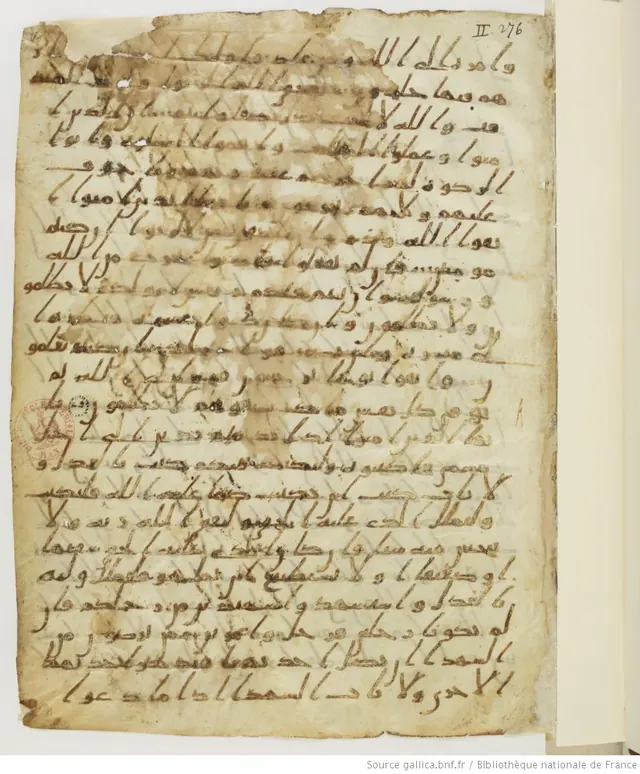
Codex Parisino-petropolitanus, c. late 7th–early 8th century
Codex Parisino-petropolitanus, c. late 7th–early 8th century · credit
items
214201 original · 13 proposed
verses covered
3616% of 6,236
suras
43of 114
cite a source
100%0 cite none
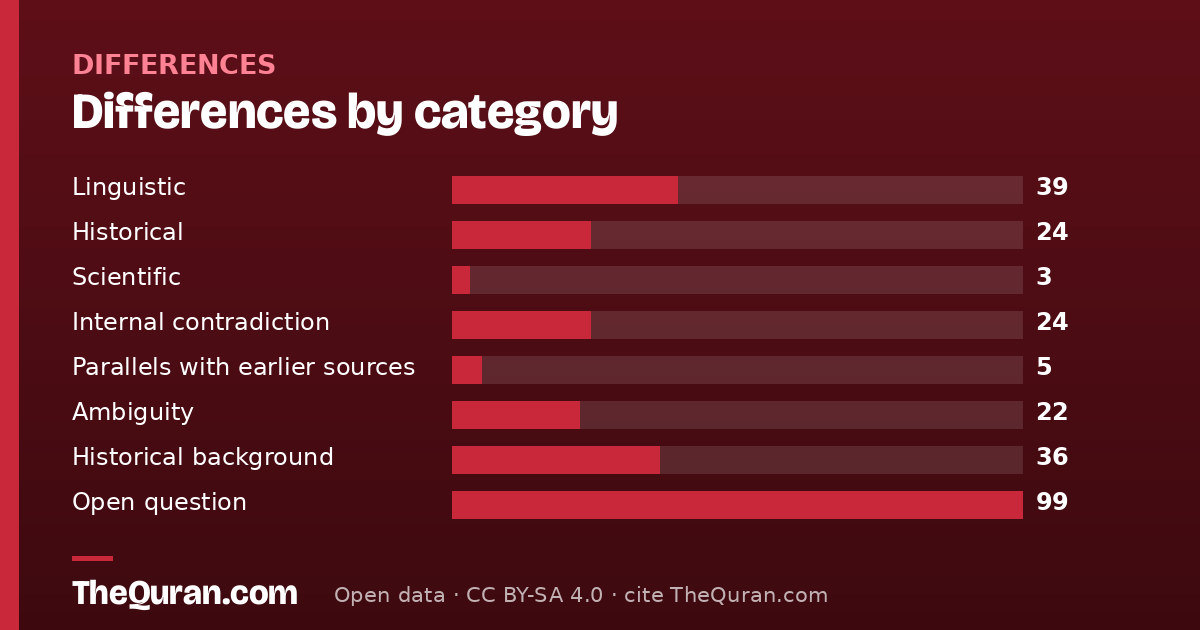
Browse by category

The old site's categories

Each item is filed under one category from the old site's list (its most specific one); the other categories it carries still show as tags.

All category tags

What the questions are about

  1. Open question · old label “Question” 105 49%
  2. Linguistic 42 20%
  3. Historical background · old label “Historical Background” 39 18%
  4. Historical 31 14%
  5. Internal contradiction · old label “Quranic Contradiction” 29 14%
  6. Ambiguity 25 12%
  7. Parallels with earlier sources · old label “Copied from other sources” 7 3%
  8. Scientific 4 2%
  9. Numerical 2 1%
  10. Geographical 1 0%

original site proposed · an item can carry more than one category, so the bars sum to more than 214.

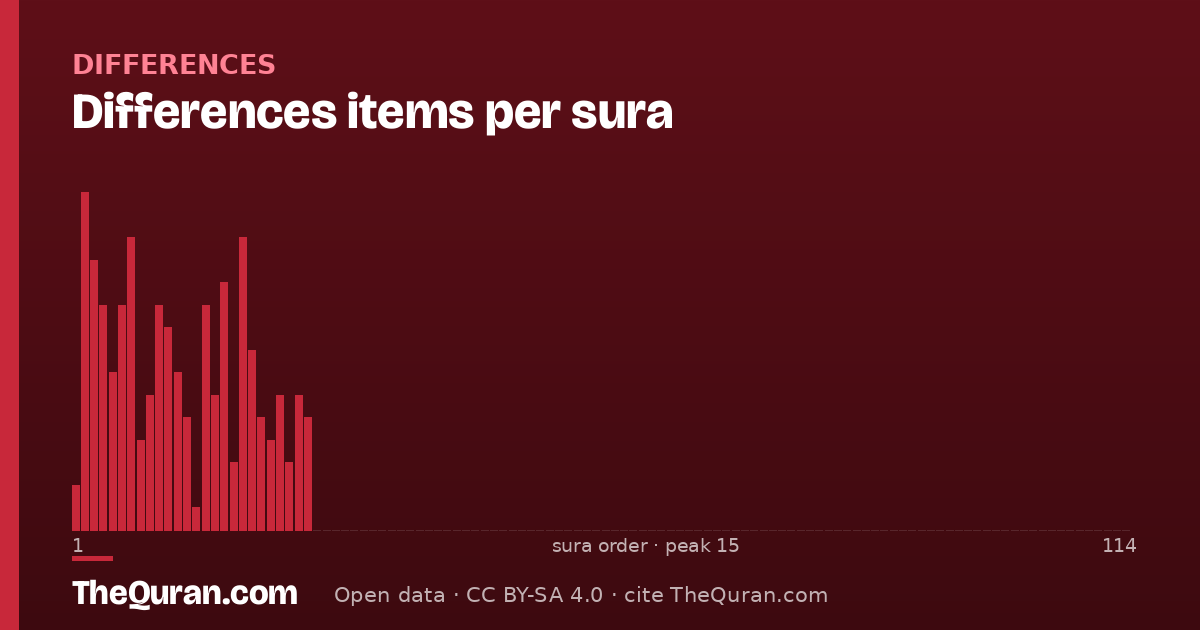
Across the Qur'an

Items per sura

1114sura order · darker = more items · none = blank
8 items · page 1 of 1 Clear
  1. 7:1244 verses Historical Argument added in review Crucifixion in Pharaoh’s Egypt Pharaoh threatens the magicians who believed Moses: “I will cut off your hands and feet on opposite sides, then I will crucify you all” (7:124; also 20:71, “on the trunks of palm trees”, and 26:49). At 12:41 Joseph tells a fellow…
  2. 26:152 verses Parallels with earlier sources Argument Allah addresses Moses and Aaron in this verse. There are two problems in the Arabic grammar of the verse. First, the word ma‘kum is translated “with you” by Palmer. To be grammatically correct in the Arabic dual form (al-muthanna…
  3. 26:454 verses Open question Argument The discourse here concerns a competition between Moses and some of the Pharaoh’s magicians. Moses wins the competition—and their conversion—when he uses his rod to swallow up their ropes and rods. However, this detail in verses …
  4. 26:83 Parallels with earlier sources Argument Here, Abraham asks God to give him judgment. The meaning of “judgment” is not clear in the verse. Islamic commentaries suggest three interpretations: (1) “wisdom,” (2) “to judge among people fairly,” or (3) “the prophethood” beca…
  5. 26:195 Parallels with earlier sources Argument Allah declares through this verse that his revelations came down “in plain Arabic language.” Other translations include “in the perspicuous Arabic tongue” (Yusuf Ali trans.), “in a perfect Arabic tongue” (Khalifa trans.), and “in…
  6. 26:2103 verses Open question Argument The text states that the devils did not descend with the Qur’ān. However, in another place the Qur’ān states that Satan interfered in the process of revelation and spoke through Muḥammad. (See the critical analysis of Q 22.52, Qu…
  7. 26:223 Open question Argument The topic of the discussion here is about the diviners or the devils. The verse states that “but most of them are liars,” which suggests that some diviners or devils are truthful.
  8. 26:2275 verses Historical background Open question Argument added in review Verses added after an objection 26:224–226 condemn poets. 26:227 then makes an exception for believing poets. Classical sources say the exception was revealed for the Prophet's own poets, and that 33:35 (naming women alongside men) was revealed after a woman co…