TheQuran.com
Differences Analysis · argument tier

Questions raised about the text

Linguistic, historical, scientific and internal-consistency questions, verse by verse. Each item is an argument, with the sources it cites and a place for the responses.

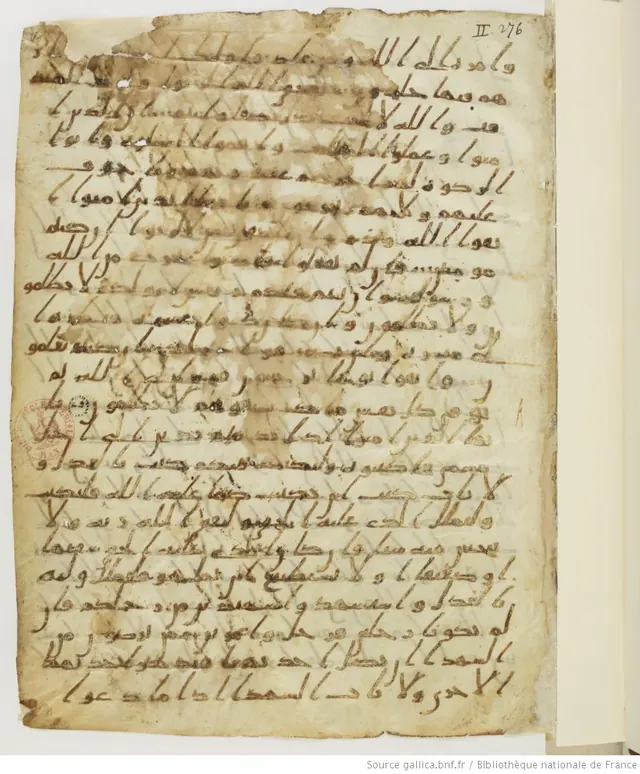
Codex Parisino-petropolitanus, c. late 7th–early 8th century
Codex Parisino-petropolitanus, c. late 7th–early 8th century · credit
items
214201 original · 13 proposed
verses covered
3616% of 6,236
suras
43of 114
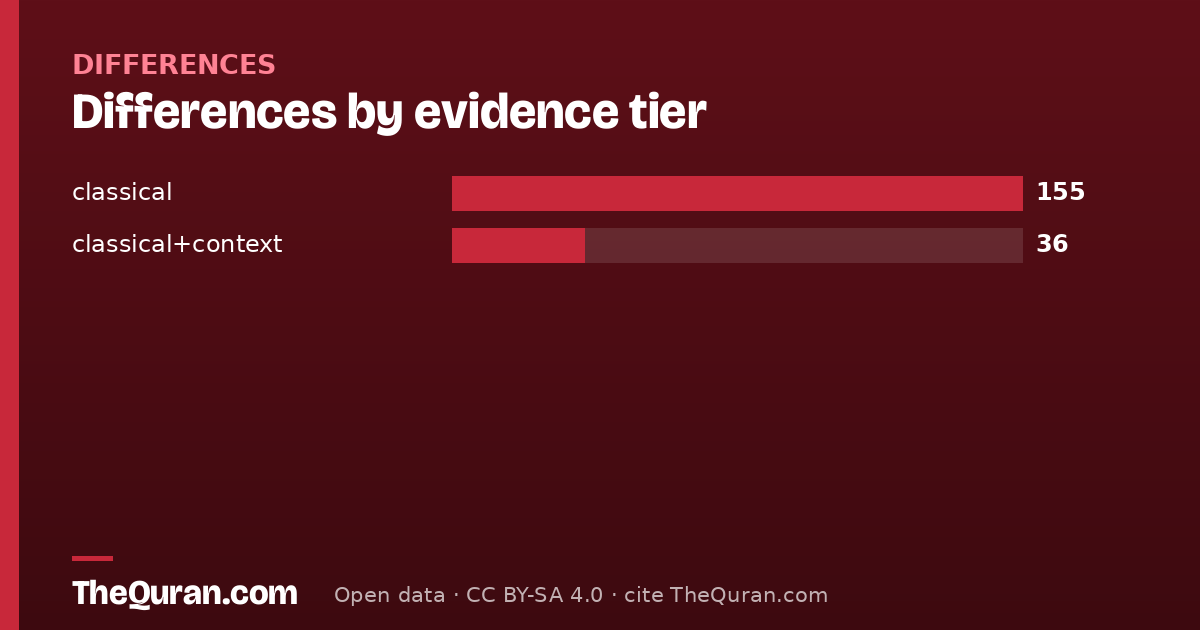
cite a source
100%0 cite none
Browse by category

The old site's categories

Each item is filed under one category from the old site's list (its most specific one); the other categories it carries still show as tags.

All category tags

What the questions are about

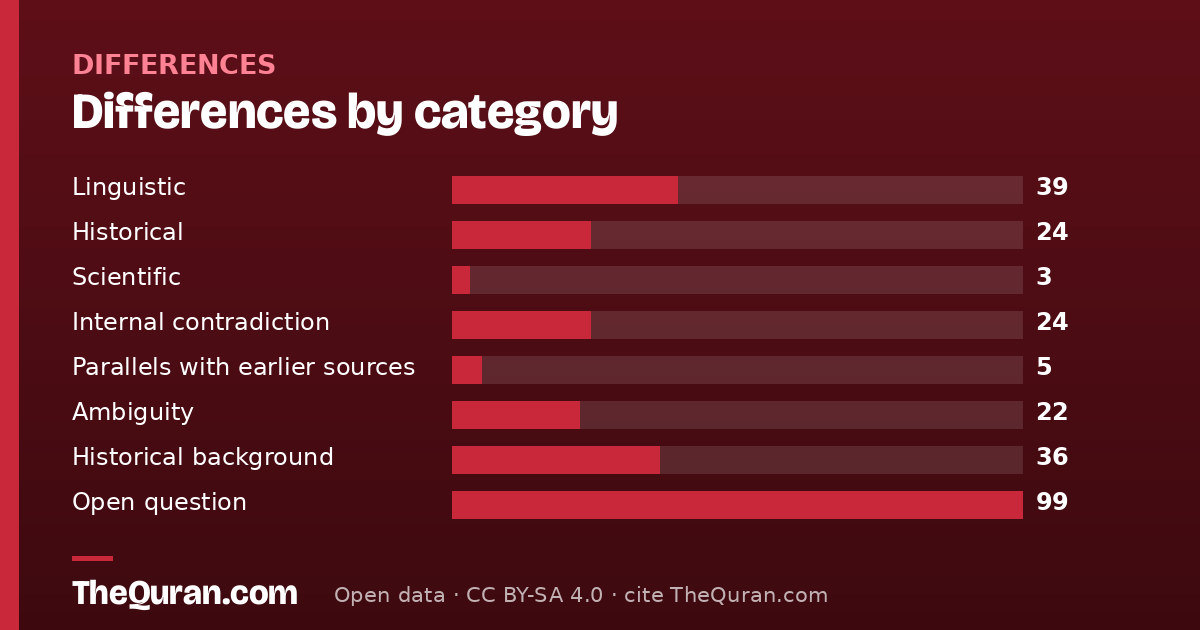
  1. Open question · old label “Question” 105 49%
  2. Linguistic 42 20%
  3. Historical background · old label “Historical Background” 39 18%
  4. Historical 31 14%
  5. Internal contradiction · old label “Quranic Contradiction” 29 14%
  6. Ambiguity 25 12%
  7. Parallels with earlier sources · old label “Copied from other sources” 7 3%
  8. Scientific 4 2%
  9. Numerical 2 1%
  10. Geographical 1 0%

original site proposed · an item can carry more than one category, so the bars sum to more than 214.

Across the Qur'an

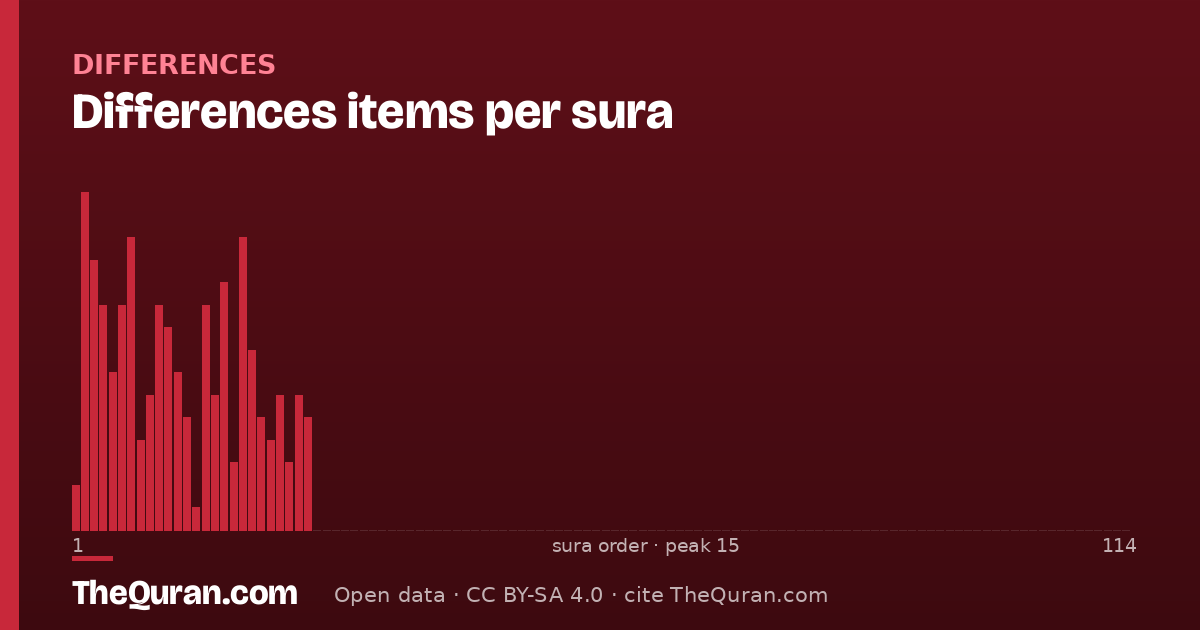
Items per sura

1114sura order · darker = more items · none = blank
17 items · page 1 of 1 Clear
  1. 2:602 verses Historical Argument The verse informs us that Moses sought to find a water source for his people. The Lord commanded him to strike “the rock” with his staff. The rock split and “and from it burst forth twelve springs” (Q 2.60; Q 7.160). The verse mi…
  2. 2:652 verses Historical Argument This verse talks about the residents of a Jewish village who break the sanctity of the Sabbath. The exegetes explain that these Jews defiled the Sabbath by fishing on that day, “so Allah metamorphosed them into monkeys because of…
  3. 7:4 Linguistic Argument Literally, this verse reads, “How many towns have we caused to be destroyed, then our punishment took her [it] on a sudden by night....” How did the destruction come? Did it come first and then the punishment came after? Does not…
  4. 7:13 Open question Argument In this verse, Allah orders Satan to leave heaven, for he is not allowed to exalt himself there, as if the passage implies that it is allowable for Satan to exalt himself on earth. Al-T. abarī responded to this ambiguity: [T]he m…
  5. 7:16 Open question Argument After Satan was ordered to leave al-Janna, he accused Allah of being the one who tempted him: “I will repel the sons of Adam from worshipping and obeying You; I will lure them as You lured me and mislead them as You misled me.” T…
  6. 7:54 Ambiguity Historical background Argument The verse describes the attribute of Allah that he has the right to create and command. Based on this idea, the linguists said that the words of Allah are ancient (eternal), not caused (or created). They declared that Allah “dist…
  7. 7:1177 verses Internal contradiction Historical Argument This story recounts a competition arranged by Pharaoh between Moses and a band of sorcerers that ends in Moses’ victory. As a result, the sorcerers declare their belief in “the Lord of Moses and Aaron” (Q 7.117-122; Q 20.69-73; Q…
  8. 7:1244 verses Historical Argument added in review Crucifixion in Pharaoh’s Egypt Pharaoh threatens the magicians who believed Moses: “I will cut off your hands and feet on opposite sides, then I will crucify you all” (7:124; also 20:71, “on the trunks of palm trees”, and 26:49). At 12:41 Joseph tells a fellow…
  9. 7:127 Internal contradiction HistoricalHistorical background Argument This verse says that some Egyptian leaders asked Pharaoh if he would take any action against Moses and the Israelites. The passage does not clearly state what Moses and the Israelites had done, referring only to their spreading “…
  10. 7:1282 verses Historical Argument This text refers to a promise made by Moses to the people of Israel, stating that they will inherit the land of Egypt. While the verse does not specifically say “Egypt,” verse 129 talks about Allah destroying the enemy (in this c…
  11. 7:133 Historical Argument This verse mentions only five plagues that fell on the Egyptians: “Then we sent upon them the flood and the locusts and the lice and the frogs and the blood....” However, according to the biblical account, ten plagues were sent a…
  12. 7:148 Parallels with earlier sources Historical Argument This verse recounts the story of a calf idol being made from the golden ornaments. The verse refers to the calf as a body “with a khuwār [mooing sound]”. In another reading ascribed to ‘Alī Ibn Abī Talib, the verse reads “he has …
  13. 7:157 Open question Argument The verse describes Muhammad as the ummī prophet, translated by Palmer as “the illiterate prophet”. The exegetes explain that the meaning of the ummī prophet is one who is sent to the Arabs (who were an illiterate people). The ve…
  14. 7:161 Linguistic Argument This verse states “and say ‘hittatun and enter the gate adoring....’” However, the words seem to have been rearranged. Elsewhere in the Qur’ān, the order is stated this way: “and enter the gate worshipping and say ‘hittatun....” …
  15. 7:176 Open question Argument This verse likens the unbeliever to a dog: “and his likeness was as the likeness of a dog, whom if thou shouldst attack he hangs out his tongue, or if thou should leave him, hangs out his tongue too...” (Q 7.176). The verse uses …
  16. 7:190 Linguistic Argument This verse refers to Adam and Eve. (See verse 189.) It tells us that after they were blessed with a son, they associated others with Allah (became idolaters). Again there is a problem in the Arabic text that is not apparent in th…
  17. 41:96 verses Internal contradiction Numerical Argument added in review Six days, or eight? Elsewhere creation takes six days (7:54; 50:38). 41:9–12 counts the earth in two days, its mountains and provisions “in four days”, and the seven heavens in two: eight if added. Al-Qurṭubī reads “in four days” as “completing four…