TheQuran.com
Differences Analysis · argument tier

Questions raised about the text

Linguistic, historical, scientific and internal-consistency questions, verse by verse. Each item is an argument, with the sources it cites and a place for the responses.

Codex Parisino-petropolitanus, c. late 7th–early 8th century
Codex Parisino-petropolitanus, c. late 7th–early 8th century · credit
items
191191 original · 0 proposed
verses covered
3035% of 6,236
suras
26of 114
cite a source
100%0 cite none
Browse by category

The old site's categories

Each item is filed under one category from the old site's list (its most specific one); the other categories it carries still show as tags.

All category tags

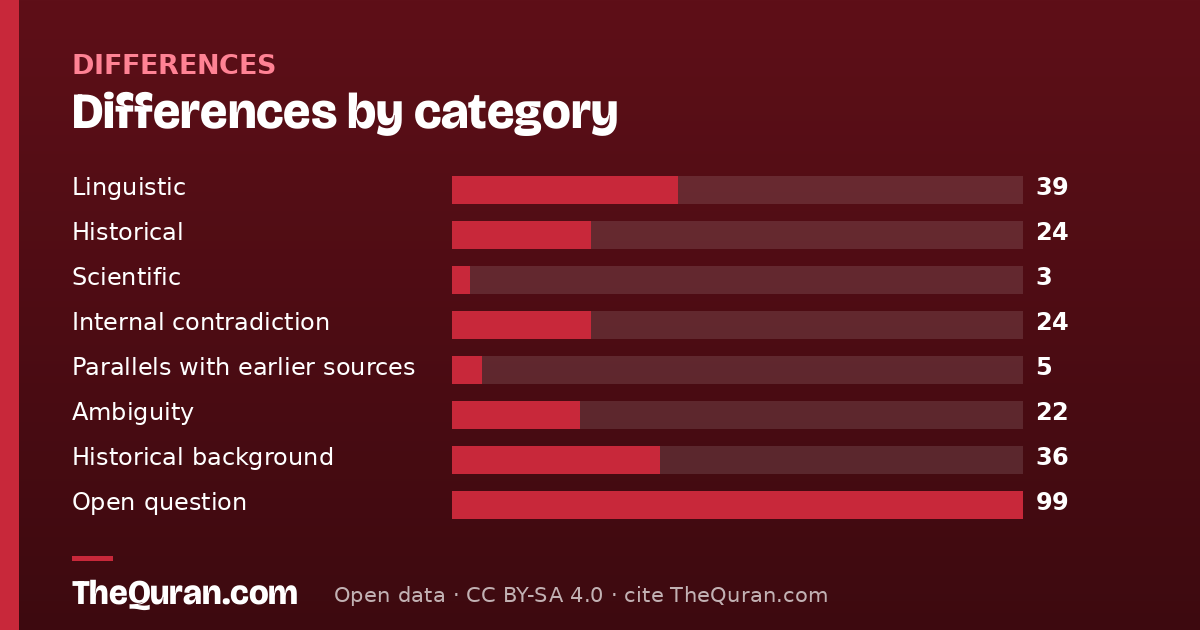
What the questions are about

  1. Open question · old label “Question” 99 52%
  2. Linguistic 39 20%
  3. Historical background · old label “Historical Background” 36 19%
  4. Historical 24 13%
  5. Internal contradiction · old label “Quranic Contradiction” 24 13%
  6. Ambiguity 22 12%
  7. Parallels with earlier sources · old label “Copied from other sources” 5 3%
  8. Scientific 3 2%
  9. Geographical 0 0%
  10. Numerical 0 0%

original site proposed · an item can carry more than one category, so the bars sum to more than 191.

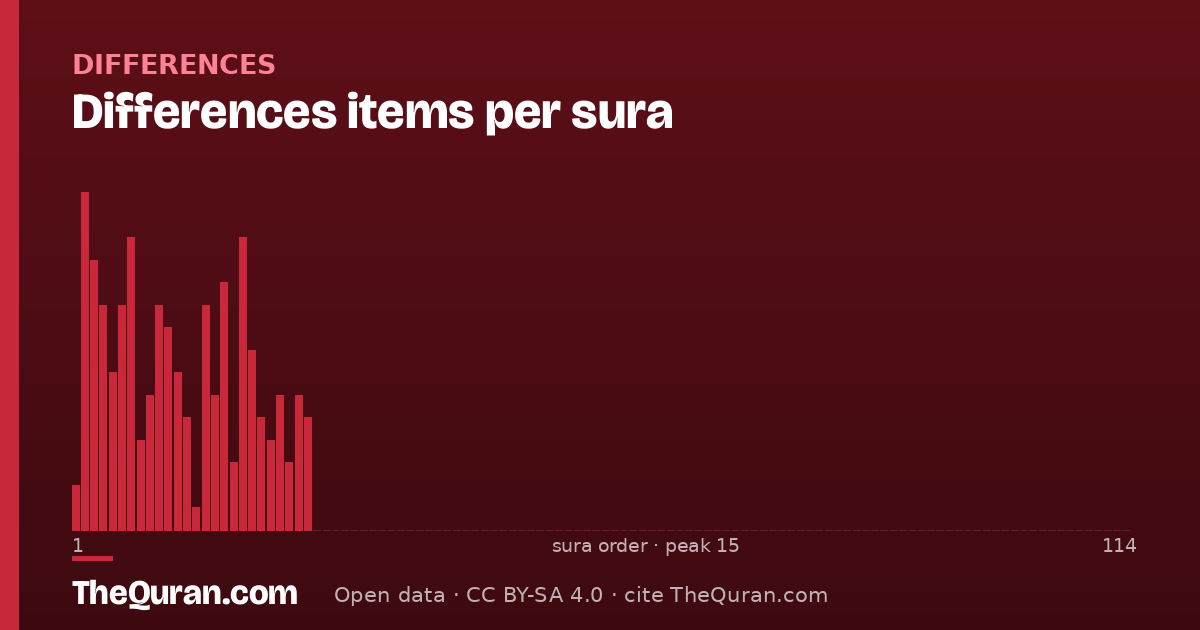
Across the Qur'an

Items per sura

1114sura order · darker = more items · none = blank
83 items · page 2 of 3 Clear
  1. 9:28 Open question Argument The verse describes the mushrikūn (blasphemers, idolaters) as najasun (the unclean, defiled, impure). Some exegetes explain the description najasun to be an abstraction for their insult and contempt. Others say that the reason th…
  2. 9:79 Open question Argument The verse states that Allah ridicules those who ridicule Muslims. Is portraying Allah as a cynic consistent with Allah’s transcendence? (Compare the comment on Q 3.54, where Allah is described as a deceiver).
  3. 10:20 Open question Argument The verse shows that the Quraysh wished Muḥammad would perform a miracle, sent down from Allah, as evidence of his prophetic claims. Muḥammad responded that such a demand is among the unseen things that only Allah knows, adding, …
  4. 10:21 Open question Argument The verse states that idolaters use a stratagem, a cleverly contrived trick, against Allah and then adds that Muḥammad should inform them that Allah is swifter than they are at scheming a stratagem: “God [Allah] is quicker at str…
  5. 10:28 Internal contradiction Open question Argument The verse states that Allah speaks to people on the Day of Judgment. This matter is confirmed by another verse: “But, by thy Lord! we will question them, one and all…” (Q 15.92). Conversely, another verse states that Allah does n…
  6. 10:53 Open question Argument The Quraysh asked Muḥammad, “whether it be true.” According to Islamic commentaries, the question refers to the authenticity of Muḥammad’s claim of prophethood and the veracity of the Qur’ān. Another suggestion claims that the qu…
  7. 11:12 Open question Argument This verse describes Muḥammad’s hesitancy towards his people about dropping parts of the Qur’ān that displease them. It is as if the verse is asking, “Muḥammad, are you thinking about hiding parts of the verses of the Qur’ān? Are…
  8. 11:34 Open question Argument In this verse, Noah declares his inability to convince his people to believe if Allah’s will is to lead them into sin. Based on this verse, al-Qurṭubī rejects the opinion of some Muslim scholars who believe that humans are free t…
  9. 11:105 Open question Argument The verse states that no one will be allowed to speak on the Day of Judgment except by Allah’s permission. However, the Qur’ān states in Q 16.111, “On the day every soul will come to wrangle for itself.” The Qur’ān also states in…
  10. 11:1182 verses Open question Argument The verse states that Allah created people to be different. What is understood from the context is that the difference is a “difference in religions,” an opinion held by the majority of Islamic commentators. However, another opin…
  11. 12:303 verses Open question Argument This text contains the story of the women who mock Zelicha because of her infatuation with Joseph and Zelicha’s response to “their malicious talk.” She invites these women to a banquet in her home, so that they too would be dazzl…
  12. 12:93 Historical Open question Argument It is not clear in the verse how the shirt would return sight to Jacob. The Islamic literature provides an attempt to explain this mystery by stating that the shirt originally belonged to Abraham. It was sent to him from heaven, …
  13. 12:106 Open question Argument In this verse, how could “most of them” believe in Allah and yet continue to worship other gods? ĢanafÏ Muslim exegete Muģammad al-Rāzī attempts to resolve this situation by offering several explanations: The phrase “most of them…
  14. 13:74 verses Open question Argument Some of the Quraysh requested Muamhmad to bring forth a miracle to prove the authenticity of his claim of being a prophet (verse 7). He responded, “God knows what each female bears, and what the wombs fall short of or add…” (vers…
  15. 13:27 Open question Argument The people of Mecca demanded that Muhammad give them tangible miracles. According to Islamic commentators, the people of Mecca asked that an angel appear with him or that Muhammad would bring out to them a treasure. But what was …
  16. 15:103 verses Open question Argument The text contains an address to Muhammad, stating that every messenger who came “before thee” (verse 10) was “mocked” (verse 11). The following text (verse 12) states that mockery is “put” by Allah into the hearts of misbelievers…
  17. 15:172 verses Open question Argument The Qur’ān explains in these verses an astronomical phenomenon: the shooting star. According to Islamic commentators, verse 17 states that the lower heaven has been kept away from every devil except the one who eavesdrops; he is …
  18. 15:2815 verses Open question Argument Although Iblīs’ refusal to bow to Adam in adoration is first mentioned in Q 2.34, both instances (Q 2.34 and Q 15.33) have generated puzzling explanations by Muslim scholars that appear contradictory to other teachings of the Qur…
  19. 15:493 verses Open question Argument The verse contains an address to Muhammad ordering him to tell the Quraysh that Allah is “the pardoning, the merciful” and that Allah’s punishment is a “grievous woe.” Then the text continues, “And inform them concerning Abraham’…
  20. 15:902 verses Linguistic AmbiguityOpen question Argument Some Islamic scholars offer these speculations regarding the identity of al-muqtasimīna (“the dividers”; Palmer trans.“the separatists”): The dividers are those who fanned out along the roads of Mecca during special occasions, e.…
  21. 16:21 Open question Argument This verse presents two issues: Redundant prose The verse describes the idols as “[d]ead, not living.” The word “dead” would have been sufficient in Arabic to describe their state. Why does the verse add “not living”? What manner…
  22. 16:26 Open question Argument The Qur’ānic story in this verse does not clearly identify the mentioned group of people nor provides any clues to help the reader. To resolve this problem, Islamic commentators suggest that the verse is speaking about Nimrod and…
  23. 16:76 Open question Argument In trying to clarify the incapability of idols, Islamic commentators suggest that this verse compares an idol to a mute man. Al-Ţabarī explains that just as a mute man is a burden to his family, so is the idol a burden to his own…
  24. 17:16 Open question Argument The decree of Allah, given in the verse, states that if he wanted to destroy a city he would command “the opulent ones thereof” and they would spread abomination. In other words, when Allah decides to destroy a town, he prepares …
  25. 17:58 Open question Argument This verse forewarns that every city will face perdition before the “day of judgment”. Muslim exegetes state that all towns will either be subject to utter destruction or that killing and suffering with overtake them, including M…
  26. 17:60 Linguistic Open question Argument The text in this verse contains two issues: Word definition (“the vision”) The verse states that Muhammad’s vision became “a cause of sedition unto men.” Muslim exegetes offer different meanings for “the vision”: A true vision sh…
  27. 17:64 Open question Argument In this verse Allah responds to Iblīs by stating that Iblīs may “[e]ntice away” people and use his power to oppress them and share with them wealth and children. In their explanation of this verse, Muslim exegetes discuss the key…
  28. 17:72 Open question Argument In this verse, another example of Qur’ānic textual ambiguity, the ambiguity rests in the meaning or symbolism of the blindness and the state of blindness “in this life” and “in the next”. One opinion states that the blindness men…
  29. 17:85 Open question Argument A question was addressed to Muhammad concerning the spirit. He replied, “The spirit comes at the bidding of my Lord, and ye are given but a little knowledge thereof.” The details of this report are that a Jew suggested to the peo…
  30. 18:12 verses Linguistic Open question Argument In one section of this passage, the Arabic literally states “did not make to it crookedness that is strait.” Without his albeit helpful insertions, Sale’s translation more closely reflects the Arabic wording: “…and hath not inser…
  31. 19:30 Open question Argument This verse states that Jesus—the infant—was made to speak by Allah, declaring himself a “servant of God” (‘Abd Allah). The clear intention behind making Jesus speak as an infant in the cradle is to refute the Christian doctrine o…
  32. 19:63 Open question Argument The verse promises al-Janna (“Paradise”) to the pious worshippers, “our servants who are pious.” Question: How can there be a pious worshipper and a worshipper who is not pious? Though the Islamic commentaries ignore this issue, …
  33. 19:82 Open question Argument In this verse, the antecedent to the pronoun “they” (“They shall deny...”) is not clearly discernible. Does this pronoun refer to the worshippers or those who are being worshipped? Some Islamic scholars suggest that Allah will ra…
  34. 19:83 Open question Argument The verse discusses Allah’s granting Satan the power to lure people and lead them to deviance. (The same issue is addressed in another sura. See the critical analysis of Q 17.64).
  35. 20:5 Open question Argument The verse states that Allah “settled on the throne,” meaning that he sat down. This image describes Allah as having a body. The belief that Allah has a body is incompatible with the Muslim view that Allah is beyond description. T…
  36. 20:7 Open question Argument The meaning of wa-akhfa, translated by Palmer as “and more hidden still”, is confusing. Muslim exegetes offer the following explanations: Self-talk that a person has not done yet. Just self-talk. Plan that is about to be executed…
  37. 21:95 Open question Argument Muslim exegetes disagree concerning the meaning of this verse. Some state that the verse means that the townspeople who died may not be brought back to this life. Others state that “we have destroyed” means “we determined to dest…
  38. 21:99 Open question Argument The Pickthall translation of this verse (“If these had been gods they would not have come thither, but all will abide therein”) more closely matches the Arabic text than the Palmer translation. (Palmer mistranslates “god,” a noun…
  39. 22:47 Linguistic Open question Argument The verse informs that a day to Allah equals a thousand human years (“…a day with thy Lord is as a thousand years of what ye number”). Muslim exegetes offer varying opinions regarding this matter. Some state that the Lord’s day i…
  40. 23:6 Open question Argument The verse permits sexual intercourse between Muslim men and their female slaves, an act that is not counted as a sin for any Muslim man because the slave woman has no right to protect her body. (See the section Female Slaves in t…