TheQuran.com
Differences Analysis · argument tier

Questions raised about the text

Linguistic, historical, scientific and internal-consistency questions, verse by verse. Each item is an argument, with the sources it cites and a place for the responses.

Codex Parisino-petropolitanus, c. late 7th–early 8th century
Codex Parisino-petropolitanus, c. late 7th–early 8th century · credit
items
191191 original · 0 proposed
verses covered
3035% of 6,236
suras
26of 114
cite a source
100%0 cite none
Browse by category

The old site's categories

Each item is filed under one category from the old site's list (its most specific one); the other categories it carries still show as tags.

All category tags

What the questions are about

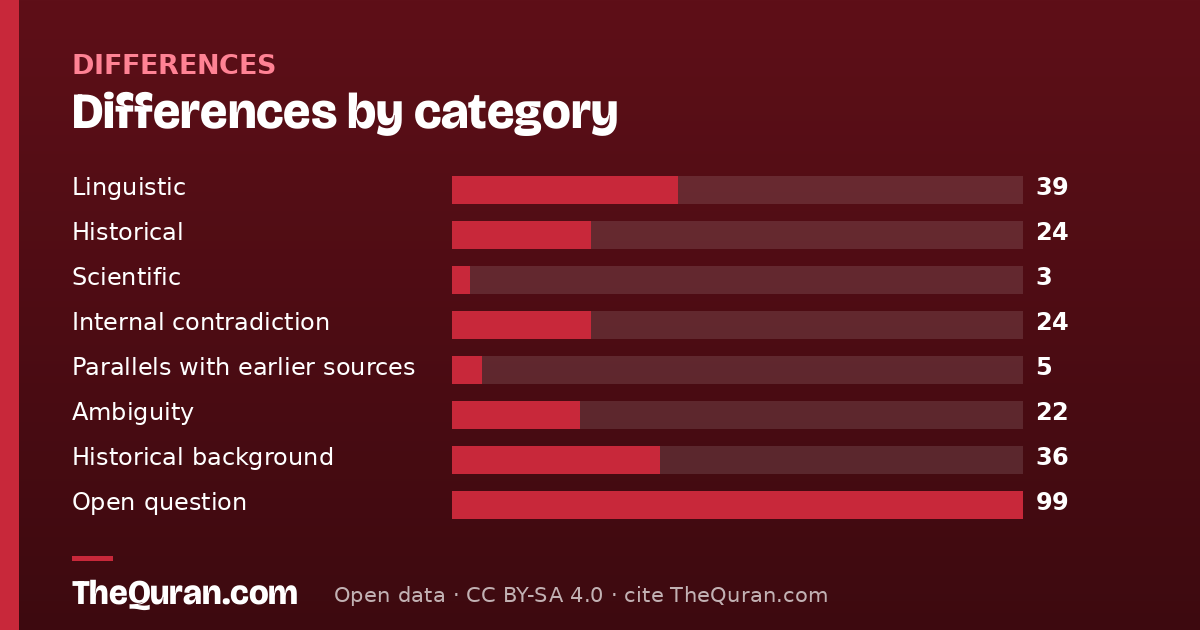
  1. Open question · old label “Question” 99 52%
  2. Linguistic 39 20%
  3. Historical background · old label “Historical Background” 36 19%
  4. Historical 24 13%
  5. Internal contradiction · old label “Quranic Contradiction” 24 13%
  6. Ambiguity 22 12%
  7. Parallels with earlier sources · old label “Copied from other sources” 5 3%
  8. Scientific 3 2%
  9. Geographical 0 0%
  10. Numerical 0 0%

original site proposed · an item can carry more than one category, so the bars sum to more than 191.

Across the Qur'an

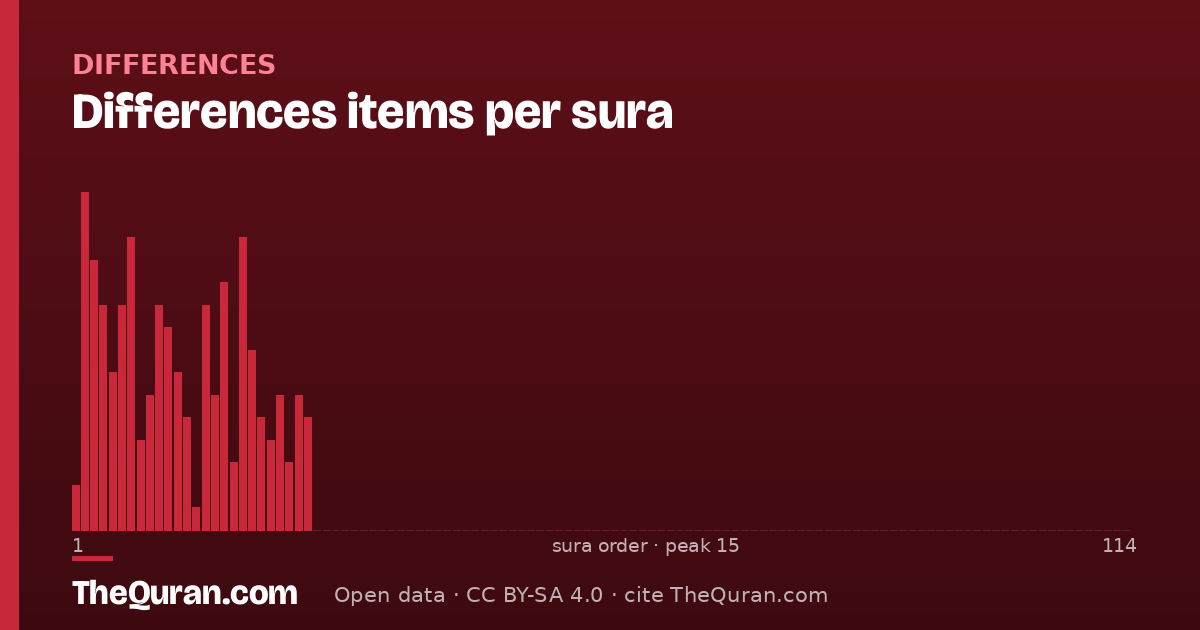
Items per sura

1114sura order · darker = more items · none = blank
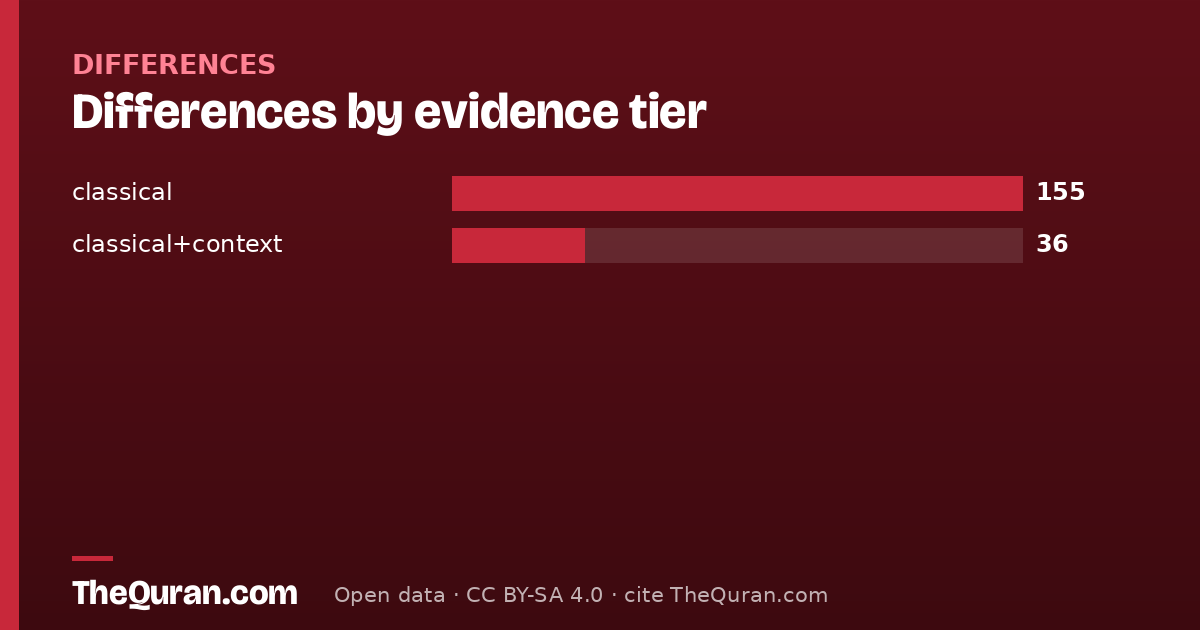
155 items · page 4 of 4 Clear
  1. 18:12 verses Linguistic Open question Argument In one section of this passage, the Arabic literally states “did not make to it crookedness that is strait.” Without his albeit helpful insertions, Sale’s translation more closely reflects the Arabic wording: “…and hath not inser…
  2. 19:16 Ambiguity Argument This text mentions the details of Mary’s distancing herself from her family by going toward an eastern region. Some Islamic commentators have stated that the location is east of Jerusalem. Others believe that she went into seclus…
  3. 19:17 Ambiguity Argument The verse states that Allah sent his “spirit” to Mary. Muslim exegetes explain that the spirit is Jibrīl, who appeared to her as a human. It is said that Jibrīl is called the “spirit” “figuratively, out of love for him”. On the o…
  4. 19:30 Open question Argument This verse states that Jesus—the infant—was made to speak by Allah, declaring himself a “servant of God” (‘Abd Allah). The clear intention behind making Jesus speak as an infant in the cradle is to refute the Christian doctrine o…
  5. 19:36 Linguistic Argument Concerning the speaker in the verse who says, “God is my Lord,” al-Rāzī mentions two opinions: The speaker is Muhammad. The speaker is Jesus, as the verse starts with “and” following “Verily, I am a servant of God; He has brought…
  6. 19:61 Linguistic Argument The Arabic verb translated by Palmer as “comes to pass” is ma’tiyan. In Arabic, the verb is actually in the passive voice—“made to pass”—instead of the active. The intended meaning requires the active voice as Palmer correctly tr…
  7. 19:63 Open question Argument The verse promises al-Janna (“Paradise”) to the pious worshippers, “our servants who are pious.” Question: How can there be a pious worshipper and a worshipper who is not pious? Though the Islamic commentaries ignore this issue, …
  8. 19:82 Open question Argument In this verse, the antecedent to the pronoun “they” (“They shall deny...”) is not clearly discernible. Does this pronoun refer to the worshippers or those who are being worshipped? Some Islamic scholars suggest that Allah will ra…
  9. 19:83 Open question Argument The verse discusses Allah’s granting Satan the power to lure people and lead them to deviance. (The same issue is addressed in another sura. See the critical analysis of Q 17.64).
  10. 20:5 Open question Argument The verse states that Allah “settled on the throne,” meaning that he sat down. This image describes Allah as having a body. The belief that Allah has a body is incompatible with the Muslim view that Allah is beyond description. T…
  11. 20:7 Open question Argument The meaning of wa-akhfa, translated by Palmer as “and more hidden still”, is confusing. Muslim exegetes offer the following explanations: Self-talk that a person has not done yet. Just self-talk. Plan that is about to be executed…
  12. 20:38 Internal contradiction Argument It is clear from this text that Pharaoh ordered the killing of children when Moses was young. Yet the Qur’ān also states that the command to kill was given when Moses was a prophet and spoke the truth (Q 40.23-25). (This contradi…
  13. 20:39 Internal contradiction Argument It is clear from this text that Pharaoh ordered the killing of children when Moses was young. Yet the Qur’ān also states that the command to kill was given when Moses was a prophet and spoke the truth (Q 40.23-25). (This contradi…
  14. 20:67 Linguistic Argument The name Moses appears at the end of the verse in Arabic to keep the rhyme. Grammatically, it should have come after the verb in keeping with the more typical Arabic sentence structure, where the subject comes after the verb.
  15. 20:70 Linguistic Argument The name Aaron comes before Moses, when he is a follower of Moses. The reason “Aaron” is mentioned first is to keep the rhyme. Moses should have been mentioned first because of his centrality to the verse and the narrative here.
  16. 20:96 Historical Argument According to Muslim exegetes, what is mentioned in the verse is that the Samaritan saw “the footprint of the messenger”. The Samaritan took a handful of dirt from the footprint of the horse and cast it into the fire, saying, “‘Be…
  17. 20:129 Linguistic Argument There is disorder in the structure of this verse, clearly seen by Palmer’s attempt to add words, i.e., “(the punishment)…(at),” to make sense of it. The words “it would have been inevitable” should have been written at the end. T…
  18. 21:782 verses Historical Argument The text deals with a judicial dispute that was arbitrated by David and Solomon. The cause of the dispute is not mentioned in the Qur’ānic text. Muslim exegetes state that the issue concerned sheep that had entered a planted land…
  19. 21:95 Open question Argument Muslim exegetes disagree concerning the meaning of this verse. Some state that the verse means that the townspeople who died may not be brought back to this life. Others state that “we have destroyed” means “we determined to dest…
  20. 21:99 Open question Argument The Pickthall translation of this verse (“If these had been gods they would not have come thither, but all will abide therein”) more closely matches the Arabic text than the Palmer translation. (Palmer mistranslates “god,” a noun…
  21. 22:18 Scientific Argument The verse talks about the created beings bowing to Allah, a worship practice generally ascribed to human beings. But, how does this concept of worship apply to “the sun, and the moon, and the stars, and the mountains…”? Muslim ex…
  22. 22:47 Linguistic Open question Argument The verse informs that a day to Allah equals a thousand human years (“…a day with thy Lord is as a thousand years of what ye number”). Muslim exegetes offer varying opinions regarding this matter. Some state that the Lord’s day i…
  23. 23:6 Open question Argument The verse permits sexual intercourse between Muslim men and their female slaves, an act that is not counted as a sin for any Muslim man because the slave woman has no right to protect her body. (See the section Female Slaves in t…
  24. 23:14 Historical background Argument Allah is described in two locations as “the best of creators” (Q 23.14 and Q 37.125). The meaning of this description of Allah has become a source of contention among Islamic scholars, leading some to say that this description me…
  25. 23:101 Internal contradiction Argument In Arabic, the verse states that on the Day of Judgment people will not question each other. (The closest English translation is found in Arberry: “For when the Trumpet is blown, that day there shall be no kinship any more betwee…
  26. 24:63 Linguistic Argument "So let those who oppose his orders beware" The Arabic Qur'an text of that verse includes the extra preposition an ("about/of") after the verb "oppose" which is not needed as the Arabic verb does not take a preposition. Some scho…
  27. 25:3 Open question Argument The verse presents an argument regarding the rationality of pagan worship. The verse mocks the faith of idolaters in gods who do not create a thing, unlike Allah the creator. Al-Rāzī explains the verse by stating, “They [the idol…
  28. 25:25 Linguistic Argument The verse means that the heavens will be split asunder “from” the clouds. The current Arabic Qur’ān has the preposition بـِ, which means “by” or “with” as in “by (or with) the clouds.” In explanation, al-Farrā’ states that the ve…
  29. 25:37 Ambiguity Argument The verse states that the people of Noah “said the apostles were liars'' in the plural, even though the verse is about the people of Noah calling him (in the singular) a liar. Muslim exegetes have attempted to resolve this gramma…
  30. 25:38 Historical Argument The verse mentions “people of ar Rass.” Al-Rass is the name of a well. Regarding the identity of these people, Muslim exegetes offer the following disparate opinions: The people of the town of Thamūd. The people of a town in Yamā…
  31. 25:44 Ambiguity Argument The verse compares the misbelievers to livestock, stating that they are “like the cattle.” Al-Ţabarī explains that “they are not but like animals that do not understand what is said to them nor comprehend”. On the other hand, Q 1…
  32. 26:152 verses Parallels with earlier sources Argument Allah addresses Moses and Aaron in this verse. There are two problems in the Arabic grammar of the verse. First, the word ma‘kum is translated “with you” by Palmer. To be grammatically correct in the Arabic dual form (al-muthanna…
  33. 26:454 verses Open question Argument The discourse here concerns a competition between Moses and some of the Pharaoh’s magicians. Moses wins the competition—and their conversion—when he uses his rod to swallow up their ropes and rods. However, this detail in verses …
  34. 26:83 Parallels with earlier sources Argument Here, Abraham asks God to give him judgment. The meaning of “judgment” is not clear in the verse. Islamic commentaries suggest three interpretations: (1) “wisdom,” (2) “to judge among people fairly,” or (3) “the prophethood” beca…
  35. 26:223 Open question Argument The topic of the discussion here is about the diviners or the devils. The verse states that “but most of them are liars,” which suggests that some diviners or devils are truthful.