TheQuran.com
Differences Analysis · argument tier

Questions raised about the text

Linguistic, historical, scientific and internal-consistency questions, verse by verse. Each item is an argument, with the sources it cites and a place for the responses.

Codex Parisino-petropolitanus, c. late 7th–early 8th century
Codex Parisino-petropolitanus, c. late 7th–early 8th century · credit
items
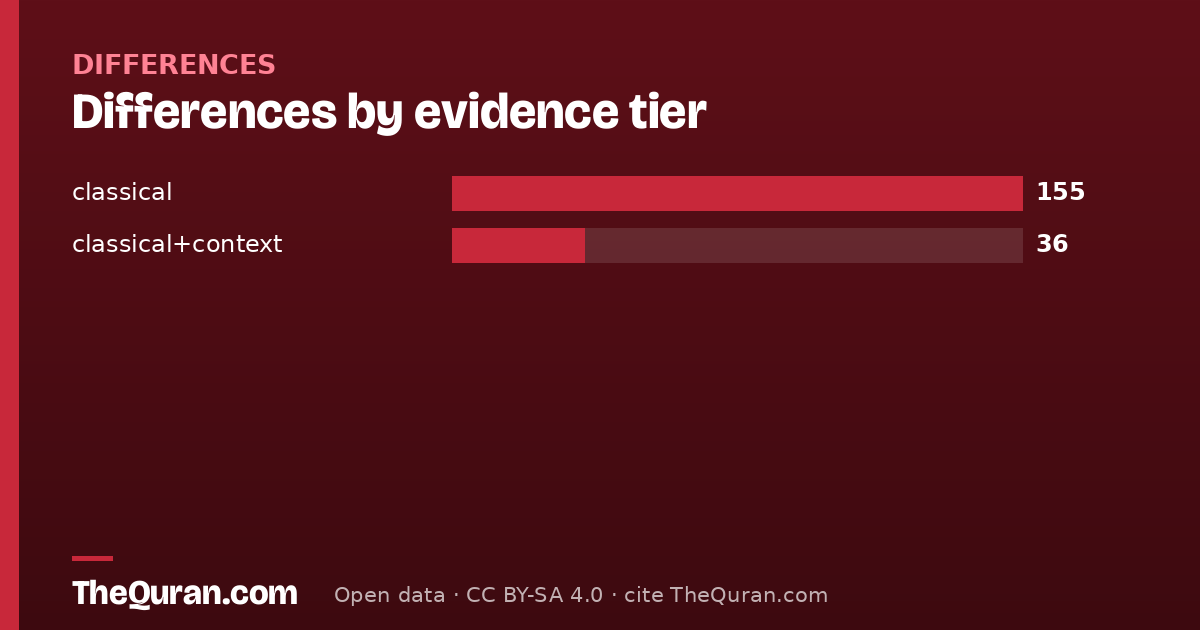
191191 original · 0 proposed
verses covered
3035% of 6,236
suras
26of 114
cite a source
100%0 cite none
Browse by category

The old site's categories

Each item is filed under one category from the old site's list (its most specific one); the other categories it carries still show as tags.

All category tags

What the questions are about

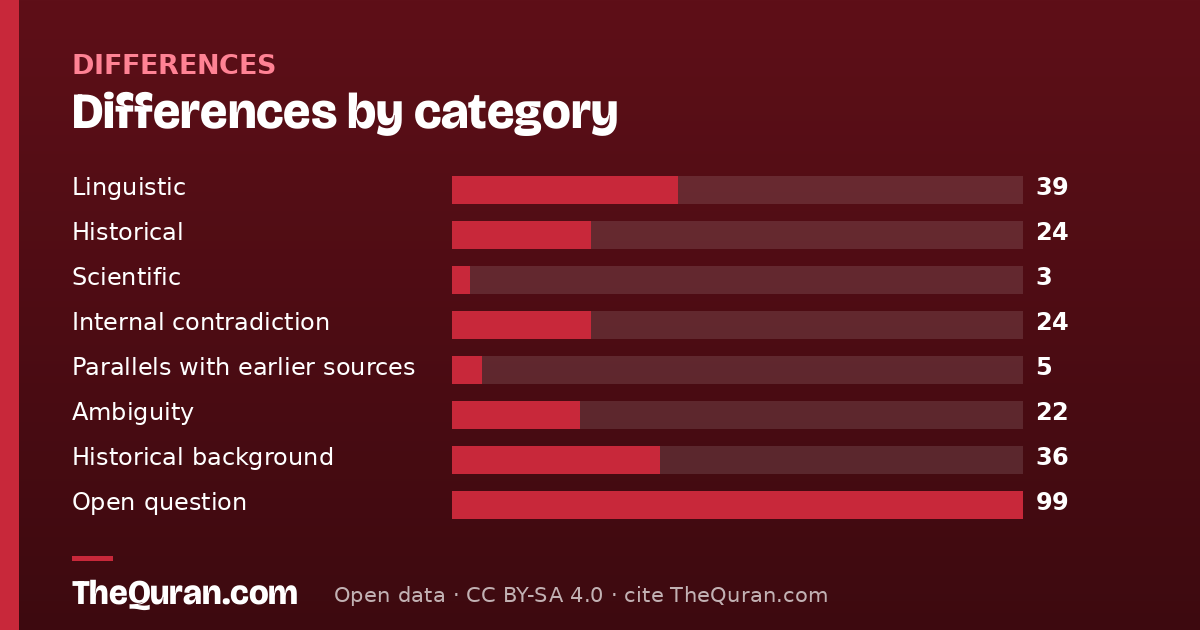
  1. Open question · old label “Question” 99 52%
  2. Linguistic 39 20%
  3. Historical background · old label “Historical Background” 36 19%
  4. Historical 24 13%
  5. Internal contradiction · old label “Quranic Contradiction” 24 13%
  6. Ambiguity 22 12%
  7. Parallels with earlier sources · old label “Copied from other sources” 5 3%
  8. Scientific 3 2%
  9. Geographical 0 0%
  10. Numerical 0 0%

original site proposed · an item can carry more than one category, so the bars sum to more than 191.

Across the Qur'an

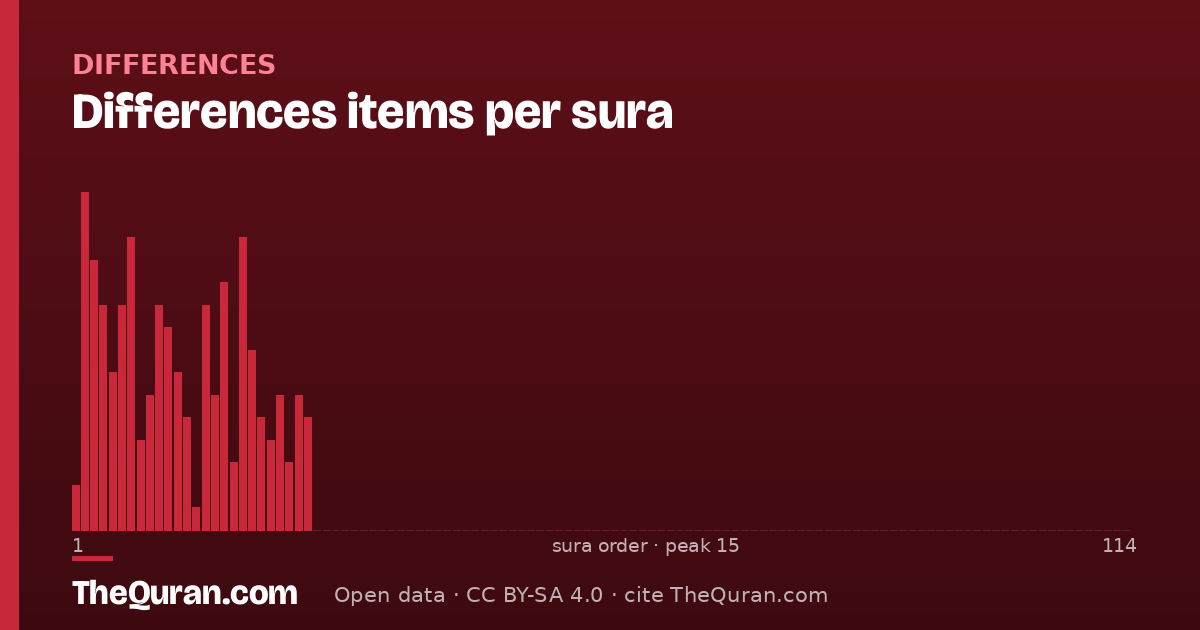
Items per sura

1114sura order · darker = more items · none = blank
32 items · page 1 of 1 Clear
  1. 2:62 Historical Open question Argument This verse puts the Jews, Christians, Sabaeans, and Muslims into one group (the believers in Allah) and promises them their reward at the end of time (Q 2.62). Another verse, Q 5.69, repeats this promise word for word. However, i…
  2. 2:221 Internal contradiction Open question Argument In this verse, the Qur’ān forbids Muslim men and women from marrying “unbelievers”: “Wed not with idolatrous women…And wed not to idolatrous men….” Because the Qur’ān accuses the Christians of being unbelievers (idolaters), marri…
  3. 3:7 Internal contradiction Argument This verse states that some of the verses of the Qur’ān are muhkamāt (“decisive”) and others are mutashābihāt (“similar, allegorical, or ambiguous”). The muhkamāt verses are of established meaning, without a need for interpretati…
  4. 3:54 Open question Argument The closest translation to the Arabic is found in the Pickthall translation: “Allah is the best of schemers” (Q 3.54). The Arabic text is clear in discussing Allah’s fight against evil by stating that Allah answers deception with…
  5. 3:192 Open question Argument This verse declares that whoever Allah sends to hell will be humiliated: “Lord! verily, whomsoever Thou hast made to enter the fire, Thou hast disgraced him.” It is well known that the Qur’ān states that everyone will go to hell:…
  6. 4:782 verses Internal contradiction Argument Contradictions in the Qur’ān usually occur in verses that are apart from each other in the same sūra or in verses from different sūras. However, in this passage, the contradiction occurs in two consecutive verses. Q 4.78 teaches …
  7. 5:69 Linguistic Argument In the current Arabic Qur’ān, the word Sabaeans is actually written in its plural nominative form, Sābi’ūn, which should have been in the objective (accusative) form Sābi’īn, as it is written in other verses: “...those who believ…
  8. 6:23 Internal contradiction Open question Argument The verse states that those who worship many gods will deny their polytheism on the Day of Judgment: “By God our Lord, we did not associate (others with thee)!” (Q 6.23). Yet, in another part of the same sūra, it reads that they …
  9. 6:108 Open question Argument This verse says that Allah makes the people’s bad deeds attractive to them. If Allah lures people into doing bad deeds and then justifies them in their own eyes, would he be fair (just) to judge them for those same deeds? (See th…
  10. 6:164 Internal contradiction Argument This verse mentions that every human who is an evildoer will endure the consequences of his own deeds and that no person will be punished on another’s behalf: “...but no soul shall earn aught save against itself; nor shall one be…
  11. 7:1177 verses Internal contradiction Historical Argument This story recounts a competition arranged by Pharaoh between Moses and a band of sorcerers that ends in Moses’ victory. As a result, the sorcerers declare their belief in “the Lord of Moses and Aaron” (Q 7.117-122; Q 20.69-73; Q…
  12. 7:157 Open question Argument The verse describes Muhammad as the ummī prophet, translated by Palmer as “the illiterate prophet”. The exegetes explain that the meaning of the ummī prophet is one who is sent to the Arabs (who were an illiterate people). The ve…
  13. 8:41 Historical background Argument This verse specifies the beneficiary groups of “a fifth.” It says that “a fifth” goes to the “His Apostle,” meaning Muhammad. The fifth, means the fifth part of the plunder and a fifth of what is discovered by men of minerals, pr…
  14. 9:362 verses Historical background Argument The calendar in the Arabian Peninsula before Islām was based on lunar months. The total days of the Arabian lunar months number 354, which is eleven days less than that of the calendar months. For this reason, the Arabs used to a…
  15. 9:79 Open question Argument The verse states that Allah ridicules those who ridicule Muslims. Is portraying Allah as a cynic consistent with Allah’s transcendence? (Compare the comment on Q 3.54, where Allah is described as a deceiver).
  16. 10:20 Open question Argument The verse shows that the Quraysh wished Muḥammad would perform a miracle, sent down from Allah, as evidence of his prophetic claims. Muḥammad responded that such a demand is among the unseen things that only Allah knows, adding, …
  17. 10:28 Internal contradiction Open question Argument The verse states that Allah speaks to people on the Day of Judgment. This matter is confirmed by another verse: “But, by thy Lord! we will question them, one and all…” (Q 15.92). Conversely, another verse states that Allah does n…
  18. 11:12 Open question Argument This verse describes Muḥammad’s hesitancy towards his people about dropping parts of the Qur’ān that displease them. It is as if the verse is asking, “Muḥammad, are you thinking about hiding parts of the verses of the Qur’ān? Are…
  19. 11:105 Open question Argument The verse states that no one will be allowed to speak on the Day of Judgment except by Allah’s permission. However, the Qur’ān states in Q 16.111, “On the day every soul will come to wrangle for itself.” The Qur’ān also states in…
  20. 13:74 verses Open question Argument Some of the Quraysh requested Muamhmad to bring forth a miracle to prove the authenticity of his claim of being a prophet (verse 7). He responded, “God knows what each female bears, and what the wombs fall short of or add…” (vers…
  21. 16:843 verses Internal contradiction Argument Verse 84 states that “those who misbelieve not be allowed (to excuse themselves).” But, two verses later (Q 16.86) the Qur’ān states that they (misbelievers) will speak: “And when those who join their partners with God say, ‘Our …
  22. 17:85 Open question Argument A question was addressed to Muhammad concerning the spirit. He replied, “The spirit comes at the bidding of my Lord, and ye are given but a little knowledge thereof.” The details of this report are that a Jew suggested to the peo…
  23. 19:61 Linguistic Argument The Arabic verb translated by Palmer as “comes to pass” is ma’tiyan. In Arabic, the verb is actually in the passive voice—“made to pass”—instead of the active. The intended meaning requires the active voice as Palmer correctly tr…
  24. 19:83 Open question Argument The verse discusses Allah’s granting Satan the power to lure people and lead them to deviance. (The same issue is addressed in another sura. See the critical analysis of Q 17.64).
  25. 20:38 Internal contradiction Argument It is clear from this text that Pharaoh ordered the killing of children when Moses was young. Yet the Qur’ān also states that the command to kill was given when Moses was a prophet and spoke the truth (Q 40.23-25). (This contradi…
  26. 20:67 Linguistic Argument The name Moses appears at the end of the verse in Arabic to keep the rhyme. Grammatically, it should have come after the verb in keeping with the more typical Arabic sentence structure, where the subject comes after the verb.
  27. 20:70 Linguistic Argument The name Aaron comes before Moses, when he is a follower of Moses. The reason “Aaron” is mentioned first is to keep the rhyme. Moses should have been mentioned first because of his centrality to the verse and the narrative here.
  28. 23:6 Open question Argument The verse permits sexual intercourse between Muslim men and their female slaves, an act that is not counted as a sin for any Muslim man because the slave woman has no right to protect her body. (See the section Female Slaves in t…
  29. 26:152 verses Parallels with earlier sources Argument Allah addresses Moses and Aaron in this verse. There are two problems in the Arabic grammar of the verse. First, the word ma‘kum is translated “with you” by Palmer. To be grammatically correct in the Arabic dual form (al-muthanna…
  30. 26:454 verses Open question Argument The discourse here concerns a competition between Moses and some of the Pharaoh’s magicians. Moses wins the competition—and their conversion—when he uses his rod to swallow up their ropes and rods. However, this detail in verses …
  31. 26:83 Parallels with earlier sources Argument Here, Abraham asks God to give him judgment. The meaning of “judgment” is not clear in the verse. Islamic commentaries suggest three interpretations: (1) “wisdom,” (2) “to judge among people fairly,” or (3) “the prophethood” beca…
  32. 26:223 Open question Argument The topic of the discussion here is about the diviners or the devils. The verse states that “but most of them are liars,” which suggests that some diviners or devils are truthful.