TheQuran.com
Differences Analysis · argument tier

Questions raised about the text

Linguistic, historical, scientific and internal-consistency questions, verse by verse. Each item is an argument, with the sources it cites and a place for the responses.

Codex Parisino-petropolitanus, c. late 7th–early 8th century
Codex Parisino-petropolitanus, c. late 7th–early 8th century · credit
items
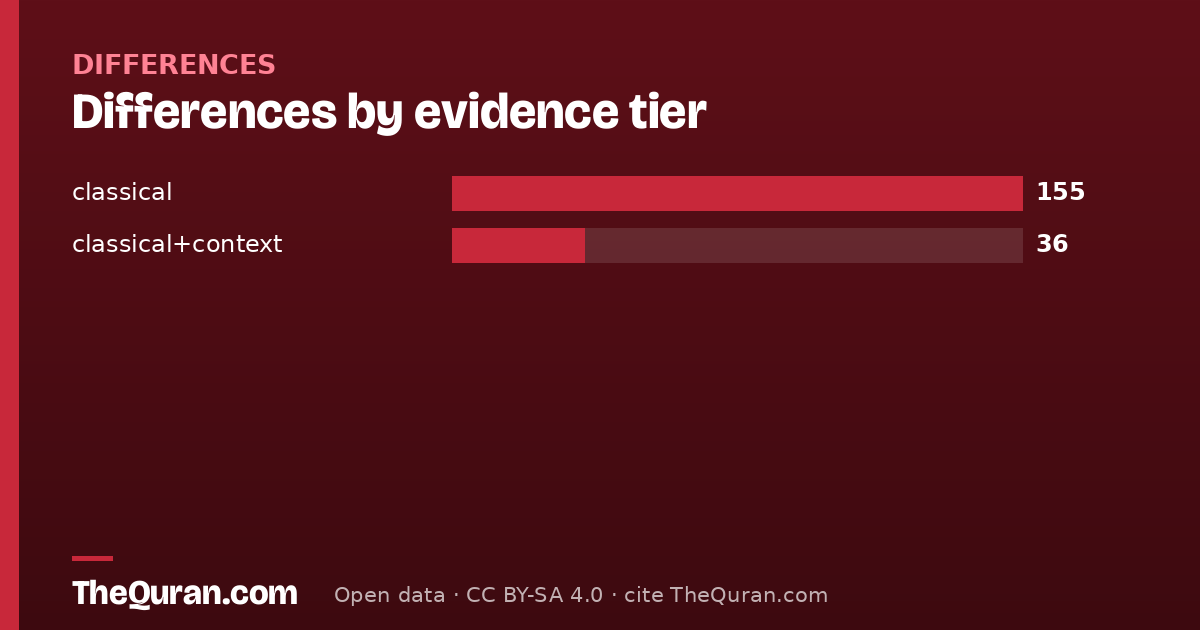
191191 original · 0 proposed
verses covered
3035% of 6,236
suras
26of 114
cite a source
100%0 cite none
Browse by category

The old site's categories

Each item is filed under one category from the old site's list (its most specific one); the other categories it carries still show as tags.

All category tags

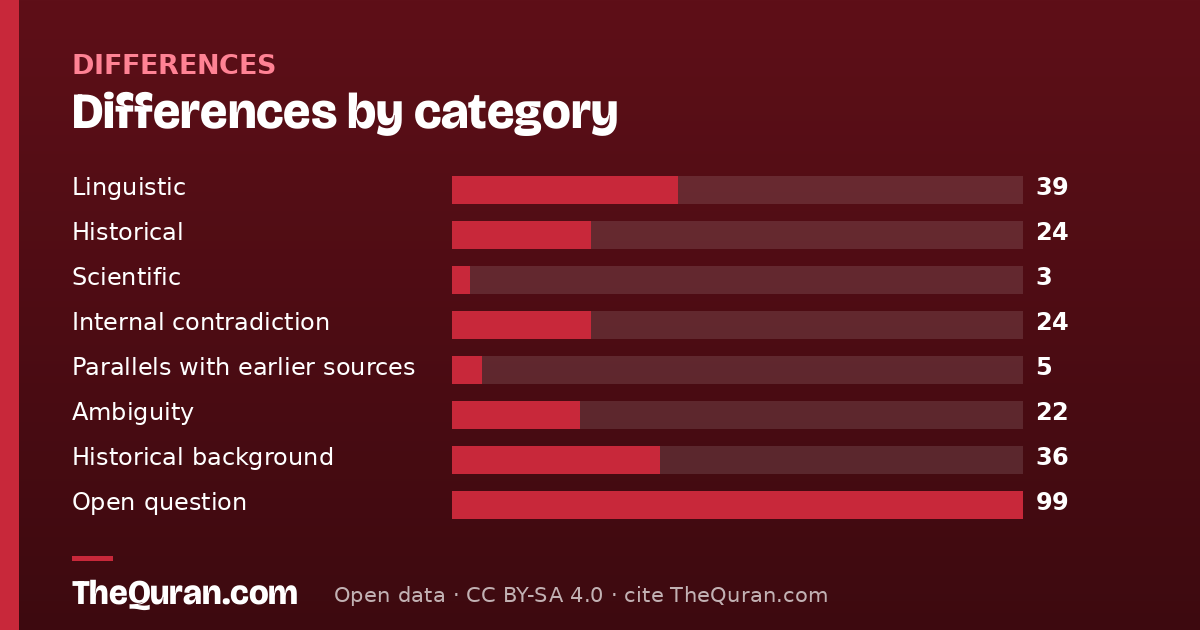
What the questions are about

  1. Open question · old label “Question” 99 52%
  2. Linguistic 39 20%
  3. Historical background · old label “Historical Background” 36 19%
  4. Historical 24 13%
  5. Internal contradiction · old label “Quranic Contradiction” 24 13%
  6. Ambiguity 22 12%
  7. Parallels with earlier sources · old label “Copied from other sources” 5 3%
  8. Scientific 3 2%
  9. Geographical 0 0%
  10. Numerical 0 0%

original site proposed · an item can carry more than one category, so the bars sum to more than 191.

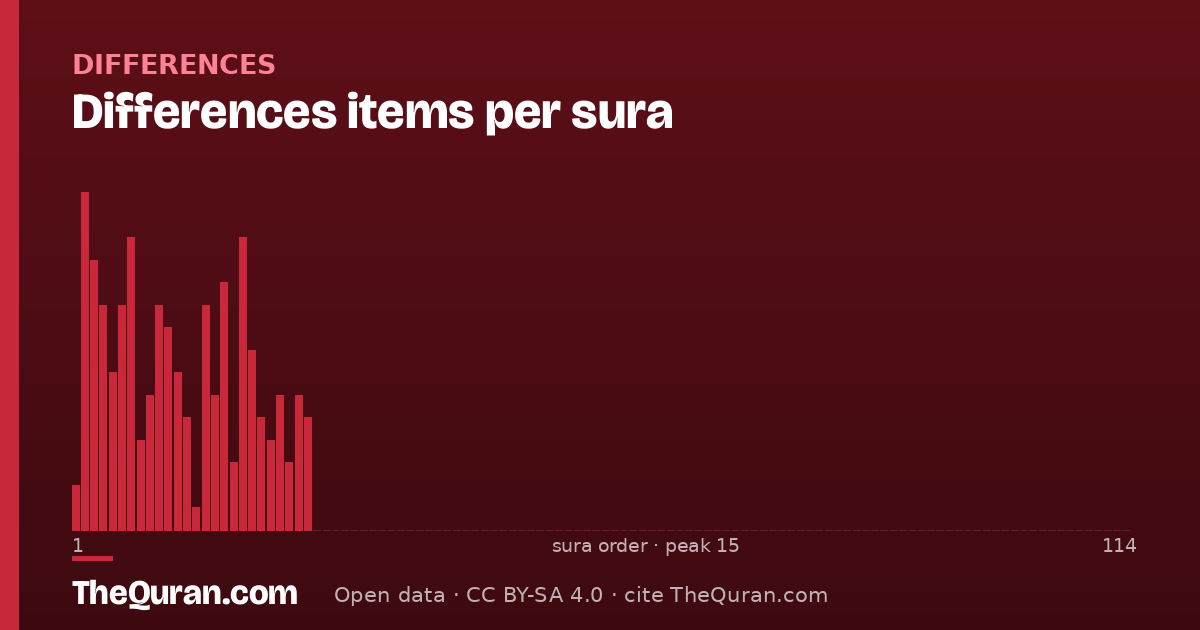
Across the Qur'an

Items per sura

1114sura order · darker = more items · none = blank
10 items · page 1 of 1 Clear
  1. 1:15 verses Parallels with earlier sources Historical backgroundOpen question Argument In the Islāmic books that recount the history of the codices, records show that Ibn Mas‘ūd refused to include Q 1, Q 113, and Q 114 in his codex of the Qur’ān, because he believed that these sūras were never intended to be a part…
  2. 1:62 verses Parallels with earlier sources AmbiguityHistorical background Argument During prayer, Muslims ask Allah to guide them to “the right path.” In Arabic, this phrase implies that the petitioner is lost and cannot find the right path. Therefore, Allah is asked to guide the way to the correct path. Accord…
  3. 2:2293 verses Historical background Open question Argument The Qur’ān justifies, or approves, repeated divorces. According to verse 229, the man is given the right to divorce his wife twice and to remarry her after the first and second divorces. But, if he divorces her a third time, she …
  4. 3:32 verses Historical AmbiguityHistorical background Argument These verses address Muhammad, stating that the book that came down to him “is confirming to what was sent down before of Allah’s books, which he had sent down upon his prophets and messengers.” It is “confirming…what they have t…
  5. 4:22 verses Linguistic Historical backgroundOpen question Argument In the first verse, the Qur’ān warns Muslims against seizing the money of orphans, considering it a great sin (Q 4.2). In the next verse, it tells Muslim men “if ye fear” that they shall not be able to deal justly with orphans, t…
  6. 4:512 verses Historical background Open question Argument This verse accuses “those to whom a portion of the Book has been given” that they “believe in Gibt and Taghut.” According to the Arabic concordance al-Qāmūs al-Muhīt., Gibt means idols or other false deities and Tāghūt means the …
  7. 6:372 verses Historical background Argument Muhammad’s opponents had repeatedly requested a miracle from him to prove that He was a prophet. It appears that a discussion had taken place between Muhammad and his opponents indicating that if Muhammad was the true prophet as …
  8. 8:222 verses Historical background Open question Argument The people of Mecca were critical of Muhammad and his revelations. When a group of the tribe of Banū ‘Abd al-Dār defeated him in a debate, Muhammad responded by reciting, “...the worst of beasts in God’s sight are the deaf, the d…
  9. 8:313 verses Historical background Open question Argument Muhammad was reciting Qur’ānic verses to the Quraysh people and telling them tales and news of the ancients as proof of his calling as a prophet. But all of this recitation was not convincing to most of the people of the Quraysh …
  10. 9:362 verses Historical background Argument The calendar in the Arabian Peninsula before Islām was based on lunar months. The total days of the Arabian lunar months number 354, which is eleven days less than that of the calendar months. For this reason, the Arabs used to a…