TheQuran.com
Differences Analysis · argument tier

Questions raised about the text

Linguistic, historical, scientific and internal-consistency questions, verse by verse. Each item is an argument, with the sources it cites and a place for the responses.

Codex Parisino-petropolitanus, c. late 7th–early 8th century
Codex Parisino-petropolitanus, c. late 7th–early 8th century · credit
items
191191 original · 0 proposed
verses covered
3035% of 6,236
suras
26of 114
cite a source
100%0 cite none
Browse by category

The old site's categories

Each item is filed under one category from the old site's list (its most specific one); the other categories it carries still show as tags.

All category tags

What the questions are about

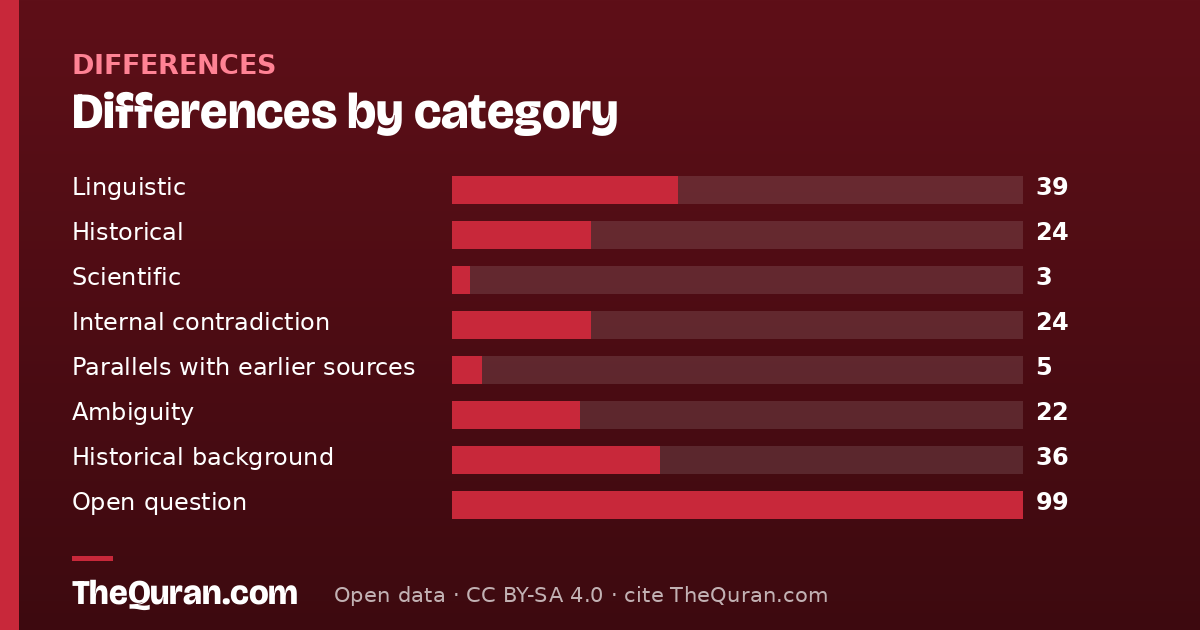
  1. Open question · old label “Question” 99 52%
  2. Linguistic 39 20%
  3. Historical background · old label “Historical Background” 36 19%
  4. Historical 24 13%
  5. Internal contradiction · old label “Quranic Contradiction” 24 13%
  6. Ambiguity 22 12%
  7. Parallels with earlier sources · old label “Copied from other sources” 5 3%
  8. Scientific 3 2%
  9. Geographical 0 0%
  10. Numerical 0 0%

original site proposed · an item can carry more than one category, so the bars sum to more than 191.

Across the Qur'an

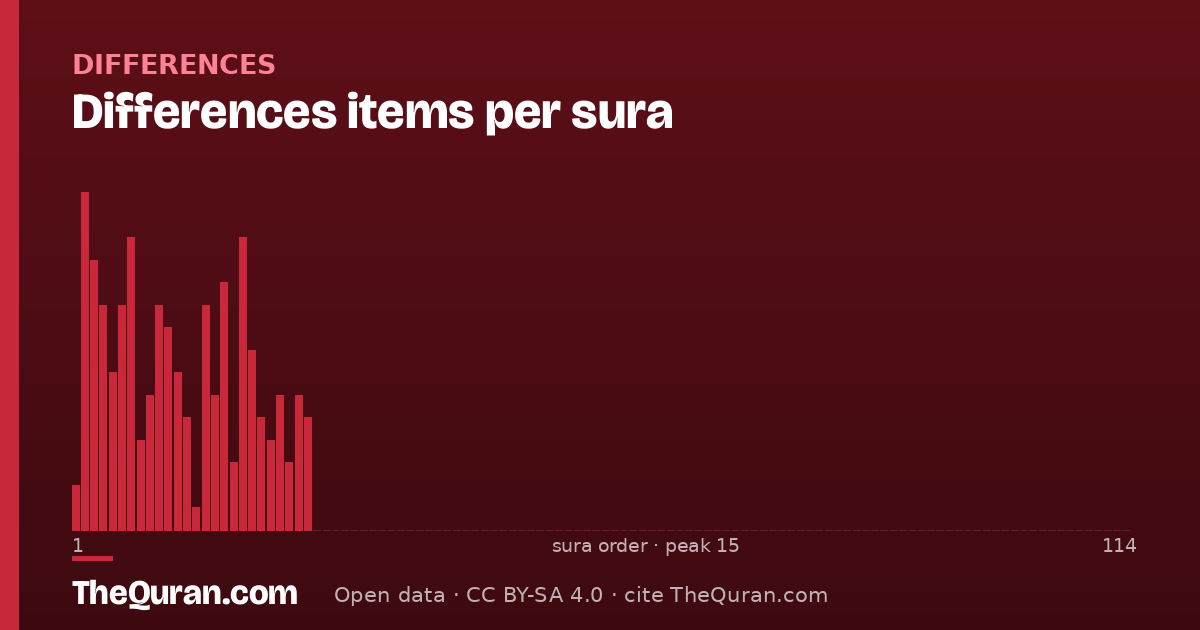
Items per sura

1114sura order · darker = more items · none = blank
10 items · page 1 of 1 Clear
  1. 2:1062 verses Internal contradiction Open question Argument In the midst of the doctrinal controversy between Muhammad and the Jews in Medina, the Jews noticed that Muhammad was annulling, time and again, rulings that he had enacted. This issue became a subject of their criticism. They sa…
  2. 11:5010 verses Historical Open question Argument Islamic commentators mention that Hūd is the son of ‘Abd Allah Ibn Rabāh Ibn al-Julūd Ibn ‘Ād Ibn ‘Aws Ibn Irm Ibn Sam Ibn Noah. They also state that Hūd was sent as a messenger to ‘Ād, a pagan tribe in the region of Hadramout in…
  3. 11:702 verses Open question Argument Regarding the story’s elements and sequence, this verse has two issues: Alternate versions The text of Q 11.70 states that when the guests of Ibrāhīm (Abraham) did not eat of his food, “he could not understand them, and harboured…
  4. 13:33 verses Scientific Open question Argument Islamic commentaries explain rawāsī to mean “steadfast or firm.” Al-Qurţubī explains that the earth is anchored by the mountains and thus made steady. Islamic commentator Ibn Kathīr presents a theory adopted by the commentators c…
  5. 15:922 verses Open question Argument The text states that all the people will be asked on Yawm al-Qiyāma (“Day of Judgment”) about “what they have done”. This verse contradicts Q 55.39: “On that day neither man nor ginn shall be asked about his crime!”
  6. 17:42 verses Ambiguity Open question Argument Verse 4 informs that Allah decreed that the Children of Israel (the Israelites) in the Book (Torah) will do evil “in the earth twice.” When the threat of the first evil came, people “endued with violence” came to the Children of …
  7. 18:6023 verses Open question Argument These verses tell a story about a journey undertaken by Moses and his companion Joshua, son of Nun. Along the way, they meet a man (verse 65) identified in Islamic commentaries as al-Khidr. At this point, Moses and al-Khidr toget…
  8. 19:272 verses Open question Argument The name Mary in English is actually Miriam in Hebrew. Thus, the Hebrew name for the mother of Jesus is Miriam. The Arabic form of Miriam is Maryam. The name Maryam is used in the Qur’ān to identify both Mary, the mother of Jesus…
  9. 24:42 verses Internal contradiction Argument The text declares that people who accuse “chaste women” without presenting evidence for the accusation are transgressors, but Allah will forgive them if they repent. This declaration contradicts another verse, Q 24.23, which stat…
  10. 26:2103 verses Open question Argument The text states that the devils did not descend with the Qur’ān. However, in another place the Qur’ān states that Satan interfered in the process of revelation and spoke through Muḥammad. (See the critical analysis of Q 22.52, Qu…