TheQuran.com
Differences Analysis · argument tier

Questions raised about the text

Linguistic, historical, scientific and internal-consistency questions, verse by verse. Each item is an argument, with the sources it cites and a place for the responses.

Codex Parisino-petropolitanus, c. late 7th–early 8th century
Codex Parisino-petropolitanus, c. late 7th–early 8th century · credit
items
191191 original · 0 proposed
verses covered
3035% of 6,236
suras
26of 114
cite a source
100%0 cite none
Browse by category

The old site's categories

Each item is filed under one category from the old site's list (its most specific one); the other categories it carries still show as tags.

All category tags

What the questions are about

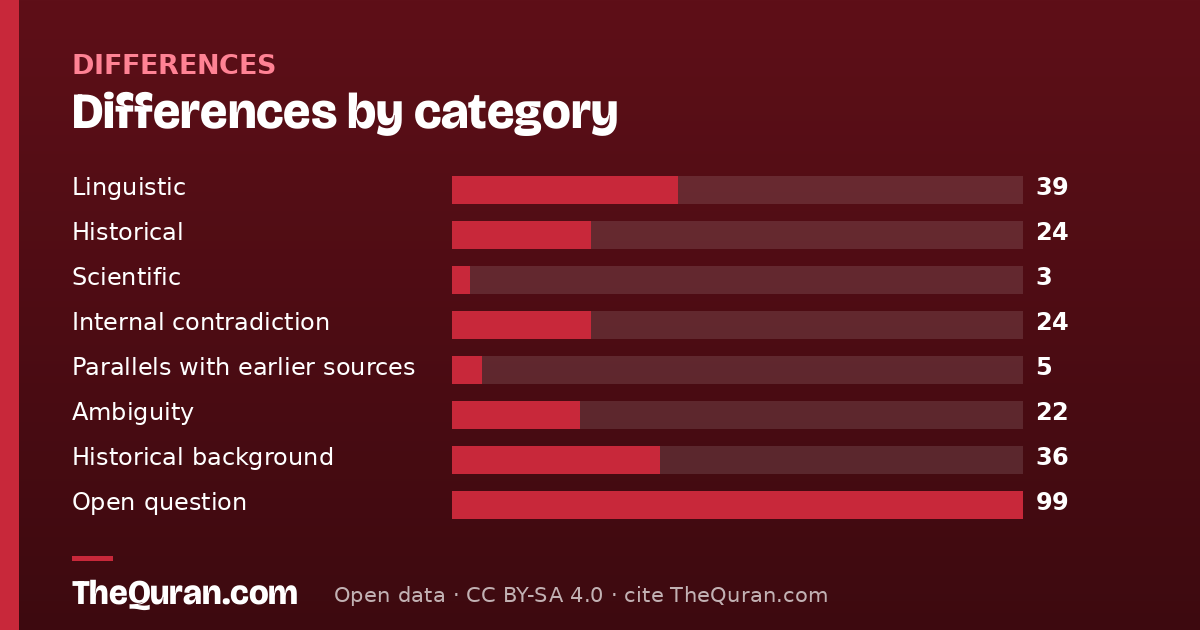
  1. Open question · old label “Question” 99 52%
  2. Linguistic 39 20%
  3. Historical background · old label “Historical Background” 36 19%
  4. Historical 24 13%
  5. Internal contradiction · old label “Quranic Contradiction” 24 13%
  6. Ambiguity 22 12%
  7. Parallels with earlier sources · old label “Copied from other sources” 5 3%
  8. Scientific 3 2%
  9. Geographical 0 0%
  10. Numerical 0 0%

original site proposed · an item can carry more than one category, so the bars sum to more than 191.

Across the Qur'an

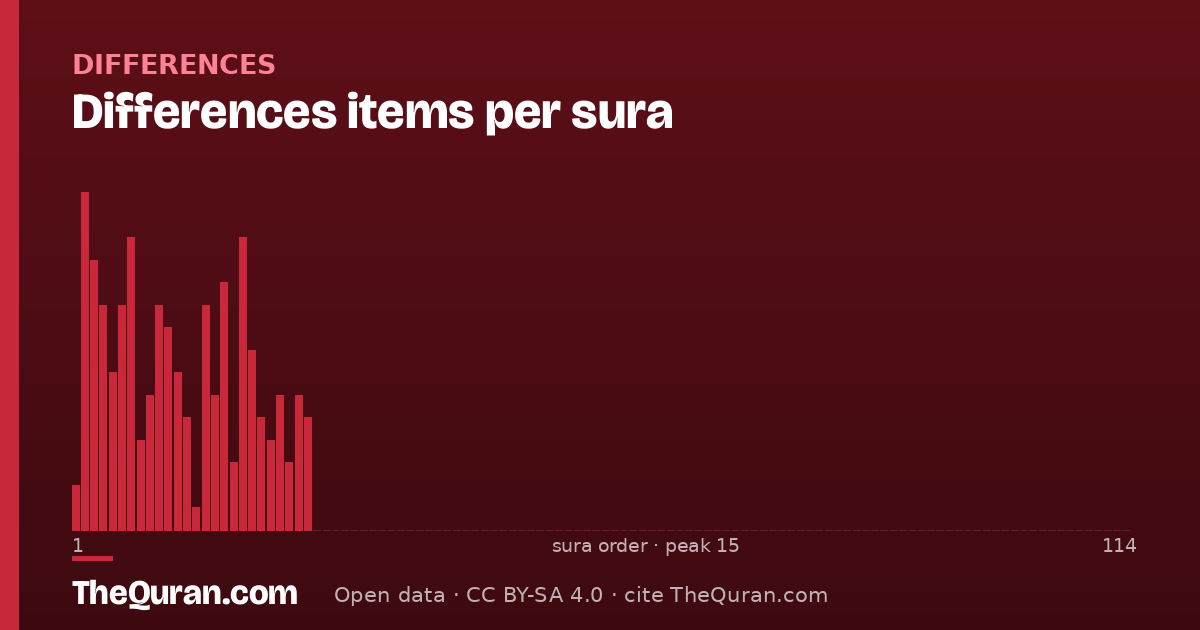
Items per sura

1114sura order · darker = more items · none = blank
9 items · page 1 of 1 Clear
  1. 2:221 Internal contradiction Open question Argument In this verse, the Qur’ān forbids Muslim men and women from marrying “unbelievers”: “Wed not with idolatrous women…And wed not to idolatrous men….” Because the Qur’ān accuses the Christians of being unbelievers (idolaters), marri…
  2. 3:7 Internal contradiction Argument This verse states that some of the verses of the Qur’ān are muhkamāt (“decisive”) and others are mutashābihāt (“similar, allegorical, or ambiguous”). The muhkamāt verses are of established meaning, without a need for interpretati…
  3. 4:782 verses Internal contradiction Argument Contradictions in the Qur’ān usually occur in verses that are apart from each other in the same sūra or in verses from different sūras. However, in this passage, the contradiction occurs in two consecutive verses. Q 4.78 teaches …
  4. 6:23 Internal contradiction Open question Argument The verse states that those who worship many gods will deny their polytheism on the Day of Judgment: “By God our Lord, we did not associate (others with thee)!” (Q 6.23). Yet, in another part of the same sūra, it reads that they …
  5. 6:164 Internal contradiction Argument This verse mentions that every human who is an evildoer will endure the consequences of his own deeds and that no person will be punished on another’s behalf: “...but no soul shall earn aught save against itself; nor shall one be…
  6. 7:1177 verses Internal contradiction Historical Argument This story recounts a competition arranged by Pharaoh between Moses and a band of sorcerers that ends in Moses’ victory. As a result, the sorcerers declare their belief in “the Lord of Moses and Aaron” (Q 7.117-122; Q 20.69-73; Q…
  7. 10:28 Internal contradiction Open question Argument The verse states that Allah speaks to people on the Day of Judgment. This matter is confirmed by another verse: “But, by thy Lord! we will question them, one and all…” (Q 15.92). Conversely, another verse states that Allah does n…
  8. 16:843 verses Internal contradiction Argument Verse 84 states that “those who misbelieve not be allowed (to excuse themselves).” But, two verses later (Q 16.86) the Qur’ān states that they (misbelievers) will speak: “And when those who join their partners with God say, ‘Our …
  9. 20:38 Internal contradiction Argument It is clear from this text that Pharaoh ordered the killing of children when Moses was young. Yet the Qur’ān also states that the command to kill was given when Moses was a prophet and spoke the truth (Q 40.23-25). (This contradi…